Origin of Inequality in Transegalitarian Societies: An Agent Based Model

NOMATEN Centre of Excellence, National Centre for Nuclear Research, Otwock-Świerk, Poland
Journal of Artificial
Societies and Social Simulation 29 (3) 2
<https://www.jasss.org/29/3/2.html>
DOI: 10.18564/jasss.6098
Received: 10-Jul-2025 Accepted: 20-May-2026 Published: 30-Jun-2026
Abstract
We present an agent based model (ABM), describing the origins of inequalities and social stratification in certain class of affluent hunter-gatherer societies. These societies, defined in the anthropological literature as transegalitarian, are characterized by availability of surplus resources and emergence of social inequalities, predating more complex structures found in sedentary agricultural communities. The relative simplicity of social structure allows to create a model, which focuses on a few key drivers of the process. These are: variability of key individual characteristics (skills and talents, luck, greediness), effects of the tendency for assortative matching, genetic heritability of certain advantages and disadvantages, and the presence of teaching/learning.. Our results provide insights into the relative importance of these individual and societal conditions in the appearance of stable stratification in initially egalitarian societies. Depending on the choice of which individual characteristics are more prized by the society (skills and contributions to the community versus accumulated and used surplus wealth), the resulting structure may be more meritocratic or oligarchic.Introduction
Inequalities (social and economic) are considered to be one of the major problems in the modern world (Deaton 2016; McNall 2015). They cover income, wealth, and power wielded by individual members of societies or very small groups. The available wealth (and the associated power to make decisions) spans the range from zero to over \(3.08 \times 10^{11}\) US dollars in 2024 and \(8.39 \times 10^{11}\) in 2026.1 Certain people can "single-handedly" shape the course of human history through their (mostly financial) power. Of course, this is not solely a 21st-century phenomenon: some emperors, kings, and party chairmen had such an opportunity in the past; but today this power can be decoupled from the political world (at least it is less directly connected). As this growing inequality is considered to be dangerous for our future as humanity, it is ever more important to consider and understand the origins and factors driving it, from the very beginning. Here, modelling and computer simulations may offer some benefit. As noted by Epstein (2008) and Nowak et al. (2013), the model need not produce an exact numerical replication of observed data, but may attempt to illuminate core dynamics and to develop a mental model beyond the intuitive level. This is, indeed, our goal in this work. Some of the simulation results may be seen as "obvious" consequences of the initial assumptions, but the model provides a framework for a study of nontrivial interactions of various social mechanisms and allows for future expansion by introducing community-specific features and constraints.
The optimum starting point for such a model would be the first societies where systematic inequalities are present. In anthropology, the appearance of significant inequalities is often associated with the transition from hunter-gatherer (H-G) communities, considered as egalitarian (see e.g. Woodburn (1982)) to agricultural ones, capable of storing large amounts of resources and long term accumulation of wealth (Sterelny 2014, 2016). This poses a problem from the modelling point of view. Even at the early agricultural/sedentary stage, the social structures are already very complex, and pinning down the mechanisms influencing growth of inequalities, for the purpose of creating a workable explanatory model, is rather difficult.
Fortunately, this traditional egalitarian (H-G)/ non-egalitarian (agriculture) division has been challenged by acknowledging the existence of another class of societies, named transegalitarian by Clark & Blake (1994) and further developed in Hayden (1995), Price & Feinman (1995), (Moreau 2020). Singh & Glowacki (2022) have argued that the applicability of the nomadic-egalitarian view is limited, and there are significant indicators of non-egalitarianism among foragers.
The current work and the model presented here have been inspired by these examples of social structures which are largely egalitarian and flexible (in which all participants generally share the same tasks, so no fixed division of labour and social roles is present), yet where the individual’s social position and power can vary — and, importantly, it can be cultivated and inherited.
It is not our goal to describe a specific H-G community with quantitative accuracy, for two reasons. First, there are large differences between circumstances of various societies identified as transegalitarian, and this would require a much more complex set of assumptions and initial/boundary conditions. Second, in small societies (and the H-G communities are relatively small) the role of personal histories, specific events and individual relationships is very strong. Agent models are not suited for describing such complex and intricate systems.
The model we propose is based on a combination of characteristics of the transegalitarian societies, observed in anthropological studies, in particular:
- the presence of certain surplus in community resources (as noted by the anthropological studies)
- the presence of variation of skills and capacities of individuals in the society, leading to differences in their contributions;
- the presence of selfish agents, who may try to ‘take’ more than the fair share (free-riders);
- the role of non-material wealth, like social prestige, relationships, or even personal characteristics (body strength, knowledge, skills);
- impact of teaching and learning in inter-generational transmission;
- potential impact of assortative matching, and resulting differences in genetic and cultural inheritance.
These are the key features that may contribute to mechanisms leading to inequality at a stage where there is no large-scale accumulation of material wealth.
We stress here that raw (material) wealth is not the only individual and social characteristic that may become the basis for inequalities. In fact, we will focus on the stratification of social position (or prestige, or power, see Henrich & Gil-White (2001)), that may result from the differences in personal traits and capacities, luck or small/temporary wealth surpluses and their smart use. Among the measures that we would use are social stratification (defined as differences in the social ranking due to personal characteristics) or the presence of hereditary leadership lineages or "dynasties" in the topmost ranked elite of a community.
Anthropological Background of the Model
Transegalitarian societies conditions and identified characteristics
In the late 1980s, the traditional divisions into egalitarian/ranked/stratified/state societies (Fried 1960, 1967) or through organization types and sizes – band/tribe/chiefdom/state (Service 1962) were found to be too crude to describe the spectrum of societies studied by anthropologists and archaeologists. Even at the least complex level of foraging societies, the evidence has shown the need to go beyond the egalitarian paradigm. Thus the notion of transegalitarian societies was born.
In a recent review, Davies (2020) contrasts the egalitarian societies (characterized by: equal treatment for all; equal outcome; equal opportunity; equality of resources and equality of welfare) with the transegalitarian ones, where one can expect inequality in various forms and relative strengths, for example: ‘leaders competing within the community, so some stratification within corporate groups; moderate heredity of positions; strategies for creating debts, surpluses and power, including bride-wealth, more elaborate feasts, and perhaps child growth payments; minor public, feasting or ritual community architecture; surplus-based corporate groups, whose aggrandizers have increased wealth, more wives and larger social networks’ The notion of an aggrandizer was introduced by Hayden (1995), who defined it as ‘any ambitious, enterprising, aggressive, accumulative individual who strives to become dominant in a community, especially by economic means’. The influence of existence of society members who do not fully contribute to the communal welfare (free-riders) has been duly recognised from the point of view of cooperation evolution by Sterelny (2016).
Hayden (1995) (restated in Hayden (2020, 2021)) notes that the necessary condition for the transition to transegalitarian societies was the presence of ‘significantly more resources from their environments to the point of producing some surpluses for exchange or other uses in normal years’. These surplus resources were used in various ways ‘to establish inequalities in power; they generate prestige technologies and regional systems of exchange to obtain prestige commodities; they establish lineages to consolidate control over resources and surpluses; and they eventually establish class systems involving owners of resources, commoners, and slaves’.
Thus, only once surplus resources became more common, the societal egalitarian pressure started to be less stringent. However, as most of the surplus (hunted game, gathered fruit/vegetables) could not be stored for a long time, they had to be used relatively quickly. Therefore our modern notions of wealth inequality based on accumulated material goods (or monetary equivalents) have to be replaced by ideas more adequate to the transegalitarian societies. Mulder et al. (2009), Smith et al. (2010) propose to define wealth in three distinct categories: material, embodied and relational, with the importance of these categories varying between societies. Such division is crucial to understanding the inequality of wealth and its transmission between generations. Because in high mobility hunter-gatherer communities material property (tools, clothing etc.), while treated as personal and often transmitted to descendants, is typically readily manufactured, without specialized tools and skills, it has less effect on well-being than somatic and relational wealth. All three forms of wealth are, however, interdependent: good health, mental acuity, strength and stamina depend on nourishment. But, in turn, they may lead to greater productivity (success in hunting, more effective gathering of resources). Successful producers may broaden their relationship network, creating alliances, debtors, reciprocal favours. Such networks, may, in turn, influence the learning of skills and better tool creation, access to healing and rare/valuable goods. The well-being of a person comes not from a simple sum of these components, but from their nontrivial combination. And wealth (in all its forms) may transform non-trivially to prestige or social power.
The differences between high and low achievers can be very substantial. For example, Wood & Marlowe (2013) note that in the Hadza communities, the best hunters bring their families 3-4 times more food than poor/medium ones. Some of the individual characteristics of members of foraging societies may be (at least partially) genetically inheritable, especially those related to the embodied wealth: intelligence, overall strength, grip strength, height and stamina…Others (hunting skills, tool creation, care and healing) can be learned, through play, teaching, observation, imitation, and participation (Lew-Levy et al. 2017).
Impact for the model. These conditions allowing departure from strict egalitarianism: presence of perishable surplus that can be used in social positioning, individual differences in productivity, and, finally, the notion of understanding wealth beyond the simplest material category are used to create the core framework of the model.
Intergenerational heritage, lineages, chiefdoms
While individual differences in embodied power, skills and experience may lead to stratification in unstructured societies, one aspect extends beyond a person’s own characteristics: inheritance of social position, power and wealth from the previous generation in the family. For example, Fitzhugh (2020) reports astonishment at the accumulations of wealth and power for the Tlingit — where chiefs were from resource-rich lineages. He reports a similar kin-based lineages for the Alutiiq.
Yet, the appearance of lineages is not universal nor "automatic". In his introduction to the collection, (Moreau 2020) confirms certain degree of relational wealth inheritance in traditional Australian (Ylongu) and New Guinea (West Mianmin) societies. But he notes that the leader status is not simply transferred from one generation to the next one via a custom or social principle. Instead, the parents’ position (inherited) would improve an individual’s starting position, with the final outcome dependent on the "genealogical good luck", enterprise and energy. Thus, chiefdom dynasties are possible, but not assured.
There’s yet another form of inheritance of wealth that easily turns into power and leadership positions. This is related to ownership of long lasting, difficult to make tools. A perfect example is provided by ownership of boats in communities living off the seas or oceans. Buela (2020) notes the advantage that the owners of boats have in the Iñupiat (Alaska). Similar hereditary leadership advantage of patrilineal ownership of boats was noted for the Lamalera (Indonesia) society by Moreau. We note here, that these advanced, hard-to-make tools may be a bridge between embodied and material wealth, as they enhance the individual physical capacities necessary for hunting/fishing, yet which can be directly transferred between generations, resulting in continued advantage held by certain kin groups.
Smith et al. (2010) has estimated the transmission coefficient of the three types of wealth for the Ache, Hadza, Ju/’hoansi, Lamalerans, and Meriam. The highest were hunting returns (embodied wealth) for Tsimane with 0.384 value, and body weight in Ache and Hadza (0.509 and 0.305, respectively). Interestingly, while for material wealth, the coefficients were lower, they were relatively high for relational wealth: for Ju/’hoansi and Lamalera they were 0.208 and 0.251, respectively.
Impact for the model. Our model incorporates simple "power inheritance" process, allowing variable levels of transfers of power in a family between generations.
Marriage types, fertility, assortative mating
The environmental, social structure and cultural variety of H-G societies is visible also in the family structures, sizes and relationships within kin related groups and outside them. To simplify our model we have assumed a monogamous society. While polygamy (mostly polygyny) is certainly present in foraging societies, most studies confirm the existence of strictly monogamous groups and where polygyny is present it is relatively limited (Hikichi & Tateno 2024; Kramer & Russell 2015; Marlowe 2005, 2003; White 2013)
The number of children surviving to reproductive age varies not only from society to society, but also within communities, depending on the availability of food and other resources. At the same time, it is reasonable to assume that the sizes of the communities remain relatively stable, not growing exponentially.
The last feature of societal life that we aim to include in our model is the bias in mate selection. Versluys et al. (2021) and Robinson et al. (2017) discuss various advantages of assortative mating in general contexts.
There’s also evidence of such selectivity in H-G societies. For example, Smith (2004) and Marlowe (2004) report assortativity among the Hadza (Tanzania), while Godoy et al. (2008) identified several parental traits used in evaluating a good match. Assortative mating was found to weakly improve offspring well-being (Tsimane, Bolivia). The benefits range from direct (combining sustenance provided by high performers ensures better conditions for the family) to indirect (best hunters having access to younger, more fertile wives), as well as cultural (e.g., via teaching abilities). Assortativity in mating may be enhanced within cultures where marriages are arranged, rather than based on courtship.
Impact for the model. Our model drastically simplifies social reality: there is no difference in roles of men and women, generations are following each other synchronously for the whole population, all families are of the same size two parents plus two children creating the new generation. At the same time we wanted to see if assortativity plays a role. To achieve this we have focused on two cases: random matching (in which marriages happen across prestige hierarchy) and an extreme case of assortativity, in which they happen only between agents closest to each other on the prestige ladder.
Role of teaching in creating and propagating inequalities
Some forms of wealth are associated with learned skills and experience (both for material wealth acquisition, such as hunting and for relational wealth—building alliances, coalitions, and other social skills). There are many ways in which children in H-G societies acquire skills necessary at a given life stage. Learning from their peers, playing, observing adults and, last but not least, dedicated teaching (Boyette & Hewlett 2017; Garfield & Lew-Levy 2025; Lew-Levy et al. 2018; Lew-Levy et al. 2017). In many cases, children of high-skill community members have the advantage to observe and to learn from their parents.
Performing a communal role has also a direct impact on the position of a successful teacher, especially in relational wealth. The need for the knowledge required for the teacher role may enhance the "seniority principle" and the position held by older members of a community. However, in many cases such skill and knowledge advantage is limited to specific activities or contexts: hunting difficult/dangerous game, creating specialized tools (e.g. boats), or ritual knowledge for shaman training (Buela 2020).
Impact for the model. As with the case of family structures, a realistic model of teaching/learning processes is beyond the scope of this work. As noted above, learning takes many forms and covers many aspects. For the purposes of the model, we have focused only on learning from one’s parents, and chosen only aspects determining productivity and social behavior of children (such as learning particular skill, such as hunting, or social behavioral pattern, such as selfishness).
Literature review – Models of foraging societies
Despite the relative lack of extensive data, the hunter-gatherer and foraging societies offer a very interesting opportunity to model social behaviors in relatively simple configurations, so our attempt is not the first one.
Smith & Choi (2007) created an agent based model (ABM) of inequality emergence based on two scenarios: the patron–client relation (in which small initial differences in land productivity are exploited) and the manager–cooperator approach (where the "managers’" role is to enforce collectively beneficial forms of production and distribution).
Mulder et al. (2009), in addition to observational data, have proposed a simple statistical model of inter-generational wealth transmission and the origins of inequality in small-scale societies, combining direct inheritance from parents and access to overall communal resources.
The Briz i Godino et al. (2013) model explored the emergence and resilience of cooperation in hunter-fisher-gatherer societies (such as the Yamana), which involves individual activities, rewards and reputation.
Pinheiro (2022) presented a model in which agents share the food following two principles: maximizing their own benefits but minimizing the differences among other members of the group. The results were compared with observations of the Hadza hunters, and stress the egalitarian aspects and their evolutionary roots.
Lewis et al. (2014) investigated the origin and consequences of demand sharing through an agent-based model which described several features of the hunter-gatherer societies: hunting, moving, sharing, reproducing and ageing. Agents were divided into several classes: loners (agents that actively hunt but do not share resources outside the nuclear family) and demand sharers (agents that are forced to share any food obtained by hunting with other agents present in the same camp or location). Detailed comparison of model input parameters and outcomes with experimental data on Hadza, Ache and Agta societies was presented.
Lastly, Wilson et al. (2023) implemented an ABM to test which conditions would favor more egalitarian or more unequal outcomes. Their model supported hypotheses that egalitarianism was most frequent when resources were not predictable, abundant, homogeneously distributed and difficult to monopolize. In contrast, significant inequality arose when resources were predictable, not abundant and easy to monopolize and protect.
We note here that assortative mating in small societies has already been a subject of recent interesting Agent Based Model works, indicating its great importance in cultural transmission (LaPolice et al. 2024; Petersen 2023).
Positioning of our model
As already noted, we aim to study the basic mechanisms which might lead to social inequality in a society where no long-term wealth accumulation is possible (in particular, to answer if it is possible to have long-term social stratification in such a case). In our approach we disregard spatial issues and focus on the role of the variance of individual characteristics of group members and their role in the appearance of inequalities. For the purposes of the model, we are combining the three components of wealth, but rearrange their role in the social structure. The embodied characteristics (both somatic and mental) form one group, which for the purposes of this paper we name "talents", which influence the effectiveness of a person as a member of society (success at hunting, special knowledge of healers and shamans, ability to create specialized tools, etc.) The talent-driven success creates material surplus, which can be used to build a person’s position within the community, via various approaches, such as feasting, investments, child growth payments or bridewealth (Hayden 1995). These activities lead to the person attaining certain position within the community, giving comparatively more or less power. As Hayden summarizes it: abundance leads to surplus, which, if used smartly, allows to win followers and control others — social power. Or, if we substitute position by prestige, as the source of social power, the model follows the arguments of Plourde (2010) and Henrich & Gil-White (2001), in which material wealth may allow conspicuous consumption (feasting) and access to prestige (hard to obtain) goods, which serve as hard-to-imitate signals of personal qualities. The competition in prestige leads to selection for leadership and status, which ultimately leads to persistent inequality. In our model many details of societal life are simplified drastically, for example everything that relies on existence of subgroups in the community and their interactions (be it alliances/factions, kinship beyond parent/child, operational hierarchies). On the other hand we tried to preserve the fundamental aspects: diversity of skills and interests of individuals, biological and cultural inheritance, certain unpredictability of achieving success, and social conventions.
Model Description and Limiting Choices
The model considers a community of agents, each of them characterized by two main characteristics: talent \(T_i\) and greed \(G_i\). As the productivity and social position measuring variables are assumed to cover the whole lifetime of an agent (rather than, say, yearly values), we do not divide the society into adults and dependent children. Following the social studies mentioned in the previous section, we assume that the environment in which the society of agents exists is relatively stable and nourishing, allowing the agents to produce enough resources to cover immediate needs and create certain surplus.
In a more realistic case, the agent characteristics are likely to be drawn from some continuous spectrum, but for our model we assumed simple binary distributions of \(T_i\) and \(G_i\). An agent may simply be "talented" (\(T_i=1\)) or not (\(T_i=0\)). For greed the choices are \(G_{max}=0.9\) for the "greedy" agents, and \(G_{min}=0.1\) for others. This reflects a common sense notion that even the least greedy agents may keep some of their own product for themselves, and that even the most greedy ones would give at least a token contribution to the common pool.
This choice of using just two variables (limited to binary values) to describe the agents is obviously a drastic simplification of multiple, complex psychological and social mechanisms linking individual preferences and capabilities, social norms and pressures and environmental factors present in the real life.
Consider first the talent \(T_i\). We remind that it describes the capacity to produce surplus over the whole "lifetime" of the agent, which will be the basis for achieving prestige and power. In reality, such conversion may significantly depend on specific events and circumstances, and evolve in time. For example, the immediate recognition and prestige of a hunter bringing huge game in times of hunger would be likely much higher than the effects of the same contribution at a time of plenty. Such individual and "historical" accounts are crucial for anthropological studies of specific societies, but are beyond the capacities of ABMs, which look only for statistical regularities.
Similar discussion is necessary for the greed characteristic \(G_i\). Its operational definition in the ABM model is quite straightforward: it is the ratio of the surplus produced during agent’s lifetime that it uses for its own purposes, rather than contributing to the whole community. We have chosen an emotionally loaded name for the variable, to stress its importance. The use of stable parameter describing the individual balance of tendencies to keep/share has strong anchoring in many theories in psychology. For example in Schwartz Values Theory (Schwartz 1992, 2016, 2012; Schwartz et al. 2012), it is connected with the relative strengths of values in the self-enhancement and self-transcendence parts of the values circumplex (in particular Power-Resources, Power-Dominance, Achievement, Benevolence-Caring, and Universalism-Concern values). Similarly, in the Moral Foundations Theory (Haidt 2001; J. Haidt & Graham 2007; Jonathan Haidt & Joseph 2007), the sharing/hoarding behaviour is determined through the interplay of individual Fairness/Cheating, Loyalty/Betrayal and Care/Harm moral conditions. In the Evolved Human Motives framework (Aunger et al. 2025, 2021; Aunger & Curtis 2013), the same tendencies are determined by hoarding, affiliation, status and nurture motives. Even this cursory review of a few psychological approaches to baseline psychological tendencies shows that the "greediness" trait we use in the model has strong support in established science – but is, in reality, quite complex. We note again, that a full description of the psycho-social conditions shaping the motivations and decisions related to community sharing is beyond the scope of our simple ABM (and, in general, beyond the scope of the current generation of ABMs). As in the case of talent, it would be more realistic to draw the greed variable from a continuous distribution (of unknown shape), but using binary values allows us to focus the simulations on the strongest effects resulting from extreme characteristics and behaviours.
The surplus produced by each agent during its lifetime (its contribution) is defined as follows:
| \[C_i = S_i (T_0 + T_i),\] | \[(1)\] |
The individual surplus production is then divided into two parts, in a way that depends on the greediness of the agent. It keeps \(G_i C_i\) for itself, while contributing \((1-G_i) C_i\) to the communal pool. In turn, the communal pool is then divided equally among all \(N\) agents. As a result, each agent \(i\) can amass the surplus wealth of:
| \[W_i = G_i C_i + \sum_{j=1}^N (1-G_j) C_j / N.\] | \[(2)\] |
As noted above, to keep the model as simple as possible and to enable the focus on strongest effects, we have decided to consider binary case of the talent and greed distributions, dividing the agents into those with the traits (talented and greedy) and those without these traits. Assuming that the two traits are independent, this leads to four categories:
- Baseline agents (B):
- \(T_i=0\) and small \(G_i=0.1\); agents without significant talent, producing only the value given by the common threshold \(T_0=1\), and contributing most of their \(C_i\) value to the communal pool.
- Thieving agents (T):
- \(T_i=0\) and large \(G_i=0.9\); greedy agents without significant talent, but who keep most of their produce to themselves, contributing only small part to the communal pool.
- Contributing agents (C):
- \(T_i=1\) and small \(G_i=0.1\); agents with high value of talent, producing much more than baseline agents, and thanks to low greed contributing a large part of what they produce to the communal pool.
- Aggrandizing agents (A):
- \(T_i=1\) and large \(G_i=0.9\); agents who are both talented and greedy. They produce more than the baseline ones, but keep most of their contribution for themselves.
In the model we have assumed a stable population size (1000 agents), and monogamous marriages and equal number of children in each family (2). The model simplifies transitions between generations: all agents are born and die synchronously, and their characteristics depend, to some extent, on those of their parents. The specific details of such succession are described below.
As we are focusing on relatively primitive societies, the material wealth obtained by an agent is not preserved beyond its lifetime, but it can be used during it for activities beyond fundamental sustenance — in particular for building up of the agents’ social position or power, using mechanisms known from anthropology: feasting, prestige technologies, fostering reciprocal exchange networks etc. Thus the wealth is transformed into the social position or power \(P_i\). We consider here three sources of such power:
- Talent power, due to recognition of the contribution to society.
- This power comes from the recognition of the talent of the agent (hunters’ skill, warrior prowess, unique capacity in materials creation, e.g. pottery etc.). This part of social position is defined as equal to the total produced value \(P^C_i=C_i\) (e.g. the accumulated amount of a game brought to the camp during the lifetime). Note that this power depends on the luck in "getting" a good hunting/foraging patch (described by the randomness of \(S_i\)).
- Wealth power, resulting from the use of agent’s wealth.
- This power reflects the conversion from surplus produce (wealth) accumulated by the agent during its lifetime into social position. For simplicity, we chose the direct mapping between personal wealth and resulting power \(P^W_i = W_i\), disregarding potential losses, missed opportunities, etc. We recall here the assumption that wealth as such, in our model, can not be passed to the next generation. But it can be used, to create the social power via mechanisms such as loans, feasts etc. And this power can be partially passed on (see below).
- Power inherited from agent’s parents.
- This part reflects the reality of inheritance of social position (being a child of a highly positioned agents). \(P^I_i = (P^{TOT}_{p1}+P^{TOT}_{p2})\), where \(P^{TOT}_{p1}\), \(P^{TOT}_{p2}\) are the values of total power (see below) of the agent’s parents \(p1\) and \(p2\).
The final total power of the agent is defined as a weighted sum of the three contributions:
| \[ P^{TOT}_i = \alpha P^C_i + (1-\alpha) P^W_i + \beta P^I_i,\] | \[(3)\] |
Trait inheritance: Biological and learning contributions
We note here that the term "inheritance" in our model covers two distinct aspects: the first one, inheritance of the social position, we described in the previous section. The second one is the inheritance of an agent’s internal traits (talent and greed) from its parents — which may be genetic or social.
For the "genetic" inheritance of the internal traits of an agent we consider here the following "biological" mechanism. First, the agents are grouped into couples ("parents"). We note that there is no differentiation of male and female social roles in the model, which may correspond to some foraging societies, but not all of them. Each such pair begets two "children" (so that the size of the population remains constant). Each of the children may receive a "gene" for each of the traits (talent, greed). These genes are considered recessive, that is to inherit the trait, both parents must possess it. Moreover, the genetic inheritance is not perfect. A proportion of children, given by the mutation factor \(\mu\) may randomly receive the trait, in a ratio that corresponds to the original ratio of the trait (greed or talent) in the population. Thus, for \(\mu=1\) all children would have randomly assigned traits, keeping the population ratios stable. On the other hand, for \(\mu=0\), because the genes are considered recessive, the traits would eventually vanish from the population.
The second stage corresponds to "learning from parents’ example" (or the role of parents in teaching their children what they consider to be important). Growing children may learn specialized knowledge from their parents (e.g. learning the hunter’s skills or learning that greed "pays off") even if they did not inherit the genetic predispositions. We consider this process to be "overdominant", in the following sense. If both parents lack the trait the child may, with learning probability \(\gamma\), grow up lacking the trait (even if it was present genetically — following the "bad example" may lead to not using the trait). If just one of the parents has the trait, the child may learn it (with the same probability \(\gamma\)). In the case when both of the parents have the trait, the probability of acquiring it grows to \(2\gamma\). Because the learning process happens after the genetic one, for \(\gamma \geq 0.5\) all the population would eventually exhibit the traits through learning. Here again, for the sake of simplicity, we use the same value of \(\gamma\) for both talent and greed.
In the simulations we consider two contrasting mating scenarios. In the random matching, the pairs of agents are drawn randomly from the population. This mixes agents with high and low power, with or without traits, etc. The second scenario assumes almost perfect assortative matching. All agents are first ranked by their total social power, and pairs are formed between the adjacent agents on the ranking list (e.g. the first (topmost) agent is matched with the second, the third with the fourth and so on). These conditions are at the extreme ends of the assortativeness in partner choice, we expect that in real societies, even when assortative matching is present, it is never so perfect, due to lack of knowledge and some randomness in social situations.
Simulation Parameters
The model is implemented in the NetLogo language (Wilensky 1999), and the source file is available upon request. The implementation allows flexible manipulation of the model parameters in a broader range of values than reported in this work. Here we use a limited number of parameter combinations, listed below.
- Matching type: binary choice between Random matching and Assortative matching.
- \(\alpha\) (what is used to create agent’s social power): 0; 0.5; 1; (from purely wealth-based evaluation, through mixed, to purely talent-based intrinsic power).
- \(\beta\) (ratio of inheritance of social power): 0; 1; (no inheritance of power or full inheritance of parents’ power).
- \(\gamma\) (probability of learning from parents): from 0; 0.05; 0.10; up to 0.45;
- \(R\) (scale of random variability of production potential of the environment ‘patch’ in which agent \(i\) operates, \(R_i\), which is drawn from a uniform distribution in the range \(-R/2; R/2\)). An agent may be "lucky", and act in a bountiful environment, or "unlucky", and work in an impoverished one. We have used \(R\): 0.5 (see discussion below).
- \(\mu\) (mutation rate for genetic transmission of talent and greed). We remind here that we assume that genetic inheritance of a trait is recessive, thus both parents must possess the trait to inherit it. We used \(\mu=0.5\), which reflects the expectation that genetic inheritance is not very strong for the complex traits such as talent and greed.
The effects of \(\alpha\) and \(\beta\) are fully deterministic, while \(\gamma\), \(\mu\) and \(R\) are probabilistic.
We note the important role of the environmental randomness parameter \(R\), which may mitigate the differences in contribution (and therefore in the talent-based social power) between the baseline and talented agents. For the chosen talent and threshold values, for \(R<2/3\) even the most lucky baseline agent contributes less than the most unlucky talented one. The situation changes when \(R>2/3\), as some lucky un-talented agents might bring more contribution than unlucky talented ones, which destroys the advantage given by talent in some cases, and makes talent less "recognizable" socially. However, in the context of our model, where we use a lifetime contribution of an agent, the "realistic" value of \(R\) should be lower. While the variability of the environment and its potential might be quite large for short time intervals (successful/unsuccessful hunt, abundant season etc.) these large variances should average over several years, especially as the agents would seek better hunting or gathering grounds.
Other parameters used in the simulations presented in this paper were considered constant (but are adjustable in the NetLogo program):
- Initial ratio of talented and greedy agents in the population has been chosen to be very small and identical for both traits: 5%. The same value is used to describe the probability of acquiring a trait as a result of a random mutation process. The rationale behind such choice was to observe whether particular preferences in the society (type of matching, the talent/wealth basis of the social power etc.) allow the greed and talent to spread in the society, and the agents exhibiting the traits to succeed.
- Production threshold (determining the average contributions of baseline agents) \(T_0 = 1\).
- Talent value \(T_i=1\) (for not-talented, \(T_i=0\)).
- Minimum greed value \(G_{min} = 0.1\) (for the non-greedy agents), maximum value \(G_{max}=0.9\) (for the greedy ones).
For such choice of the parameters, the starting values of the numbers of agents in specific classes and their intrinsic social power (excluding inherited contribution) are presented in Table 1 (assuming no variation in the environment production capacity \(R=0\)). The differences in contributions and wealth (translating to social power) between agent classes are significant enough to lead to fast model convergence. For brevity, we present here results for this limited set of variable values, but the NetLogo model allows the users many more choices of the parameters. Small changes of the model "fixed" parameters defining agents, such as \(T_i\) (for talented agents) or the difference between \(G_{min}\) and \(G_{max}\), from the values listed above do not change the qualitative results of the simulations. At the same time, if the differences between talented/non-talented or greedy/sharing agents become small enough (compared to the random variations due to environment capacity, \(R\), and the baseline production \(T_0\)), the ordering of power/prestige follows the random pattern, and, in particular, the probability of long-term dynasty survival (see Sections 5.4, 5.6) diminishes. We have chosen to present the results for the selected values of \(\alpha\) and \(\beta\) (corresponding to significant "classes" of social systems, easily qualitatively distinguishable). The model is robust in the sense of small deviations from these values leading only to small effects in the simulation results.
| Talented | Greedy | Baseline | Contributors | Thieves | Aggrandizer | ||
|---|---|---|---|---|---|---|---|
| Average initial number of agents | 50 | 50 | 902.5 | 47.5 | 47.5 | 2.5 | |
| Talent power (\(\alpha = 1\)) | 1 | 2 | 1 | 2 | |||
| Wealth power (\(\alpha=0\)) | 1.003 | 1.103 | 1.803 | 2.703 | |||
| Mixed power (\(\alpha=0.5\)) | 1.0015 | 1.5515 | 1.4015 | 2.3515 | |||
Results
The choice of this discrete set of parameters was motivated by the goal of the model to discover where the mechanisms described so far lead the evolving society, and which conditions play a significant role. We did not aim at reproducing the statistics of a specific society. Thus the natural choice was to look at border cases, for example social power based purely on talent or purely on wealth. We looked also at an even mixture of the two origins of social power. Similarly, we looked at the evolution with full power inheritance and without it, and with random matching or assortative one. One of the parameters that influenced the results non-trivially (when randomness \(R\) and mutation rate \(\mu\) were held constant) was learning rate \(\gamma\). The presented results show the social structure after the system has reached stable configurations (which happens typically after less than 100 generations). Due to non-zero randomness of productivity assumed in simulations (\(R=0.5\)) the numbers of agents in each category change randomly from generation to generation, so in each run we calculate their averages during a hundred generations (generations 151-250). For each set of parameters, the simulations are repeated 10 times, using the BehaviorSpace functionality of NetLogo, and the final results presented in the figures are averages of averages. The standard deviation, in each case, was much smaller than the size of the markers used in the figures.
We shall start the presentation of the results from the random matching case. Regardless of the choice of the origin of social power (\(\alpha\)), presence or absence of inheritance of social power of the parents (\(\beta\)) and even environmental variability (\(R\)), the overall composition of the society is remarkably similar (left columns in Figures 1, 2). For low learning rate \(\gamma\) values, when genetic processes dominate, the recessive nature of the trait inheritance leads to a decrease of the number of greedy and talented agents. Only when \(\gamma\) becomes greater than about 0.25 (for the greed) or 0.3 (for the talent) the number of the respective agents passes the initial/random mutation threshold, but then these numbers grow very quickly, and at \(\gamma=0.5\) all agents become aggrandizers (i.e. both talented and greedy).
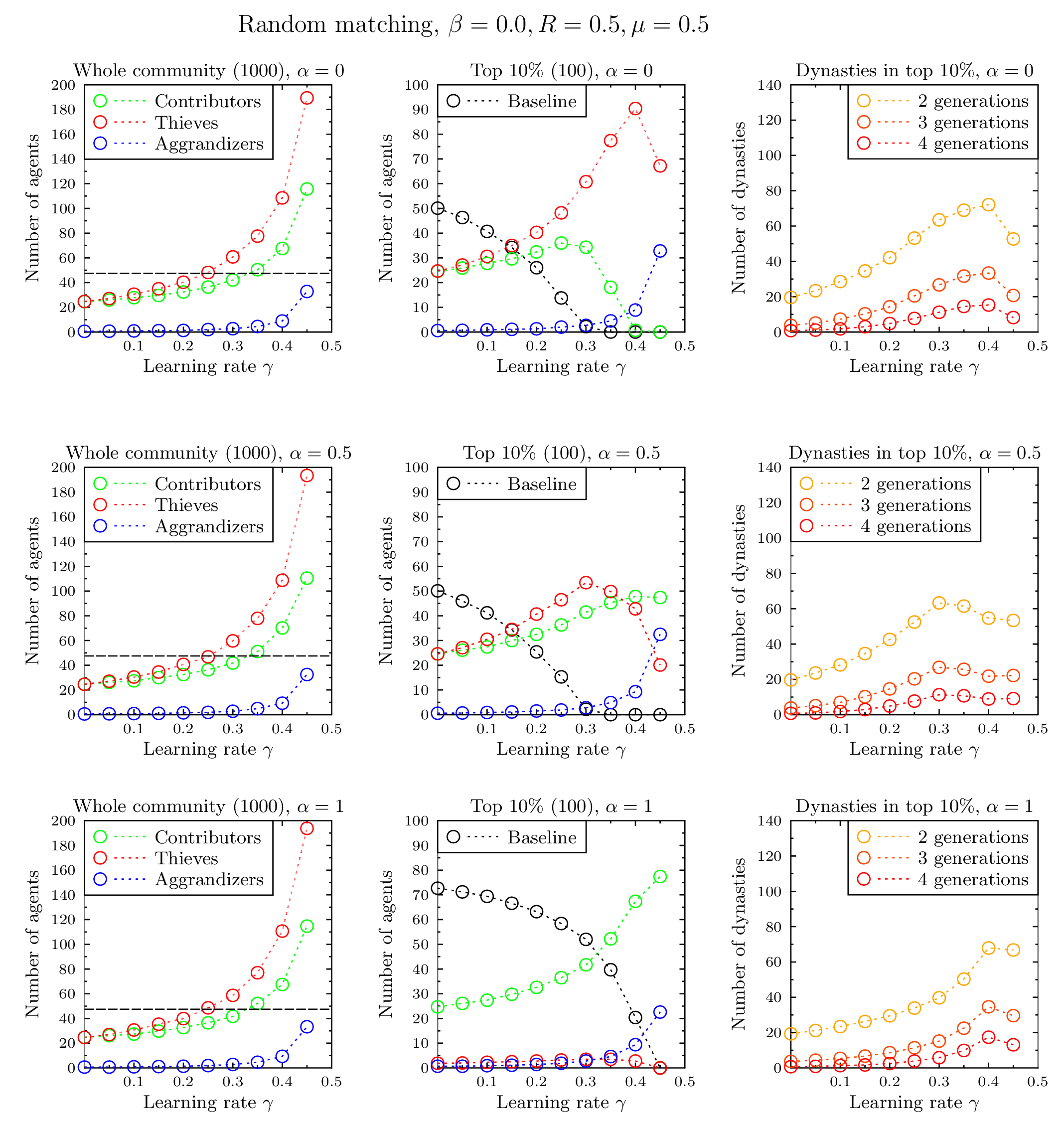
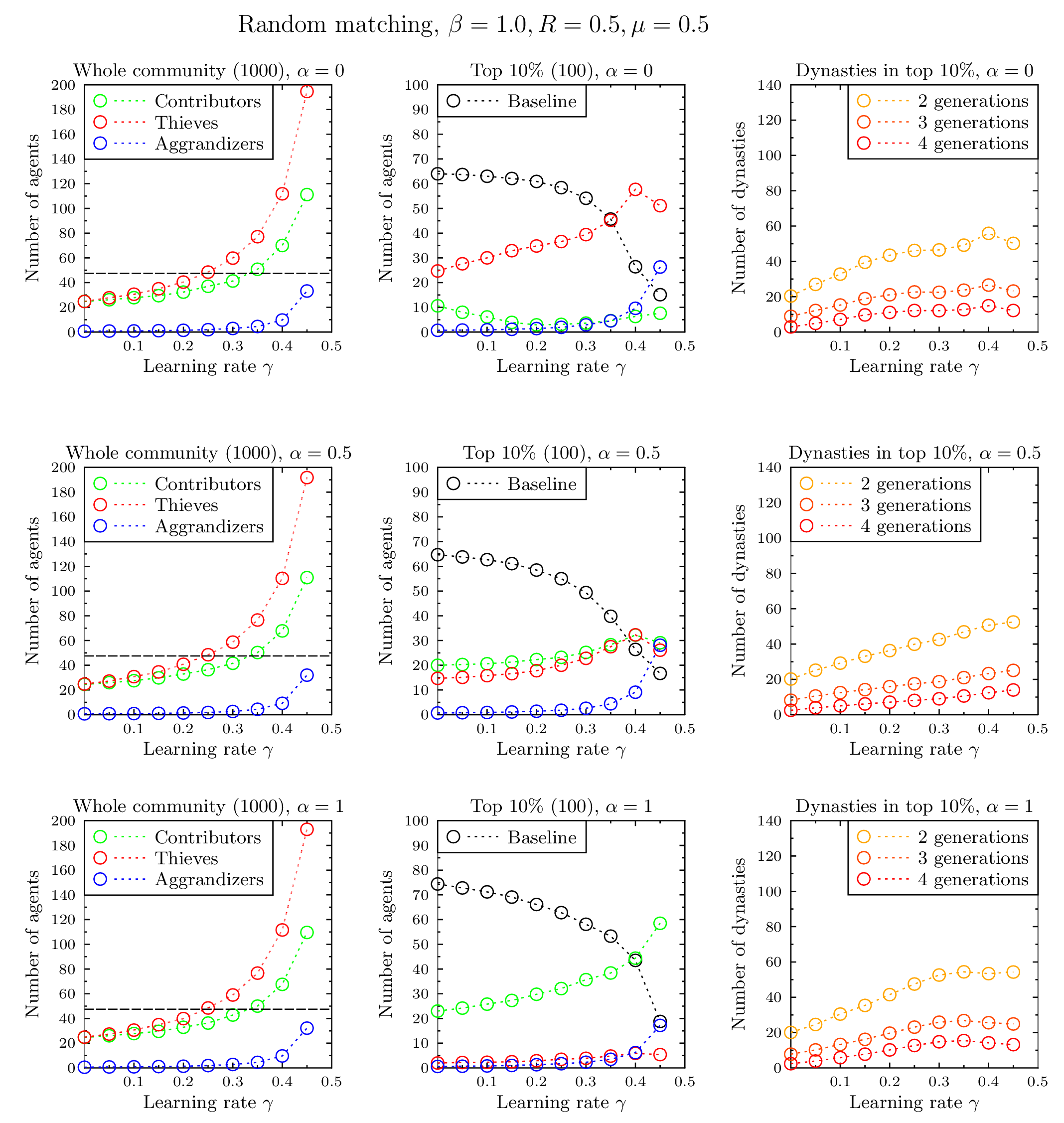
When we turn to the composition of the top 10% "elite" of the society (middle columns in Figures 1 and 2), we observe some quantitative dependence on the presence of power inheritance \(\beta=0, 1\). However, the largest difference is visible as function of the source of social power \(\alpha\). For low values of learning rate \(\gamma\) the total number of talented and greedy agents is smaller than the size of this elite, so a large part of the elite is formed by the baseline agents. This gradually diminishes with growing \(\gamma\), giving way to an elite dominated by the thieves, contributors and aggrandizers. We observe an interesting interplay between the effects of \(\alpha\) and \(\beta\). In the talent-driven power case (\(\alpha=1\)) the baseline agents in the elite coexist (and for increasing \(\gamma\) are replaced by) the talented agents, with greedy agents almost absent, as expected from common sense. Similarly, for the mixed case, both talented and greedy agents are present (in similar numbers) in the elite. Inheritance of parents’ power decreases the numbers of the talented/greedy agents in the elite somewhat, but does not change the qualitative picture. This decrease simply reflects that with power inheritance a number of baseline agents (neither greedy nor talented), resulting from either random mutations or the recessive genetic process may have retained the position in the elite "earned" by their parents’ traits and achievements. In the case of wealth-based power (\(\alpha=0\)), when inheritance is present (\(\beta=1\), Figure 2) the greedy agents dominate, as we would expect. But when there is no power inheritance, at least for small \(\gamma\) values the numbers of talented and greedy agents in the elite are very similar, and the greed starts to dominate only for relatively large values of \(\gamma > 0.25\).
The rightmost columns of Figures 1 and 2 describe another aspect of the top elite, namely the presence of "dynasties" of agents. An agent belongs to a dynasty of depth 2 if it and one of its parents were part of the elite, similarly a depth 3 dynasty requires the agent, one of the parents and one of the grandparents to be part of the elite, and so forth. We note that for low \(\gamma\) values the number of dynasties in the random matching case is rather small, even for depth-2 dynasties. And while it grows with increasing \(\gamma\), the number of 3- and 4-generational dynasties remains very low, indicating that the "lineage" of the elite is dynamically changing.
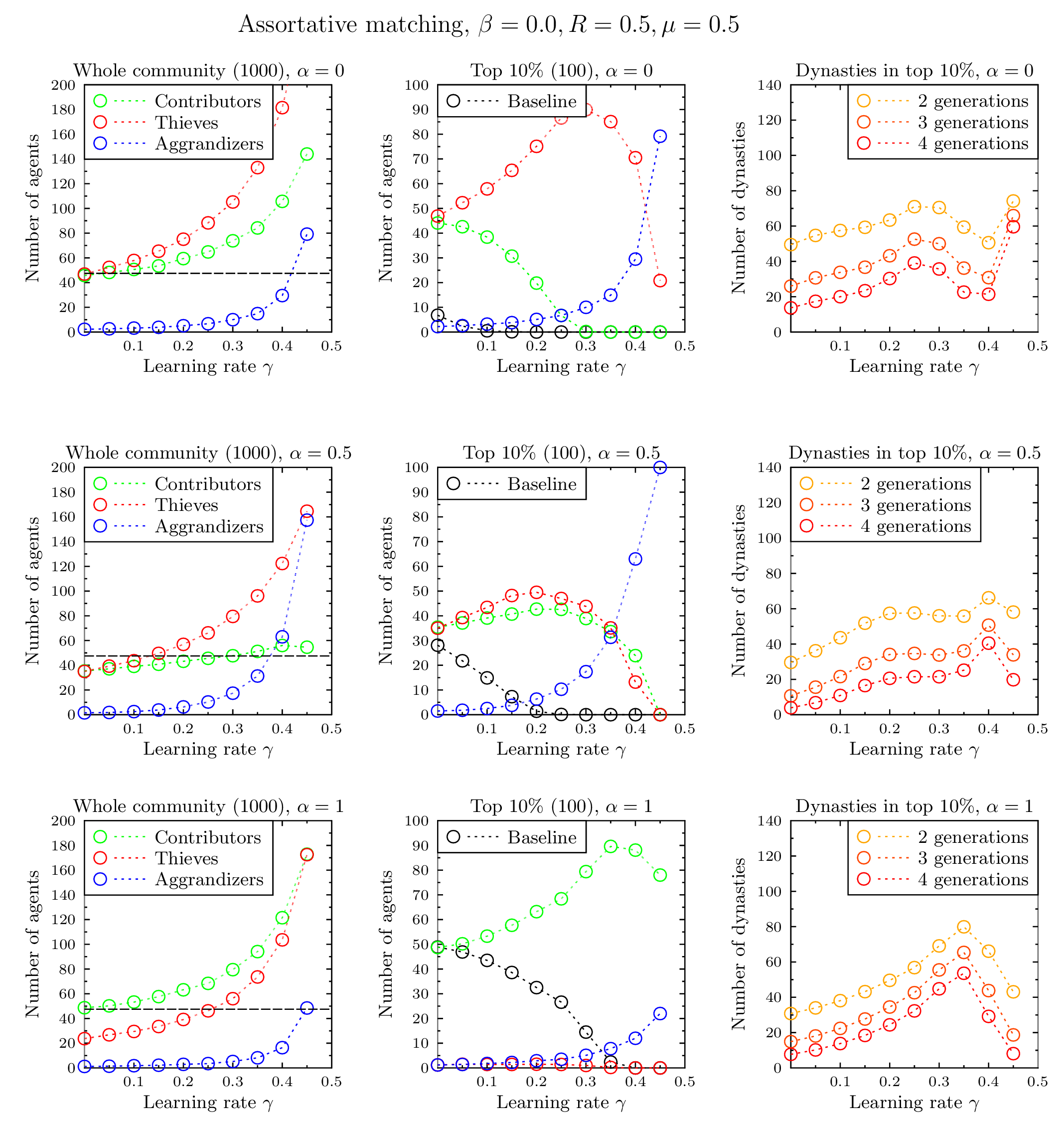
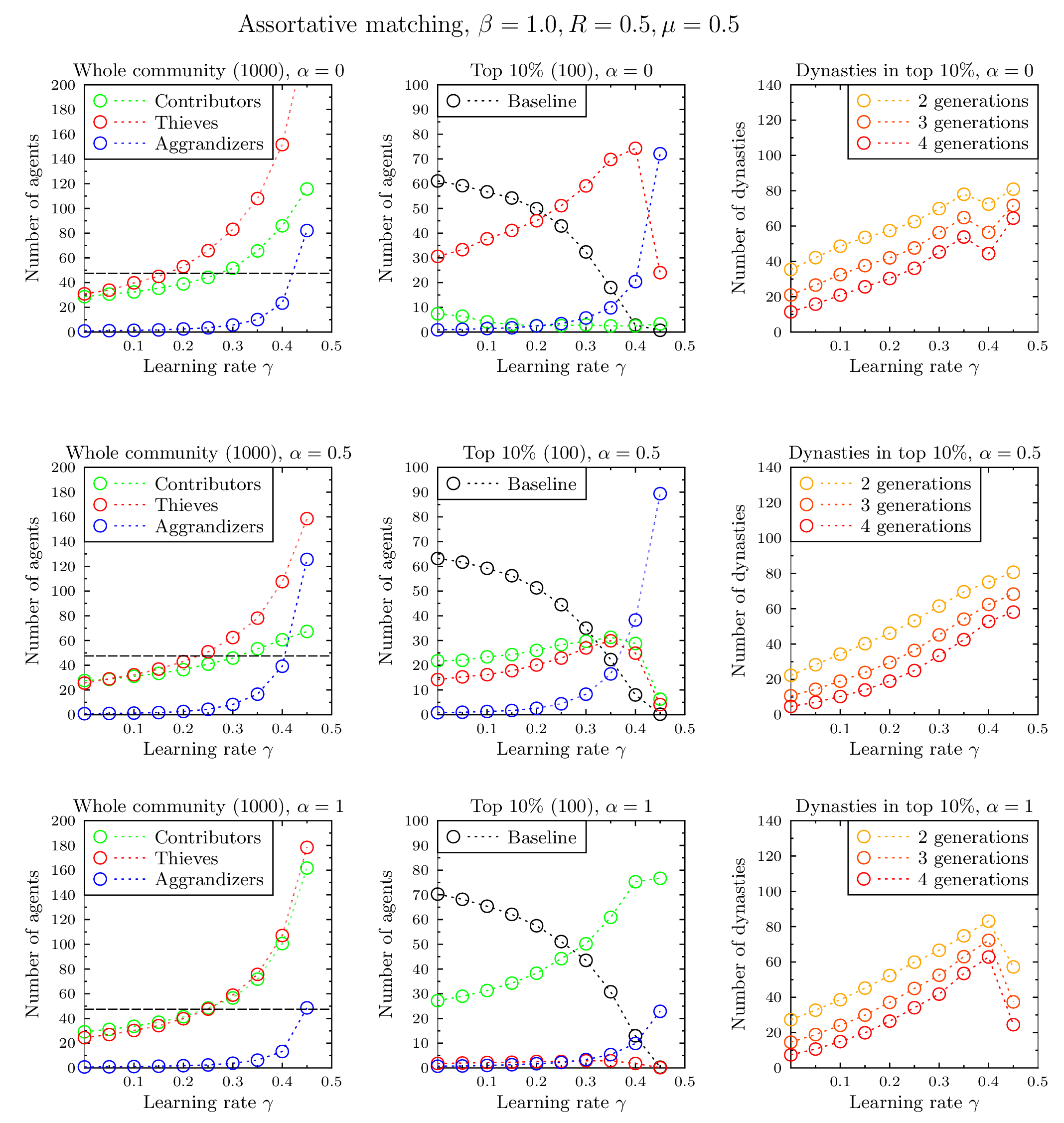
When we turn to the assortative matching cases (Figures 3 and 4) we observe significant differences between simulation scenarios, in particular, stronger dependence on the choice of the source of social power (\(\alpha\)). For \(\alpha=0\) and \(\beta=0\) even for very low \(\gamma\) values the numbers of contributors and thieves are greater than the value expected for random mutations, and there are almost no baseline agents in the elite. While the numbers of both greedy and talented agents increase with increasing learning rate, only the former quickly dominate the elite composition (so that for \(\gamma > 0.25\) it is composed from thieves and aggrandizers). For the mixed case (\(\alpha=0.5\)) the number of greedy agents grows faster than the talented ones, but the elite is roughly divided equally between contributors and thieves (small \(\gamma\)), or simply dominated by aggrandizers, who appear quickly in large numbers with increasing \(\gamma\). In the case of talent-sourced power (\(\alpha=1\)) the greedy agents are less numerous overall, and practically absent from the elite, which is shared between talented and baseline agents. For large \(\gamma\), the elite is composed only from the talented agents. The privilege due to possessing (or learning) an advantageous, socially promoted trait is much stronger in the assortative matching case.
Similarly, the dynasties in the assortative matching case are more stable, especially at middle values of \(\gamma\approx 0.25\). There is a sizable number of agents in the elite with many generations of ancestors who were also elite members. However, the dependence of the number of agents in depth 2-4 dynasties does not grow monotonically with increasing \(\gamma\) in most cases. One can observe sharp drops at high values of \(\gamma\). The explanation is relatively simple: as the number of privileged agents (be it thieves or contributors) grows beyond 100 (the arbitrary elite size), they begin to "compete" for the topmost positions, and the random environmental capacity (driven by \(R\)) begins to reshuffle their rankings.
Individual view
So far we have focused the presentation of results on the macroscopic dependence on model parameters, showing averages of various agent types numbers at stable evolutionary states or averaged distributions of lineages or dynasties in the community elite. An interesting alternative way of presentation is offered by a "microscopic" look at these elites, showing each agent’s social position at a given moment in history.
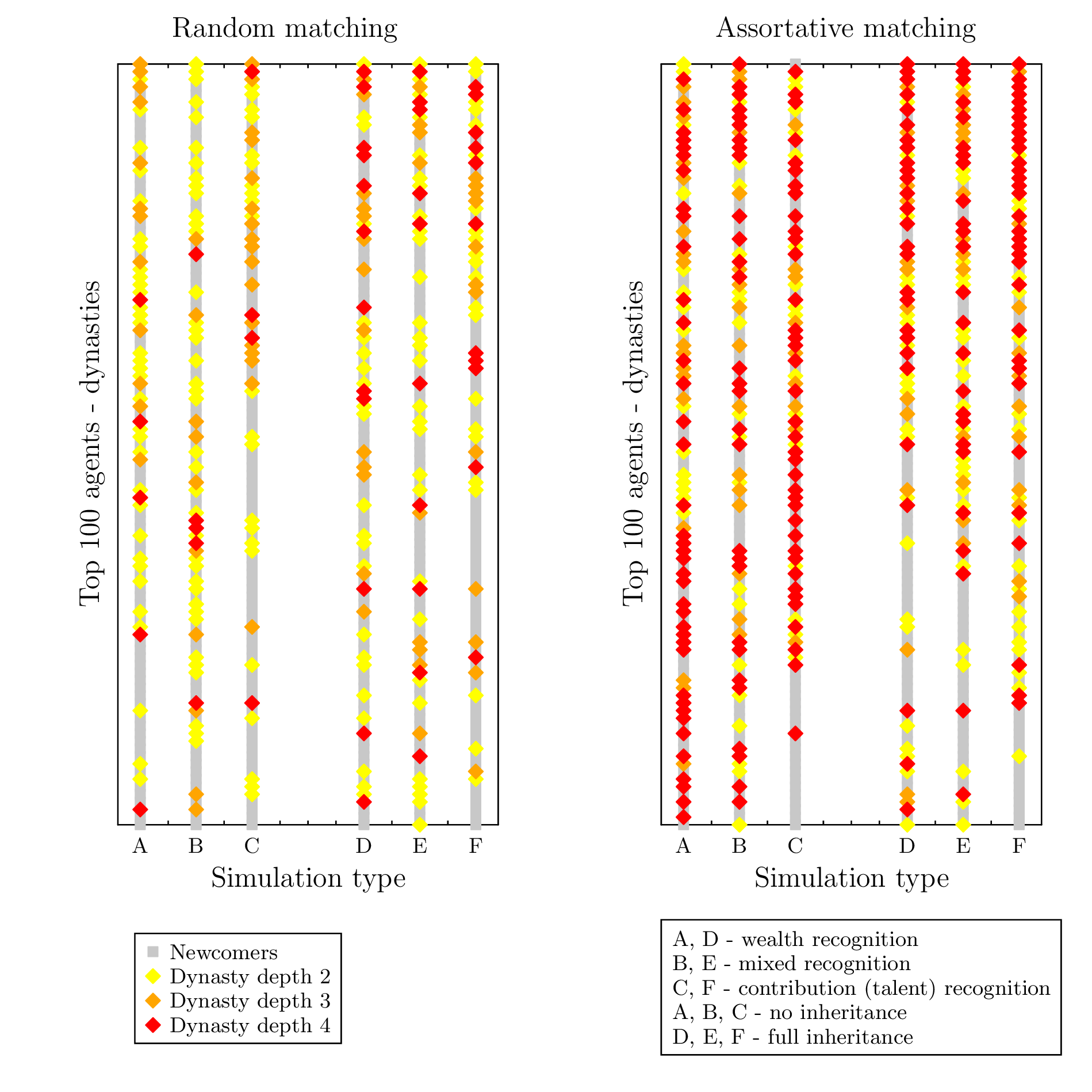
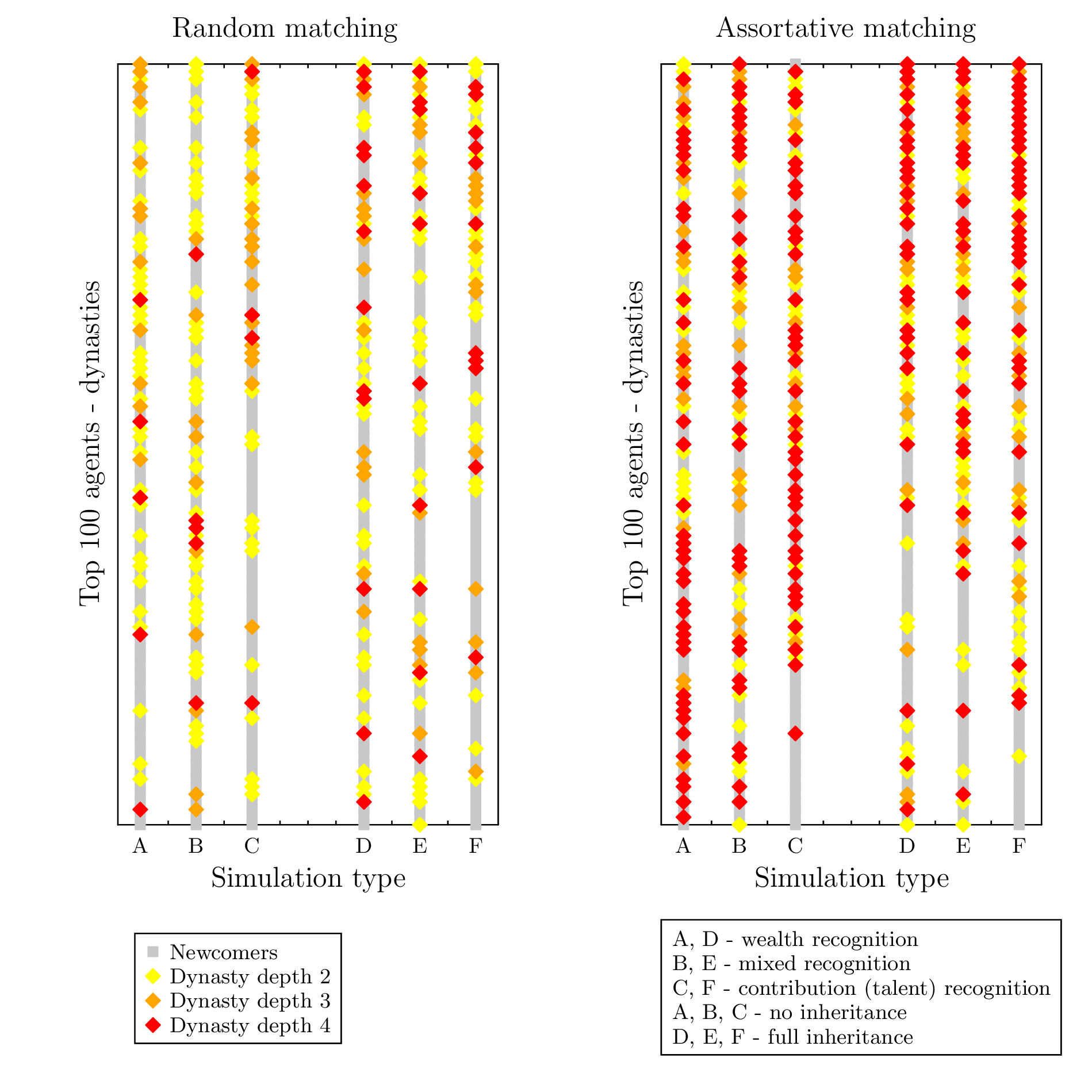
A revealing picture is shown, when we study the actual composition of the top 10% elite by agent category and dynasty length. The snapshots shown in Figures 5 and 6 show stark difference between the random matching and assortative matching scenarios. The latter show much more stability (deeper dynasties, Figure 6) and the dominance of agents with preferred traits (whether it is greed or talent, or both (Figure 5). Individual rankings may change from generation to generation (children do not automatically occupy their parents’ ranking positions), but in some cases the dynasties may reach quite long depths. And most of the baseline agents found in the elite cohort (gray color in Figure 5) are children of privileged parents, who had the "misfortune" of not inheriting the advantageous trait or did not learn it.
Measuring inequality – Gini coefficient
When we consider all the varied aspects of human life, inequality may be found in many forms. In today’s heavily monetized world, the economists proposed a simple numerical measure of inequality within a society, the Gini coefficient. It measures the inequality among the values of a frequency distribution, such as income levels. The general formula for Gini coefficient for quantity \(x_i\) characterizing \(N\) agents is:
| \[G= \frac{\sum_{i=1}^N \sum_{j=1}^N |x_i - x_j|}{2 N^2 \bar{x}},\] | \[(4)\] |
A Gini coefficient of 0 reflects perfect equality, where all income or wealth values are the same. In contrast, a Gini coefficient of 1 reflects maximal inequality among values, where a single individual has all the income while all others have none. The modern world is characterized by relatively high values of the wealth Gini coefficient, varying country-to-country, but in the range of 0.6-0.8, or more (Davies et al. 2008). We note here that even with the wealth of economic data today, there are discussions regarding specific calculations and data for these estimates. Also, today wealth can be easily "stored" and accumulated, even on multi-decade timescales. Thus it might be interesting to note that the Gini coefficient for yearly income in modern societies is much lower (world average 0.382; Nadim Haddad et al. (2025)). This type of measurement would be closer to the situation in H-G societies where long-term material storage capabilities are limited.
With respect to inequalities in various foraging societies, several anthropological studies have reported the values of \(G\). These reported values vary strongly, depending on the property being measured, in some cases showing values lower than those found in modern societies, but in some cases indicating rather high inequality. For example, Smith et al. (2010) divided the wealth into the embodied, material and relational, and reported averaged Gini coefficients for the Ache, Hadza, Ju/’hoansi, Lamalerans, and Meriam as 0.215, 0.357 and 0.229 in each category. (We note here that the embodied wealth distribution is severely restricted by biological constraints, while material wealth may have broader distribution). Yu et al. (2019) reported values for Neolithic settlements in North and East China ranging from 0.19 to 0.38. Page et al. (2023) calculated wealth Gini coefficient for Agta foragers per camp, with minimal value of zero, mean of 0.23 and maximum of 0.44.
All these estimates are even more difficult methodologically, because of the lack of easily measurable wealth measures (conversion to money), present in the modern world.
Gini coefficient, model results
It is possible to calculate the values of the Gini coefficient for the total power (not material wealth!) in our simulations. The resulting \(G\) values (see Table 2) are smaller than the ones reported for actual H-G societies mentioned in Section 5.11.
| Random matching | ||||||
|---|---|---|---|---|---|---|
| \(\alpha\) | \(\beta\) | \(G\) (for \(\gamma=0.25\)) | \(G\) (for \(\gamma=0.35\)) | |||
| 0 | 0 | 0.041 | 0.069 | |||
| 0 | 1 | 0.040 | 0.060 | |||
| 0.5 | 0 | 0.075 | 0.089 | |||
| 0.5 | 1 | 0.049 | 0.058 | |||
| 1 | 0 | 0.110 | 0.122 | |||
| 1 | 1 | 0.070 | 0.079 | |||
| Assortative matching | ||||||
| \(\alpha\) | \(\beta\) | \(G\) (for \(\gamma=0.25\)) | \(G\) (for \(\gamma=0.35\)) | |||
| 0 | 0 | 0.083 | 0.117 | |||
| 0 | 1 | 0.053 | 0.095 | |||
| 0.5 | 0 | 0.092 | 0.119 | |||
| 0.5 | 1 | 0.055 | 0.077 | |||
| 1 | 0 | 0.130 | 0.144 | |||
| 1 | 1 | 0.081 | 0.101 | |||
The explanation for the low values comes directly from the way our model is designed. First, for most \(\gamma\) values, the number of agents with high total power is small. Secondly the ratio of the maximum power to the average power is lower than a few times (for the simulation parameters values shown in Table 2 the ratio is smaller than 3). Note that for the modern world wealth inequality cited in the introduction, the ratio is of the order of \(10^{6}\).
With these conditions in mind, the calculated \(G\) values are expected to be very small. But there are some systematic properties to note. First, the coefficients are smaller when power inheritance is present (\(\beta=1\)), especially in the assortative matching scenario. This can be attributed to a relatively high number of baseline agents who had the luck of having high power parents, without the benefits offered by talent or greed. Second, and more important, for the same \(\alpha, \beta\) and \(\gamma\) parameter values, the Gini coefficient is much higher for the assortative matching scenario. Coupled with the presence of long-term dynasties in this scenario, this shows that assortative matching is likely the most important factor in the appearance of systemic inequality, even in hunter-gatherer societies. The importance of assortative matching in these societies is confirmed, for example, by Marlowe (2004) and Godoy et al. (2008). Even the apparently negative observations of Sear & Marlowe (2009), who found no evidence for biological trait preferences, are limited, because mate choice may depend on different characteristics (domains), not just the physical cues (Marlowe lists fertility, intelligence, foraging skills, hard-working and character — traits that translate to contributions and social power).
Discussion and Conclusions
Our model has been devised for the relatively affluent hunter-gatherer societies, which have limited capacity for storing food (especially the long-term storage) and which are still largely mobile. They are named transegalitarian, because they show certain level of internal inequalities, following the description of Hayden (1995).
Therefore we have assumed that certain characteristics of the society and agents’ behavior are as given, without attempt to derive them or explain within the model. For example, we assume the presence of baseline sharing mechanisms, typical for fully egalitarian societies, and focus the model on deviations from such processes. It is important to remember that in transegalitarian communities a significant amount of egalitarian sharing is still present. The origins of such egalitarian sharing (apparently an altruistic behaviour) are a mighty topic of research. There are multiple competing evolutionary explanations, including, among others, kin selection, reciprocity, risk mitigation, need-based sharing and even group selection (Apicella et al. 2012; Fehr et al. 2002; Gintis 2000; Gurven 2004; Hamilton & Dimond 2012; W. D. Hamilton 1964a, 1964b; Smith et al. 2019; Thompson 2000; Traulsen 2010; Traulsen & Nowak 2006; Trivers 1971; Wilson 1975, 2005; Wilson & Sober 1994).
The answer to the question which of these mechanisms (or more likely, what mixture of them) applies to which types of societies and environments is crucial if we want to answer the question which mechanisms, conditions or processes led away from egalitarian societies to transegalitarian. So, skipping this issue and assuming that certain amount of sharing is a norm which does not need explaining, is an obvious weakness of our model.
Bliege Bird & Bird (1997) have compared predictions of some of theoretical models with observations from several egalitarian H-G societies. They have found that one of the models for sharing fits particularly well with the observational data. The approach, named tolerated theft (Blurton Jones 1984, 1987; Hawkes et al. 2018; Winterhalder 1996) shifts the cause of sharing from voluntary altruistic action of the sharer to a selfish pressure of the person(s) wanting a part of the resource to be shared. Blurton Jones noted that the benefits of immediate consumption of food follow a diminishing utility curve: the same amount of food is worth much more to a starving person than to a satiated one. So, when a hungry person challenges a successful hunter, demanding a share of the catch, their determination is much greater than the willingness to defend the resource. Moreover, such confrontations seldom lead to actual fights, as the risks of injury mostly outweigh the benefits of keeping the resource. The owners tolerate forced sharing, and in time such tolerance might be surrounded by cultural norms and customs.
For clarity we note here that our use of the word "thieves" is radically opposite to the one implied by the tolerated theft hypothesis. There, "thieves" are people breaking the ownership rule (and thus promoting more egalitarian distribution). In our case, we use the term for those who break the egalitarian principles of sharing, already assumed to be the norm.
The tolerated theft hypothesis has a crucial advantage from our point of view, in that it allows a natural expansion leading to the premises of our approach — when the environmental conditions provide more resources than the bare necessary minimum. In such situations, the number of starving and desperate members of the society is minimized, and the steepness of the utility curve is less diverse. Therefore, there is less immediate pressure on the successful foragers to forcibly share. But, while the utility of food in the direct consumption sense still follows a flattening curve, the existence of a surplus could lead to other uses than staving off hunger. Among such uses could be conspicuous consumption, feasting, creating dependencies and debts—essentially social positioning uses of the surplus resources. In contrast to physical consumption, there is, in principle, no upper limit for such uses, no corresponding "satiation". Even in egalitarian societies, in which every resource is freely and immediately shared (Shahu 2018), there are benefits for the sharer outside consumption: "sharer receives long-term credibility, interest and benefits closely tied to moral obligations". These benefits might increase when resource surplus can be judiciously used with specific goals and benefits in mind, targeting specific recipients to create links and alliances.
The next step is the recognition that, as with the hunting/foraging skills, there is a diversity of the social skills among people. Some people would be better at reaping the effects of feasts, at creation of alliances and bonds. For them, the utility of using a "unit of surplus" transformed into social power would be much greater than for those who are relatively inept in social skills. So they would be motivated to resist the sharing pressure (implied in the tolerated theft model). Moreover, another effect comes into the play: intelligent use of surplus, leading to creation of alliances and dependents allows the socially adept person to share the potential defense costs and risks over a larger group. This not only increases the benefits of hoarding but also decreases the associated risks. Which leads to the creation of the aggrandizer class, as proposed by Hayden (1995).
So, with the presence of the surplus resources and diversity of skills (both hunting/ foraging skills and the social ones) the tolerated theft approach transforms into the basis for the model presented here. The question that led to egalitarian societies "whether it pays off to share?" (and various types of "yes" answers) is replaced by "how to share most effectively and with whom?". This resulted in divisions in societies: clans, cliques and stratifying the roles. Which, we note, becomes even more strategic when long-term storage becomes available, allowing massive wealth accumulation — but requiring resources to protect this wealth.
In the light of the above discussion, our choice of the two parameters describing individual agents requires a brief explanation. The skill/talent parameter, describing the variation of individual productivity is quite obvious. But our use of a single greed parameter actually combines two features: the amount of produced goods that an agent decides to keep for itself and the social skill, through which the agent transforms this hoarded wealth into social power. As already noted, we have chosen the wealth-to-power conversion factor to be identical for all greedy agents. In a more advanced model, these two parameters might be varied independently.
Moreover, we have focused on single agents and (at most) nuclear families of 2 parents, 2 children, while the actual H-G societies show much more complex, hierarchical structure of social networks (Hamilton et al. 2007). Kin-based clans, multi-generational linkages, presence of formalized alliances between clans --- all such phenomena are absent in our model. This means that in the real world, complementary skillsets may be combined, overcoming individual weaknesses and improving the outcomes achieved through such cooperation.
Also, the model radically simplifies the way that produce brought to the community by an individual or small group is shared. In reality there are multiple ways such sharing happens, in addition to tolerated theft, there is preference for sharing within ones’ kin (which is totally absent in the model), sharing aimed at establishment of reciprocal relations (which is partially present – hidden in our translation from wealth to social power). Moreover, we assumed that the society, while having a ranking hierarchy based on power, has no operational hierarchy which might force specific forms of sharing (e.g. chieftain and his bullies demanding "their share" from others). Even on our drastically simplified approach, where all this is covered by a single, individual-based parameter of greed (\(G_i\)), there are already multiple parameters, making detection of key mechanisms difficult. In our belief, construction of a generic model that would contain all potential social structures, sharing mechanisms, family structures, productivity tools, etc., valid for multiple H-G societies is not feasible. While, with the right level of detail of anthropological data, it might be possible to create a more realistic multi-agent replica of it, it would be limited to this specific case.
In contrast, our simplified model reproduces the common sense expectations of the effects of the "cultural choices" of the origins of the social power (prestige, social position) — whether it is the disposable wealth, which can be used to build ally networks (relational power), create debt obligations and even improve ones own (and family) health and physical qualities through better nourishment, or recognition of ones own contribution to the society (foraging and hunting talent and skills, hard work, intelligence). In the first case, the agents focused at personal wealth dominate the elite, in the second, its the agents who contribute the most. In this sense the results are quite obvious.
However, we recall that the model starts from an almost negligible proportion of the society being either talented or greedy (5% in each case). What we observe as the simulations evolve into a steady state are not only the rise of the preferred agents to the top, but also changes in the overall composition of the community. For low learning rates (small \(\gamma\)) the stable numbers of the thieves/contributors may be even smaller than the initial ones (and, as assumed in the model, than the numbers resulting from random genetic mutations). So, when learning is weak, almost the whole community is composed of baseline agents and is highly egalitarian. When the learning possibility becomes sufficiently high, the numbers of preferred agents in the stable state rise sharply. Moreover, these "whole society" numbers of thieves and contributors in the random matching case are only weakly dependent on the social preference \(\alpha\) and inheritance \(\beta\) (leftmost columns in Figures 1 and 2). What changes is the composition of the elite: who rises to the top.
The situation changes radically when matching is assortative. The effects of learning (high \(\gamma\)) and their dependence on \(\alpha\) and \(\beta\) are seen not only in the elite, but also in the general composition of the community (Figures 3 and 4). For high enough capacity to learn from parents and assortative matching a dominance of agents exhibiting the two traits (talent and greed) in the social elite becomes significant and durable. We could name the two extreme cases as origins of oligarchy (\(\alpha=0\)) or meritocracy (\(\alpha=1\)). The real societies are most likely somewhere in between these extremes, promoting the aggrandizers, who combine the two traits, a category introduced by Hayden (1995, 2020).
While the presence of "power inheritance" (\(\beta=1\)) in the assortative matching scenario increases the depth of the dynasties in the elite, this happens due to the addition of one generation of baseline children of privileged parents. The dynasties are longer on average, while the composition of the elite in such scenario looks more balanced (in the sense of the elite not being dominated by privileged agents and containing a significant number of baseline agents). If we translate the model results to human societies, this is not a more "egalitarian" solution, but rather an unearned power effect. The baseline agents in the elite did not "advance" there due to random luck (which could have increased their contribution/wealth), but are the un-talented and not-greedy children from powerful lineages. As the power inheritance is limited to one generation, their particular lineages are most likely bound to drop from the elite rank.
In our discussion of the relative importance of conditions which might influence the process of stratification and inequality buildup, the role of luck (differences in the environmental productivity for the agents) is quite limited, at least if the separation between lucky un-talented agents and unlucky talented ones is present (\(R<2/3\)). Only when \(R\) is much greater than this threshold (for example \(R=1.5\), where there is a large overlap between distributions of the contributions of talented and un-talented agents) we observe the advantages of talent to disappear. Then the only consistent path to power is via the greediness trait. This model prediction – that excessively large random variability of produced resources would lead to larger preferences for keeping the produce within the immediate/extended family – could be compared with some detailed ethnographic data. For example, (Wood & Marlowe 2013) notes that among the Hadza effects of a big game hunt (which happens infrequently) are not shared in the same way as the rest of sustenance – producers keep more than in the case of small game/foraging.
Lastly, we stress the importance of another "cultural choice" parameter: learning (described by \(\gamma\)). Recall that \(\gamma\) describes learning of both: skills (talent) and social behavior (greed) from the agent parents. As we noted, in real societies there are other ways of learning: from peers, from community joint practices, and observing best performers, whether they are kin related or not. Learning mostly from parents preserves advantages or disadvantages that the parents already have. On the other hand, the "communal" ways of teaching and learning promote equality and can smooth over the starting point differences. Figures 1- 4 show how drastically society composition (ratio of aggrandizers, thieves, and contributors versus the baseline) may change with increasing \(\gamma\) – capacity to mimic the characteristics of parents by children by cultural, non-genetic means. In our view, together with assortative matching, family-based learning is one of the dominant mechanisms promoting and preserving long-term stratification in transegalitarian societies.
Because our model is drastically simplified compared to the richness of actual H-G societies, there are many potential paths for its development. The most important would be inclusion of groups and dynamical social networks structure, change from synchronous to asynchronous generation change and recognition of changing roles of agents as they age. Many more improvements are possible. But we do not believe in modeling for modeling’s sake. In our opinion, even the current simple approach provides some nontrivial insights, in particular related to important roles of assortative matching and in-family teaching/learning. It is our hope that the anthropological community would find this paper valuable enough for a re-analysis of existing data or a search for new evidence, especially in historical longevity of elite social structures and evidence for "dynasties" and, perhaps, in the fundamental question of how such societies evaluate the value of various forms of contributions to the society and translate them to social positions. This could be a real motivation for refinement and development.
Notes
- Source: https://www.forbes.com/billionaires/ (accessed Nov 13, 2024 and March 17, 2026). Scientific notation is used here not only to avoid misunderstandings due to the different meanings of the word ‘billion’ between the US and Europe, but also to emphasize the eleven orders of magnitude difference.↩︎
References
APICELLA, C. L., Marlowe, F. W., Fowler, J. H., & Christakis, N. A. (2012). Social networks and cooperation in hunter-gatherers. Nature, 481(7382), 497–501. [doi:10.1038/nature10736]
AUNGER, R., & Curtis, V. (2013). The anatomy of motivation: An evolutionary-ecological approach. Biological Theory, 8(1), 49–63. [doi:10.1007/s13752-013-0101-7]
AUNGER, R., Foster, D., & Curtis, V. (2021). Psychometric analysis of a postulated set of evolved human motives. Frontiers in Psychology, 12. [doi:10.3389/fpsyg.2021.680229]
AUNGER, R., Gallyamova, A., & Grigoryev, D. (2025). Network psychometric-based identification and structural analysis of a set of evolved human motives. Personality and Individual Differences, 233, 112921. [doi:10.1016/j.paid.2024.112921]
BLIEGE Bird, R. L., & Bird, D. W. (1997). Delayed reciprocity and tolerated theft: The behavioral ecology of food-sharing strategies. Current Anthropology, 38(1), 49–78. [doi:10.1086/204581]
BLURTON Jones, N. G. (1984). A selfish origin for human food sharing: Tolerated theft. Ethology and Sociobiology, 5(1), 1–3. [doi:10.1016/0162-3095(84)90030-x]
BLURTON Jones, N. G. (1987). Tolerated theft, suggestions about the ecology and evolution of sharing, hoarding and scrounging. Social Science Information, 26(1), 31–54. [doi:10.1177/053901887026001002]
BOYETTE, A. H., & Hewlett, B. S. (2017). Teaching in hunter-gatherers. Review of Philosophy and Psychology, 9(4), 771–797. [doi:10.1007/s13164-017-0347-2]
BRIZ i Godino, I., Santos, J. I., Galán, J. M., Caro, J., Álvarez, M., & Zurro, D. (2013). Social cooperation and resource management dynamics among late hunter-fisher-gatherer societies in Tierra del Fuego (South America). Journal of Archaeological Method and Theory, 21(2), 343–363. [doi:10.1007/s10816-013-9194-3]
BUELA, A. (2020). Leadership and inequality among the Iñupiat: A case of transegalitarian hunter-gatherers. In L. Moreau (Ed.), Social Inequality Before Farming? (pp. 71–82). McDonald Institute for Archaeological Research, University of Cambridge.
CLARK, J. E., & Blake, M. (1994). The Power of Prestige: Competitive Generosity and the Emergence of Rank Societies in Lowland Mesoamerica. In Factional competition and political development in the new world (pp. 17–30). Cambridge University Press. [doi:10.1017/cbo9780511598401.003]
DAVIES, J. B., Sandström, S., Shorrocks, A. F., & Wolff, E. N. (2008). The world distribution of household wealth (Nos. 003; Vol. 2008). UNU-WIDER. [doi:10.1093/acprof:oso/9780199548880.003.0019]
DAVIES, W. (2020). Responses of Upper Palaeolithic humans to spatio-temporal variations in resources: Inequality, storage and mobility. In L. Moreau (Ed.), Social Inequality Before Farming? (pp. 131–166). McDonald Institute for Archaeological Research, University of Cambridge.
DEATON, A. (2016). The threat of inequality. Scientific American, 315(3), 48–53.
EPSTEIN, J. M. (2008). Why model? Journal of Artificial Societies and Social Simulation, 11(4), 12.
FEHR, E., Fischbacher, U., & Gächter, S. (2002). Strong reciprocity, human cooperation, and the enforcement of social norms. Human Nature, 13(1), 1–25. http://129.3.20.41/eps/mic/papers/0305/0305008.pdf [doi:10.1007/s12110-002-1012-7]
FITZHUGH, B. (2020). Reciprocity and asymmetry in social networks: Dependency and hierarchy in a north pacific comparative perspective. In L. Moreau (Ed.), Social Inequality Before Farming? (pp. 233–254). McDonald Institute for Archaeological Research, University of Cambridge.
FRIED, M. H. (1960). On the Evolution of Social Stratification and the State. Bobbs-Merrill.
FRIED, M. H. (1967). The Evolution of Political Society: An Essay in Political Anthropology. McGraw-Hill.
GARFIELD, Z. H., & Lew-Levy, S. (2025). Teaching is associated with the transmission of opaque culture and leadership across 23 egalitarian hunter-gatherer societies. Nature Communications, 16(1). [doi:10.1038/s41467-025-58764-9]
GINTIS, H. (2000). Strong reciprocity and human sociality. Journal of Theoretical Biology, 206, 169–179. [doi:10.1006/jtbi.2000.2111]
GODOY, R., Eisenberg, D. T., Reyes-Garcı́a, V., Huanca, T., Leonard, W. R., McDade, T. W., Tanner, S., Team, T. B. R., & others. (2008). Assortative mating and offspring well-being: Theory and empirical findings from a native Amazonian society in Bolivia. Evolution and Human Behavior, 29(3), 201–210. [doi:10.1016/j.evolhumbehav.2007.12.003]
GURVEN, M. (2004). Reciprocal altruism and food sharing decisions among Hiwi and Ache hunter-gatherers. Behavioral Ecology and Sociobiology, 56(4). [doi:10.1007/s00265-004-0793-6]
HAIDT, J. (2001). The emotional dog and its rational tail: A social intuitionist approach to moral judgment. Psychological Review, 108(4), 814–834. [doi:10.1037/0033-295x.108.4.814]
HAIDT, J., & Graham, J. (2007). When morality opposes justice: Conservatives have moral intuitions that liberals may not recognize. Social Justice Research, 20(1), 98–116. http://faculty.virginia.edu/haidtlab/articles/haidt.graham.2007.when-morality-opposes-justice.pdf [doi:10.1007/s11211-007-0034-z]
HAIDT, J., & Joseph, C. (2007). The moral mind: How five sets of innate intuitions guide the development of many culture-specific virtues, and perhaps even modules. In P. Carruthers, S. Laurence, & S. Stich (Eds.), The Innate Mind (Vol. 3, pp. 367–391). Oxford University Press. [doi:10.1093/oso/9780195332827.003.0019]
HAMILTON, A., Milne, B. T., Walker, R. S., Burger, O. & Brown, J. H. (2017). The complex structure of hunter–gatherer social network. Proceedings of the Royal Society B: Biological Sciences, 274, 1622, 2195–2203. [doi:10.1098/rspb.2007.0564]
HAMILTON, A., & Dimond, C. C. (2012). Groups, individuals, and evolutionary restraints: The making of the contemporary debate over group selection. Biology and Philosophy, 27, 299–312. [doi:10.1007/s10539-011-9255-5]
HAMILTON, W. D. (1964a). The genetical evolution of social behaviour II. Journal of Theoretical Biology, 7(1), 17–52.
HAMILTON, W. D. (1964b). The genetical evolution of social behaviour I. Journal of Theoretical Biology, 7(1), 1–16.
HAWKES, K., O’Connell, J., & Blurton Jones, N. (2018). Hunter‐gatherer studies and human evolution: A very selective review. American Journal of Physical Anthropology, 165(4), 777–800. [doi:10.1002/ajpa.23403]
HAYDEN, B. (1995). Pathways to power principles for creating socioeconomic inequalities. In T. Douglas Price & G. M. Feinman (Eds.), Foundations of Social Inequality (pp. 15–86). Plenum Press.
HAYDEN, B. (2021). Foragers or “feasters ”? inequalities in the upper palaeolithic. Paléo, Hors-série, 36–49. [doi:10.4000/paleo.6607]
HAYDEN, B. D. (2020). Responses of Upper Palaeolithic humans to spatio-temporal variations in resources: Inequality, storage and mobility. In L. Moreau (Ed.), Social Inequality Before Farming? (pp. 117–129). McDonald Institute for Archaeological Research, University of Cambridge.
HENRICH, J., & Gil-White, F. J. (2001). The evolution of prestige: Freely conferred deference as a mechanism for enhancing the benefits of cultural transmission. Evolution and Human Behavior, 22(3), 165–196. [doi:10.1016/s1090-5138(00)00071-4]
HIKICHI, M., & Tateno, M. (2024). Relationship between energy acquisition and family composition in hunter-gatherers. Anthropological Science, 132(2), 117–132. [doi:10.1537/ase.231215]
KRAMER, K. L., & Russell, A. F. (2015). Was monogamy a key step on the hominin road? Reevaluating the monogamy hypothesis in the evolution of cooperative breeding. Evolutionary Anthropology: Issues, News, and Reviews, 24(2), 73–83. [doi:10.1002/evan.21445]
LAPOLICE, T. M., Williams, M. P., & Huber, C. D. (2024). The European Neolithic expansion: A model revealing intense assortative mating and restricted cultural transmission. [doi:10.1101/2024.04.29.591653]
LEWIS, H. M., Vinicius, L., Strods, J., Mace, R., & Migliano, A. B. (2014). High mobility explains demand sharing and enforced cooperation in egalitarian hunter-gatherers. Nature Communications, 5(1). [doi:10.1038/ncomms6789]
LEW-LEVY, S., Lavi, N., Reckin, R., Cristóbal-Azkarate, J., & Ellis-Davies, K. (2018). How do hunter-gatherer children learn social and gender norms? A meta-ethnographic review. Cross-Cultural Research, 52(2), 213–255. [doi:10.1177/1069397117723552]
LEW-LEVY, S., Reckin, R., Lavi, N., Cristóbal-Azkarate, J., & Ellis-Davies, K. (2017). How do hunter-gatherer children learn subsistence skills?: A meta-ethnographic review. Human Nature, 28(4), 367–394. [doi:10.1007/s12110-017-9302-2]
MARLOWE, F. W. (2004). Mate preferences among Hadza hunter-gatherers. Human Nature, 15(4), 365–376. [doi:10.1007/s12110-004-1014-8]
MARLOWE, F. W. (2005). Hunter-gatherers and human evolution. Evolutionary Anthropology: Issues, News, and Reviews, 14(2), 54–67. [doi:10.1002/evan.20046]
MARLOWE, F. W. (2003). The mating system of foragers in the standard cross-cultural sample. Cross-Cultural Research, 37(3), 282–306.
MCNALL, S. G. (2015). The problem of social inequality why it destroys democracy, threatens the planet, and what we can do about it. Routlege, New York.
MOREAU, L. (Ed.). (2020). Social Inequality Before Farming? McDonald Institute for Archaeological Research, University of Cambridge.
MULDER, M. B., Bowles, S., Hertz, T., Bell, A., Beise, J., Clark, G., Fazzio, I., Gurven, M., Hill, K., Hooper, P. L., & others. (2009). Intergenerational wealth transmission and the dynamics of inequality in small-scale societies. Science, 326(5953), 682–688. [doi:10.1126/science.1178336]
NADIM Haddad, C., Gerszon Mahler, D., Diaz-Bonilla, C., Hill, R., Lakner, C., & Lara Ibarra, G. (2025). The World Bank’s new inequality indicator. [doi:10.1596/41687]
NOWAK, A., Rychwalska, A., & Borkowski, W. (2013). Why simulate? To develop a mental model. Journal of Artificial Societies and Social Simulation, 16(3), 12. [doi:10.18564/jasss.2235]
PAGE, A. E., Ruiz, M., Dyble, M., Major-Smith, D., Migliano, A. B., & Myers, S. (2023). Wealth, health and inequality in Agta foragers. Evolution, Medicine, and Public Health, 11(1), 149–162. [doi:10.1093/emph/eoad015]
PETERSEN, B. C. (2023). An economic model and evidence of the evolution of human intelligence in the middle pleistocene: Climate change and assortative mating. PLoS One, 18(8), e0287964. [doi:10.1371/journal.pone.0287964]
PINHEIRO, M. (2022). Egalitarian sharing explains food distributions in a small-scale society. Journal of Artificial Societies and Social Simulation, 25(3), 5. [doi:10.18564/jasss.4835]
PLOURDE, A. M. (2010). Human power and prestige systems. In P. M. Kappeler & J. B. Silk (Eds.), Mind the Gap - Tracing the Origins of Human Universals (pp. 139–152). Springer. [doi:10.1007/978-3-642-02725-3_6]
PRICE, T. D., & Feinman, G. M. (1995). Foundations of Social Inequality. Springer.
ROBINSON, M. R., Kleinman, A., Graff, M., Vinkhuyzen, A. A. E., Couper, D., Miller, M. B., Peyrot, W. J., Abdellaoui, A., Zietsch, B. P., Nolte, I. M., Vliet-Ostaptchouk, J. V. van, Snieder, H., Alizadeh, B. Z., Boezen, H. M., Franke, L., Harst, P. van der, Navis, G., Rots, M., Snieder, H., … Visscher, P. M. (2017). Genetic evidence of assortative mating in humans. Nature Human Behaviour, 1(1). [doi:10.1038/ejhg.2017.50]
SCHWARTZ, S. H. (1992). Universals in the content and structure of values: Theoretical advances and empirical tests in 20 countries. In Advances in Experimental Social Psychology (pp. 1–65). Elsevier. [doi:10.1016/s0065-2601(08)60281-6]
SCHWARTZ, S. H. (2016). Basic individual values: Sources and consequences. In T. Brosch & D. Sander (Eds.), Handbook of Value: Perspectives from Economics, Neuroscience, Philosophy, Psychology and Sociology (pp. 63–84). Oxford University Press. [doi:10.1093/acprof:oso/9780198716600.003.0004]
SCHWARTZ, S. H. (2012). An overview of the Schwartz theory of basic values. Online Readings in Psychology and Culture, 2(1). [doi:10.9707/2307-0919.1116]
SCHWARTZ, S. H., Cieciuch, J., Vecchione, M., Davidov, E., Fischer, R., Beierlein, C., Ramos, A., Verkasalo, M., Lönnqvist, J.-E., Demirutku, K., Dirilen-Gumus, O., & Konty, M. (2012). Refining the theory of basic individual values. Journal of Personality and Social Psychology, 103(4), 663–688. [doi:10.1037/a0029393]
SEAR, R., & Marlowe, F. W. (2009). How universal are human mate choices? Size does not matter when hadza foragers are choosing a mate. Biology Letters, 5(5), 606–609. [doi:10.1098/rsbl.2009.0342]
SERVICE, E. R. (1962). Primitive social organization : An evolutionary perspective. Random House, New York.
SHAHU, M. B. (2018). Reciprocity practices of nomadic hunter-gatherer Rāute of Nepal. Hunter Gatherer Research, 4(2), 257–285. [doi:10.3828/hgr.2018.18]
SINGH, M., & Glowacki, L. (2022). Human social organization during the late pleistocene: Beyond the nomadic-egalitarian model. Evolution and Human Behavior, 43(5), 418–431. [doi:10.1016/j.evolhumbehav.2022.07.003]
SMITH, D., Dyble, M., Major, K., Page, A. E., Chaudhary, N., Salali, G. D., Thompson, J., Vinicius, L., Migliano, A. B., & Mace, R. (2019). A friend in need is a friend indeed: Need-based sharing, rather than cooperative assortment, predicts experimental resource transfers among agta hunter-gatherers. Evolution and Human Behavior, 40(1), 82–89. [doi:10.1016/j.evolhumbehav.2018.08.004]
SMITH, E. A. (2004). Why do good hunters have higher reproductive success? Human Nature, 15(4), 343–364. [doi:10.1007/s12110-004-1013-9]
SMITH, E. A., & Choi, J.-K. (2007). The emergence of inequality in small-scale societies: Simple scenarios and agent-based simulations. In T. Kohler & S. van der Leeuw (Eds.), Modeling Socioecological Systems (pp. 105–120). SAR.
SMITH, E. A., Hill, K., Marlowe, F. W., Nolin, D., Wiessner, P., Gurven, M., Bowles, S., Borgerhoff Mulder, M., Hertz, T., & Bell, A. (2010). Wealth transmission and inequality among hunter-gatherers. Current Anthropology, 51(1), 19–34. [doi:10.1086/648530]
STERELNY, K. (2014). A paleolithic reciprocation crisis: Symbols, signals, and norms. Biological Theory, 9, 65–77. [doi:10.1007/s13752-013-0143-x]
STERELNY, K. (2016). Cooperation, culture, and conflict. The British Journal for the Philosophy of Science, 64(1), 31–58.
THOMPSON, N. S. (2000). Shifting the natural selection metaphor to the group level. Behavior and Philosophy, 28(1/2), 83–101. https://www.jstor.org/stable/27759407
TRAULSEN, A. (2010). Mathematics of kin-and group-selection: Formally equivalent? Evolution, 64(2), 316–323. [doi:10.1111/j.1558-5646.2009.00899.x]
TRAULSEN, A., & Nowak, M. A. (2006). Evolution of cooperation by multilevel selection. Proceedings of the National Academy of Sciences, 103(29), 10952–10955. http://www.pnas.org/content/103/29/10952.abstract [doi:10.1073/pnas.0602530103]
TRIVERS, R. L. (1971). The evolution of reciprocal altruism. Quarterly Review of Biology, Vol. 46, 35–57. http://salmon.psy.plym.ac.uk/year2/psy250-family-evolutionary-psychology/trivers-reciprocal-atruism.pdf [doi:10.1086/406755]
VERSLUYS, T. M., Mas-Sandoval, A., Flintham, E. O., & Savolainen, V. (2021). Why do we pick similar mates, or do we? Biology Letters, 17(11), 20210463. [doi:10.1098/rsbl.2021.0463]
WHITE, A. A. (2013). Subsistence economics, family size, and the emergence of social complexity in hunter–gatherer systems in eastern North America. Journal of Anthropological Archaeology, 32(1), 122–163. [doi:10.1016/j.jaa.2012.12.003]
WILENSKY, U. (1999). NetLogo.
WILSON, D. S. (1975). A theory of group selection. Proceedings of the National Academy of Sciences, 72(1), 143–146. http://www.pnas.org/cgi/reprint/72/1/143.pdf [doi:10.1073/pnas.72.1.143]
WILSON, D. S., & Sober, E. (1994). Reintroducing group selection to the human behavioral sciences. Behavioral and Brain Sciences, 17(4), 585–607. [doi:10.1017/s0140525x00036104]
WILSON, E. O. (2005). Kin selection as the key to altruism: Its rise and fall. Social Research: An International Quarterly, 72(1), 1–8. [doi:10.1353/sor.2005.0012]
WILSON, K. M., Cole, K. E., & Codding, B. F. (2023). Identifying key socioecological factors influencing the expression of egalitarianism and inequality among foragers. Philosophical Transactions of the Royal Society B: Biological Sciences, 378(1883). [doi:10.1098/rstb.2022.0311]
WINTERHALDER, B. (1996). A marginal model of tolerated theft. Ethology and Sociobiology, 17(1), 37–53. [doi:10.1016/0162-3095(95)00126-3]
WOOD, B. M., & Marlowe, F. W. (2013). Household and kin provisioning by hadza men. Human Nature, 24(3), 280–317. [doi:10.1007/s12110-013-9173-0]
WOODBURN, J. (1982). Egalitarian societies. Man, 17(3), 431–451. [doi:10.2307/2801707]
YU, S.-Y., Chen, X.-X., & Fang, H. (2019). Inferring inequality in prehistoric societies from grave sizes: A methodological framework. Archaeological and Anthropological Sciences, 11(9), 4947–4958. [doi:10.1007/s12520-019-00845-0]