Will China Become a Christian-Majority Nation? Regulation, Demand, and an Agent-Based Test of the Supply-Side Theory

American University, United States
Journal of Artificial
Societies and Social Simulation 29 (4) 3
<https://www.jasss.org/29/4/3.html>
DOI: 10.18564/jasss.6237
Received: 07-Jun-2026 Accepted: 31-Aug-2026 Published: 31-Oct-2026
Abstract
Whether China will become a Christian-majority nation in the twenty-first century is among the most visible disputes in the social science of religion. Influential projections forecast sustained Protestant growth toward a majority by mid-century, resting on the supply-side premise that religious demand is high and roughly constant and that state regulation drives growth by pushing demand into underground churches. Survey evidence instead shows the Christian share plateauing at a few percent. This study adjudicates the theoretical claim rather than the data by formalizing the supply-side mechanisms as an agent-based model and asking whether they can generate the projected growth under the theory's own logic. The model is built for explanation, not prediction. It distinguishes the demand the projections require, a congregational demand for membership sustained by long-term investment, from the transactional religiosity that dominates Chinese religious life; it makes the distribution of that congregational demand explicit, and it grants Christianity every structural advantage. The mechanisms produce rapid growth only when the population is assumed receptive before any evangelism begins. And under the regulation China imposes, the Christian share plateaus in the single digits, rises at most to the low twenties under the most favorable variations, and never approaches a majority. The finding holds across extensive sensitivity, network, and denominational analyses, with the receptivity distribution alone accounting for 84 percent of the variance in outcomes; it breaks only when suppression is allowed to manufacture demand without limit, an assumption the theory does not license. We conclude that supply-side mechanisms sort and intensify congregational demand but cannot create it from transactional religiosity, and that demand governs the growth trajectory.Introduction
Whether China is becoming a Christian-majority country is among the most visible disputes in the contemporary social science of religion. In his presidential address to the Society for the Scientific Study of Religion, F. Yang (2016a) drew trajectory lines of mean estimates of Christian population from different data sources since 1949, and projected 7 to 10 percent annual Protestant growth, which would make China a country with 160 million Christians by 2025, a country with more Christians (230 million) than the United States by 2030, and finally a Christian-majority nation by 2050 with 67 percent of Protestant population. Stark and Wang (2015) also reached similar projections, attributing sustained expansion to competitive supplier innovation under their rational choice framework. Against these projections, Hackett & Tong (2025) recently reviewed 19 nationally representative surveys and found that growth rates have plateaued or declined since approximately 2010. Yang has challenged the credibility of these survey findings, arguing that “who would want to answer survey questions on religion?” in the increasingly hostile political environment under Xi Jinping (Ong 2023).1 Meanwhile, empirical studies have found no evidence that government regulations significantly affected survey response rates or Christian identification patterns (Francis-Tan 2023; Hackett & Tong 2025).
Behind the data impasse stands a verbal theoretical claim that can be examined on its own terms. The projections rest on a rational-choice account in which religious demand is high and constant across populations (Stark & Finke 2000), so that shortage and suppression in the state-sponsored religious market drive consumers toward underregulated and banned alternatives such as underground house churches (Yang 2006, 2010), whose suppliers are more creative (Stark & Wang 2015). In addition, under persecution, the most devout adherents remain, through the blood-of-martyrs effect and strict church effect (Iannaccone 1994; Yang 2018). Regulation is thus claimed to fuel growth rather than dampen it, sharpening the dispute into one counterintuitive question: can state regulation drive Christian growth?
We address this question by formalizing the verbal theory’s core mechanisms as an agent-based model and asking what trajectory they generate under the theory’s own logic. This is a model for theoretical exploration and explanation, not prediction (Edmonds et al. 2019). Its purpose is to test generative sufficiency: if the formalized mechanisms cannot produce the projected growth even when granted every structural advantage, the shortfall lies in the theory rather than in the data (Epstein 2012). China is the demonstrating case because it is where the projections have been made most explicitly and where the regulation question is sharpest.
Even in a free market, and even after giving Christianity every advantage the theory asks for, the model produces rapid, sustained growth only when we assume the population is already inclined toward religion before any evangelism begins. Once we add the kind of regulation China imposes, the Christian share levels off in the single digits, reaching about 19 percent at most under the most favorable network we tested, and never reaches a majority. What decides the outcome is how receptive the population is to begin with, not how Christianity is supplied. This pattern holds when we vary each assumption one at a time, when we vary twelve assumptions together, across a series of more realistic social networks, and even when we grant the persecution effect the strongest form the theory can reasonably claim. The share crosses into a majority in only one case, when we let suppression raise receptivity without limit, an assumption the theory cannot defend. That single exception is itself the point: the only way to break the ceiling is to drive up demand directly.
Theory and Background
China is known for high levels of religious regulation and suppression. Historically and demographically, Christians remain a small minority in China and Christianity a relatively new religion to Chinese culture compared to other world religions like Buddhism and Islam.2 Our model begins in 1980 at a Christian share of 0.5 percent, and this starting value is itself informative. By government estimates, there were approximately 6 million Protestants and Catholics combined (0.5 percent of the population) by 1982 as opposed to 3 million Christians by the early 1950s (Hackett 2023; Pew Research Center 2023). Two features of this baseline matter for the model. First, it is the one figure all sides of the present dispute accept: the high-growth projections and the survey-based estimates alike take the early-1980s share as their common point of departure, since the political turmoil between the mid-1950s and the late 1970s left no usable religious-demographic data. It is, in that sense, an initial singularity, the last point before the reform-era trajectory begins and the first for which a credible number exists. Second, 0.5 percent is small enough that the subsequent trajectory is governed by conversion and transmission dynamics, which makes it a clean initialization for testing growth mechanisms.
Religious regulation has never been abandoned as a government policy. Civil freedoms, including religious freedom, have been continuously infringed by the state and have reportedly worsened since 2012 (Cook 2017; Francis-Tan 2023). Churches have been torn down, dissenting pastors are arrested, public evangelicalism and religious education for adolescences are forbidden and absent in both public and private schools. And Chinese population has been declining since early 2020s (e.g., National Bureau of Statistics of China (2021)). Both intuitively and on the theory’s own market logic, these conditions should depress Christian growth. Why, then, do some social scientists of religion continue to project stable growth and a possible Christian majority? Their reasoning rests on a set of supply-side mechanisms that we formalize below, introducing each as a construct the model will later operationalize.
The most developed theory to explain the growth is based on Stark & Finke(2000)'s rational choice theory of religion (Carvalho et al. 2019), which applies a market metaphor to understand religious change and growth in China. Organized religions and leaders are suppliers of religious goods and believers are consumers. The core claim is that religious demand is constantly high across populations and cultures. But the supply side of religious goods varies. Where the state suppresses religious markets, growth may stop but religious demand persists and remains latent. Where markets are less regulated and more competitive, vigorous suppliers such as Christian churches capture and even amplify that demand. When it comes to China, the theory predicts that the post-Mao relaxation of religious control should unleash sustained religious growth, with Christian groups proving especially innovative and effective competitors in the newly opened religious market like post-Soviet Union countries (Froese 2008; Stark & Wang 2015; Sun 2017).
The demand concept doing the work in these projections deserves specification, because religious demand is not one thing. What congregation-based Christianity offers is not a commodity but a long-horizon investment: members commit time, money, and social capital to a single exclusive supplier in exchange for a “bundled” package of collectively produced goods whose returns are deferred, contingent on continued participation, and partly promised beyond this life (Braunstein et al. 2026). Much religious demand is instead transactional: discrete services purchased episodically from non-exclusive suppliers for immediate this-worldly ends, with rapidly diminishing marginal utility (Iannaccone 1995). Chinese religious life has historically been dominated by this second, diffused mode (Yang 1967), so the temple revival and ritual economies routinely cited as evidence of abundant demand are evidence of transactional demand. The projections this paper discusses, however, are counts of Christians and only congregational demand produces those quantities. The supply-side wager is thus that China’s transactional or magic-based religiosity is convertible at scale into congregational investment. But neither Stark and Wang nor Yang specify the mechanism.3 Throughout this paper, “religious demand” refers to demand for the congregational, investment type.
In addition, the religious-economy framework was built largely on the competitive dynamics based on white American Protestant experiences (Bender 2013), while a large considerable Chinese Christian groups are indigenous, Pentecostal-inflected, and healing-oriented (Lian 2010). Second, the literature is silent about Islam on the theory’s own logic an anomaly, since if deregulation unleashes latent demand and strictness wins the competition for it, the strictest congregational supplier in the market should be a prime beneficiary of any opening. The omission suggests that Christianity functions in this literature less as one competitor among others than as the presumed natural beneficiary of religious freedom, an assumption with a missionary-era genealogy rather than a theoretical warrant. This study inherit both boundaries deliberately, to test the theory on its own terms, and return to them later.
In addition, Yang’s projection is best understood as an extrapolation with a post hoc explanation. F. Yang (2016a) fitted trend lines to mean estimates of the Christian population since 1949 and projected the implied annual growth rate forward. Under a “modest” 7 percent annual rate, the compound average he reports for Protestants from 1950 to 2010, the projection yields more than 224 million Protestants by 2030, exceeding the entire Christian population of the United States, with higher rates and longer horizons implying a Protestant majority by mid-century.4
Yang’s earlier work offers a more bounded account, and the discrepancy is instructive. In his study of conversion in reform-era urban China, Yang (2005) locates Christian growth in a specific and finite audience: young people dislocated by rapid marketization, for whom Christianity carried the prestige of modernity and the West relative to indigenous traditions such as Daoism or Buddhism. On that account the reform-era surge is a transient response to a particular conjuncture rather than the start of an open-ended trajectory.5 One contribution of ours is to integrate that earlier, demand-led logic and trace where it leads.
A further feature of Yang’s framework bears on how the theory should be tested. Although Yang’s argument is self-labelled as demand-side, its operative mechanisms are largely supply-side. His shortage-economy and triple-market framework (Yang 2006, 2010) treats state regulation not as purely constraining but as productive: regulation creates a tripartite market of red (state-approved), black (banned), and gray religions, and the shortage of approved supply pushes consumers into gray and black channels. Persecution, in this account, may further purify the church by screening out uncommitted free riders while hardening the resolve of those who remain. Yet neither Stark and Wang nor Yang establishes that suppression raises demand rather than merely relocating it. The triple-market logic describes where existing demand is expressed, not whether the pool grows, and Yang (2005)'s emphasis on symbolism leaves the sign uncertain: in post-2012 China, where the state and state-censored media more aggressively cast Christianity as a vehicle of western cultural invasion and political propaganda to be contained (Cook 2017), that symbolism plausibly points down.
Both Stark and Wang’s and Yang’s frameworks presuppose high retention rates among existing believers. The strict church thesis (Iannaccone 1994) provides the micro-level mechanism: groups that impose costly requirements screen out free-riders and raise the commitment of those who remain, so that stricter denominations such as evangelical and charismatic churches should outperform lenient ones such as mainline Protestantism. If persecution acts as such a selection mechanism, it raises the Christian share by reducing exit, but it operates on existing members rather than on the size of the receptive pool.
A competing tradition challenges the demand premise directly. Secularization theorists (Stolz et al. 2024; Voas & Chaves 2016), for example, argue that modernization, scientific development, religious pluralism, and welfare state expansion systematically erode religious receptivity, especially societal authority of religious organization (Chaves 1994), creating a finite and declining pool of potential converts. Cohort-replacement accounts specify the mechanism through intergenerational transmission: demand is not merely finite but declines across successive cohorts socialized in increasingly secular conditions (Zhou et al. 2024). This dynamic is plausibly accelerated by the de-religionization policies intensified since 2012, which both depress retention among current believers and constrict the formation of receptive future cohorts. Survey data showing stagnation since approximately 2010 are consistent with this account (Hackett & Tong 2025).
An Agent-Based Approach and the Model’s Purpose
The dispute over Chinese Christianity has reached an impasse that is not only about data quality but about theory. Both Yang and Stark and Wang invoke a religious-economy model, yet their accounts remain verbal, and verbal reasoning cannot adjudicate predictions that depend on multivariate, multistage mechanisms interacting over decades. Formalization is therefore necessary, and it is what agent-based modeling provides.
The case for simulation is especially strong where outcomes hinge on the higher moments of group characteristics rather than on their averages (Makowsky 2019). An agent-based model (ABM) constructs an artificial population of heterogeneous agents who interact under explicit rules, so that researchers can observe which macro-level outcomes a set of theorized micro-level mechanisms actually produces. This yields a generative form of explanation: if the mechanisms are sufficient, the model grows the claimed outcome; if they are not, the theory is incomplete however compelling its verbal logic (Epstein 2012). The answer is informative either way, since sufficiency vindicates the theory’s core logic while failure identifies what it omits.
ABMs have been applied productively in the sociology of religion and economics of religion. Iannaccone & Makowsky (2007) simulated religious change across interacting communities from rational-choice and social-influence premises, and Chattoe (2006) formalized functionalist accounts of church survival. Makowsky (2011) modeled the competitive dynamics of liberal and strict congregations, and Fan et al. (2021) simulated the conditions under which religious fundamentalism takes root. The most sustained program comes from the Modeling Religious Change project at the Center for Mind and Culture and its collaborators: Gore et al. (2018) initialized agents from International Social Survey Programme distributions to project religiosity and existential security across European countries. Wildman et al. (2020) synthesized six leading social-science explanations of secularization into a single ABM, identifying conditions under which populations shift from supernatural belief to post-supernaturalism and back. And most recently, Puga-Gonzalez et al. (2025) extended this line of scholarship by modeling both the rise and decline of religion through mechanisms linking anxiety, prosociality, and the development of secular institutions that substitute for religious cooperation. We follow this lineage and describe the model below using the ODD protocol (Grimm 2020).
Following Edmonds et al. (2019), we state the model’s purpose explicitly: it is a model for theoretical exploration and explanation, not prediction. We do not forecast China’s Christian population. But our model tests whether a verbal theory can generate its claimed population outcomes when its mechanisms are formalized and granted every structural advantage. The key independent variable is the distribution of religious receptivity, which makes explicit the demand-side constraint the supply-side theory assumes away. The context differs too: prior models examine religious decline in low-regulation democracies, whereas ours examines growth under a state that actively suppresses religious markets. To our knowledge, no computational model has tested whether the rational-choice theory of religion can in fact generate the sustained Christian growth. The model described next addresses that gap. Full parameter tables and the complete ODD specification are in the online supplement.
We can therefore state, before presenting the model, what result would count for and against the theory. The supply-side account is vindicated if its formalized mechanisms, granted every structural advantage described below, generate sustained growth of the order its proponents project: roughly 7 percent annually, carrying Christianity from 0.5 percent of the population in 1980 toward a majority by mid-century, particularly under the regulation China imposes and under at least one defensible assumption about the distribution of latent congregational demand. The account is refuted as generatively insufficient if no configuration of its mechanisms produces that trajectory unless the population is assumed to be already receptive before any mechanism operates. That is, unless the conclusion is built into the premise. Two intermediate outcomes are informative rather than decisive. Growth that reaches the projected pace only in an unregulated market would support the mechanisms while falsifying the productive-regulation thesis, and a regulated trajectory that plateaus in the low single digits, matching the survey estimates, would indicate that the theory’s own logic predicts the very plateau its proponents dispute. Because a negative result could always be attributed to an unfavorable parameterization rather than to the theory, we hold any verdict to a further standard: it must survive the full battery of robustness analyses reported below—one-at-a-time parameter sweeps, a mega-test setting every adjustable parameter to its most favorable value simultaneously, joint perturbation of twelve parameters, and progressively more realistic network structures.
The Model
Purpose
The model tests whether the supply-side theory of religion, formalized and granted every structural advantage, can generate the sustained Christian growth its proponents project for China. It is a model for theoretical exploration and explanation rather than prediction (Edmonds et al. 2019): we do not forecast a Christian population but ask which trajectories the theory’s mechanisms can and cannot produce, and under what assumptions about demand.
Entities, state variables, and scales
The model contains a single agent type, an individual, and two collective structures, religious groups and a social network. Each agent carries a continuous receptivity score \(R\) in the interval from minus two to two, representing its latent propensity to make and sustain the investments that joining and remaining in an organized religion requires; a high-\(R\) agent converts readily and exits rarely, a low-\(R\) agent resists conversion and leaves easily. Each agent also holds an identity, one of five Christian denominations, four non-Christian (NC) religions, or None (unaffiliated), together with a tenure and a record of whether it was born into or converted to its identity. The five Christian denominations differ on three fixed attributes: entry strictness, the \(R\) required to join; retention strictness, how well the group holds members, transmits identity to children, and boosts converts’ \(R\); and evangelism, outreach intensity. The four NC groups carry a recruitment setting, an intergenerational transmission rate, and a switching cost, the additional \(R\) a member needs to convert to Christianity (see Table 1). Agents are embedded in a social network in which each draws fifteen ties under homophily constraints; because ties are symmetrized into an undirected graph, the realized mean degree is about thirty. One simulated population is five thousand agents, run from 1980 to 2080 in half-year timesteps.
| Denomination | Entry S | Retain S | Evangelism | Initial percent | Note | |
|---|---|---|---|---|---|---|
| Evangelical | 0.2 | 0.7 | 0.9 | 0.1 | Easy in, hard out | |
| Mainline | 0.2 | 0.2 | 0.2 | 0.1 | Easy in, easy out | |
| Catholic | 0.4 | 0.5 | 0.3 | 0.1 | Moderate | |
| Charismatic | 0.8 | 0.9 | 0.9 | 0.1 | Hard in, hard out | |
| Other Christian | 0.3 | 0.3 | 0.4 | 0.1 | Mixed | |
| Total | 0.5 | |||||
Note: Entry S = gatekeeping threshold (higher = harder to join). Retain S = community strength (higher = lower exit, higher \(R\) boosts, better transmission). Evangelism = outreach intensity per timestep.
Process overview and scheduling
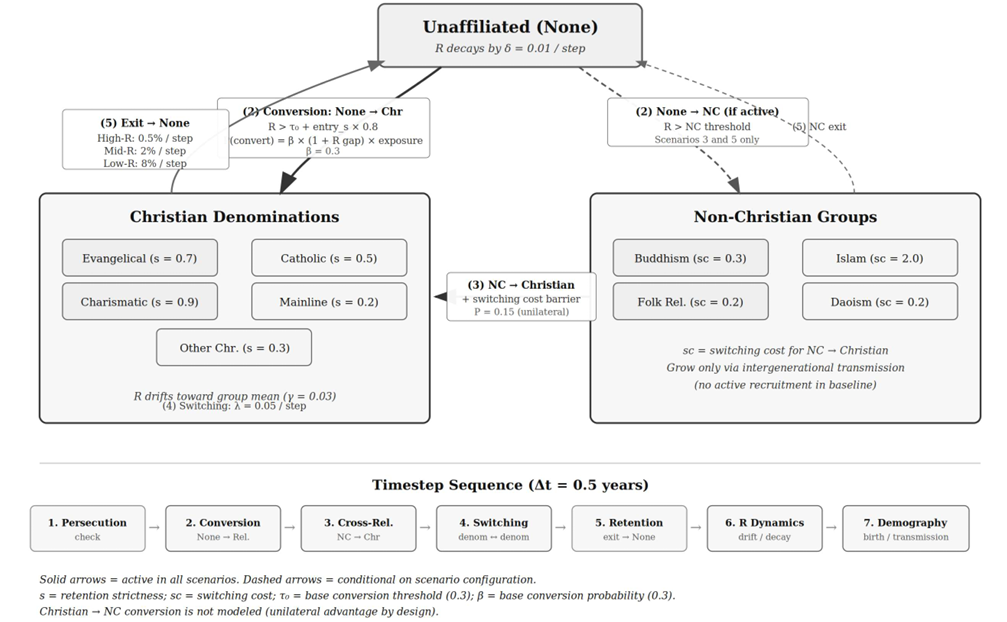
Each timestep executes seven processes in fixed order. (1) Persecution check: if the Christian share exceeds a threshold (5 percent of the population in regulated scenarios), suppression activates, reducing evangelism and modifying the \(R\) of committed and marginal Christians. (2) Conversion (None to religion): unaffiliated agents are exposed to each group in proportion to the share of their network neighbors belonging to it, weighted by that group’s evangelism, and convert if their \(R\) exceeds the group’s entry threshold, with probability scaling in the gap. (3) Cross-religion conversion (NC to Christian): NC members may convert through the same mechanism, subject to a switching-cost barrier; the reverse is not modeled. (4) Inter-denominational switching: Christians move between denominations as the fit between their \(R\) and a denomination’s strictness changes. (5) Retention: members exit to None with a probability set by their \(R\) category and their group’s retention strictness. (6) \(R\) dynamics: unaffiliated \(R\) decays (secular erosion), religious agents’ \(R\) drifts toward co-religionist means through social reinforcement, and under active suppression high-\(R\) Christians receive a solidarity boost while low-\(R\) Christians receive a deterrence penalty. (7) Demography: 2 percent of agents are replaced per timestep, with children inheriting religion probabilistically; after 2012 intergenerational transmission is reduced (20 percent in the baseline). Figure 1 below shows the flow. The complete step-by-step schedule, including the order in which agents are updated within each process, is enumerated in Section S2 of the online supplement so that the model can be replicated on other platforms.
Design concepts
(1) Basic principles. The model formalizes three bodies of theory: the supply-side, rational-choice account of religious markets, in which vigorous suppliers capture latent demand; the strict-church thesis, in which costly membership raises retention and commitment; and the secularization and cohort-replacement view, in which receptivity is finite and declines across generations. Receptivity \(R\) is the explicit representation of demand that the supply-side theory leaves unspecified. (2) Emergence. The aggregate Christian share and its denominational and commitment composition are not imposed but emerge from individual conversion, switching, retention, and demographic replacement. (3) Adaptation and objectives. Agents do not optimize over a planning horizon. They respond myopically to their current state and local environment, converting, switching, or exiting as their \(R\) compares to group thresholds, which represents bounded, preference-driven choice rather than foresight. (4) Sensing and interaction. Agents sense only the religious identities of their network neighbors, and interaction is local: exposure to a group rises with the share of an agent’s neighbors who belong to it. (5) Stochasticity. Conversion, switching, retention, and demographic replacement are probabilistic, and initial receptivity and network ties are drawn at random. Each condition is run for one hundred replications with different seeds, and results are reported as means with variability across runs. (6) Collectives. Denominations and NC groups are fixed collectives with shared attributes; the network is an emergent collective that re-forms as agents gain co-religionist ties and shed out-group ties on conversion. (7) Observation. At each step we record the share in each identity, the distribution of \(R\), the high, mid, and low \(R\) composition of Christians, and the proportion of Christians who entered by conversion rather than inheritance.
Details
The default population reflects China circa 1980: 0.5 percent Christian, split equally across the five denominations6; 32.5 percent non-Christian (Folk Religion 20 percent, Buddhism 8 percent, Daoism 3 percent, Islam 1.5 percent); and 67 percent unaffiliated.7 Receptivity is drawn from one of four distributions (below), and newly affiliated agents receive small \(R\) boosts scaled by group strictness. The model uses no empirical time series as input. The four receptivity distributions are theoretical archetypes, not estimates of the Chinese population, chosen to span the plausible space of assumptions about latent demand.
Submodels
The conversion, cross-religion conversion, switching, retention, \(R\)-dynamics, and demography submodels are specified in full in the supplement. Here we note the features that bear on the results. Only Christianity actively evangelizes in the baseline, so the conversion channel operates in its favor, and cross-religion conversion is unidirectional toward Christianity. NC switching costs follow the argument of Stark & Finke (2000) that the social cost of changing religion is high; Islam, for instance, has a high switching cost and near-complete transmission, reflecting the ethnic boundedness of Hui and Uyghur identity, while Folk Religion has no formal recruitment, blending with cultural tradition – a diffuse, transactional mode carrying a zero entry threshold in the model; correspondingly, the large unaffiliated pool is not secular but simply outside the congregational market. The one-directionality of cross-religion conversion likewise follows from this scope rather than from an assumption of Christian advantage: because folk religion and most lay Buddhism and Daoism supply transactional rather than congregational goods, there is no bundled package on the other side for a Christian to convert to; a Christian who returns to temple visiting has exited the congregational market, a flow the model captures as exit to None through retention. Islam, the one clearly congregational non-Christian supplier, is closed on ascriptive grounds, represented by its prohibitive switching cost and near-complete transmission; we bracket it rather than theorize it (see limitations). Where these simplifications err, they err in Christianity’s favor, and the active-competitor scenarios show the results are not sensitive to this scope condition. The network is built as a homophily-constrained random graph, not an Erdős-Rényi graph, with Christian agents at 50 percent co-religionist homophily and NC agents at 25 percent, reflecting the dense within-group ties documented for Chinese house churches (Cao 2010; Kang 2016). The tie count draws on the social-brain “sympathy group” of roughly twelve to fifteen close contacts (Bretherton & Dunbar 2020; Dunbar 1993; Gantley et al. 2022). The model also includes an optional suppression-triggered receptivity mechanism, the formal counterpart of the claim that regulation drives latent demand into gray and black markets: while suppression is active it raises the R of non-Christian agents. This mechanism is set to zero in all baseline scenarios and is exercised only in a dedicated robustness analysis, in a one-time form that the theory licenses and a continuous form that deliberately over-grants it (see Results).
Simulation experiments
We cross five competitive scenarios with four receptivity distributions, a five-by-four design of twenty conditions, each run for one hundred replications (Table 2). The scenarios range from a two-way contest between Christianity and the unaffiliated in a free market to a crowded, regulated market with active NC competitors. The four distributions are: Normal (mean zero, standard deviation one), a neutral population; Bimodal (modes at minus and plus 0.8), a polarized population; Right-skewed (a Beta distribution with shape parameters five and two, rescaled), a religiously favorable population that operationalizes the rational-choice premise that most people carry positive latent demand of the congregational type – in effect, the assumption that China’s transactional religiosity is already convertible into congregational commitment – and that gives the theory its best case; and Left-skewed (the mirror image), a secularized population. These distributions are archetypes spanning the space of demand assumptions, not empirical estimates.
| Scenario | Regulation | Extra Persecution (if triggered) |
|---|---|---|
| Christians and Nones (No regulation) | 0 | Never |
| Christians and 4 Passive NC (No regulation) | 0 | Never |
| Christians and 4 Active NC (No regulation) | 0 | Never |
| Christians and 4 Passive NC (state regulation) | 0.5 | 5 percent trigger |
| Christians and 4 Active NC (state regulation) | 0.5 | 5 percent trigger |
Note: NC = non-Christian. Regulation intensity = constant evangelism reduction for all groups (0.5 = 50 percent reduction). Persecution triggers when Christian share exceeds the threshold, adding further suppression.
The baseline grants Christianity advantages exceeding anything the theory describes in practice. It is the sole active recruiter from the unaffiliated pool, enjoys unilateral cross-religion conversion, and deploys the highest evangelism intensities; strict-church retention reduces its exit rates; the unregulated scenarios impose no state restriction; and the network gives Christian agents twice the homophily and twice the tie-rewiring benefit of NC groups. This design gives the theory’s mechanisms their best opportunity to generate sustained rapid growth, and whether they do is the question this study tests. To verify that the results are not artifacts of the baseline topology, we also examine a community-structured network with realistic clustering, a right-skewed degree distribution, and a degree-receptivity coupling, together with a complex-contagion rule under which adoption requires a critical mass of neighbors; these are robustness checks, and the homophily-constrained network remains the main specification.
Results
We first confirmed the model’s internal validity with seven boundary-condition tests, each with a known correct outcome: a population initialized entirely at \(R = -2\) drives Christianity extinct, one at \(R = +2\) drives it above 80 percent, zero evangelism produces zero conversions, full regulation halts evangelism, and demography conserves population size. All seven pass (details are in the online supplement, section S1). Because the model’s purpose is explanation rather than prediction, our validation below is pattern-oriented, asking whether the model reproduces the qualitative regularities of the Chinese case rather than forecasting a population figure.
Demand, not supply, governs the trajectory
Our central result is that the receptivity distribution, not the supply-side mechanisms, governs the trajectory of Christian growth. Figure 2 shows the Christian share across all twenty scenario-by-distribution conditions. Under the normal and bimodal distributions, Christianity never exceeds 3.7 percent of the population, even in the most favorable scenario, a free-market contest against the unaffiliated alone. Adding non-Christian competitors lowers the peak to between 1.4 and 2.0 percent, and adding regulation drives it below 1 percent. By 2080 the Christian share settles between 0.2 and 1.8 percent under the normal and bimodal distributions and reaches extinction under the left-skewed distribution within two decades regardless of competitive conditions.
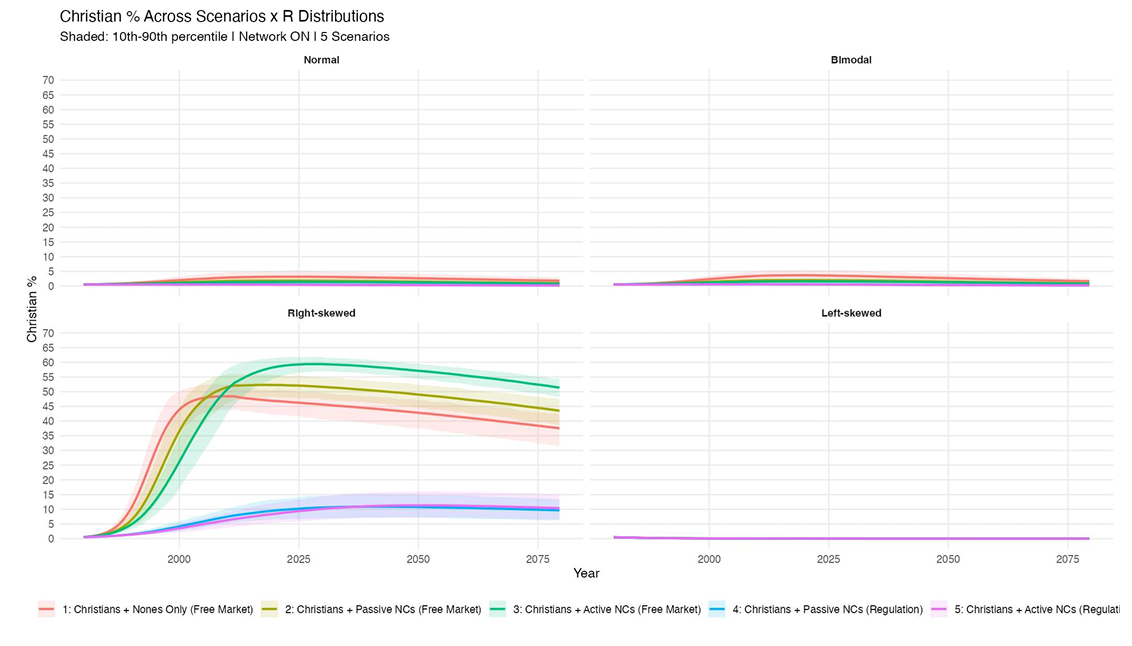
Only under the right-skewed distribution does Christianity grow substantially, peaking between 48 and 59 percent in the free market and about 11 percent under regulation. But this distribution builds in the conclusion: it assumes most agents begin with positive receptivity, a population already predisposed toward religion before any mechanism operates. The gap between a 3 percent and a 59 percent outcome is therefore set by how many people are available to convert, not by how vigorously Christianity is supplied. No amount of evangelism, strictness, or structural advantage compensates for a population that is not receptive.
Regulation always suppresses growth
Because the regulation question is the pivot of the dispute, we examine it directly. The claim under test is the productive-regulation thesis: that suppression and persecution drive growth by pushing demand into underground channels and purifying the church. In the model the net effect of regulation is consistently negative. Under the right-skewed distribution, the free market with passive non-Christian competitors peaks at 52.3 percent, while the otherwise identical regulated condition peaks at 10.9 percent, a reduction of about 80 percent (Figure 2, lower-left panel). Whatever solidarity persecution generates is bounded by the membership it removes.
The purifying effect is real but visible only in composition, not in size. Table 3 reports the receptivity and denominational composition of surviving Christians at 2080 under the right-skewed distribution. In the free market, Christians are a mixed population, roughly half high-receptivity and half mid, with mean \(R\) near 1.0, and Evangelicals hold 79 to 90 percent of the community. Under regulation the picture inverts: surviving Christians are almost entirely high-receptivity, mean \(R\) sits effectively at the ceiling (1.99), and Charismatics, the strictest profile, hold 97 to 99 percent, while Mainline, Catholic, and other denominations are eliminated. Regulation does not merely thin the church; it purges all but its strictest form. This confirms the selection logic of the strict-church and blood-of-martyrs accounts, but selection redistributes commitment within a shrinking population rather than enlarging it. Persecution purifies the church without growing it, and the pattern holds across distributions: under the normal distribution, regulated scenarios never reach even 1 percent.
| Christian % | High R % | Mid R % | Low R % | Mean R | Evangelical % | Charismatic % | |
|---|---|---|---|---|---|---|---|
| 1: Free, Nones only | 37.6 | 54.1 | 45.9 | 0.0 | 1.04 | 79.0 | 21.0 |
| 2: Free, Passive NC | 43.5 | 48.9 | 51.1 | 0.0 | 1.02 | 85.0 | 15.0 |
| 3: Free, Active NC | 51.4 | 44.2 | 55.8 | 0.0 | 1.00 | 89.4 | 10.6 |
| 4: Reg, Passive NC | 9.6 | 100.0 | 0.0 | 0.0 | 1.99 | 1.4 | 98.6 |
| 5: Reg, Active NC | 10.4 | 99.3 | 0.7 | 0.0 | 1.99 | 2.9 | 97.1 |
Note: \(R\) ranges from \(-2\) to \(2\). High-\(R\): \(R > 1.0\); Mid-\(R\): \(0 < R \leq 1.0\); Low-\(R\): \(R \leq 0\). Low-\(R\) Christians are absent in all scenarios. Mainline (Three-Self), Catholic, and other Christian denominations are effectively extinct (\(<0.1\%\)) in all five scenarios and are omitted from the table. Evangelical and Charismatic shares are within-Christian percentages at 2080. Evangelical retention strictness = 0.7; Charismatic retention strictness = 0.9.
Can a persecution-driven demand boost rescue growth?
The preceding test holds demand fixed under suppression. But the strongest form of the productive-regulation thesis claims that suppression itself raises demand, pushing the latent-religious toward the forbidden faith. We tested this directly by adding a mechanism that raises the receptivity of non-Christian agents while suppression is active, the formal counterpart of demand being driven into gray and black markets. Because suppression must be reachable for the mechanism to fire, these runs use Scenario 4 with the right-skewed distribution and lower the persecution threshold so that crackdown begins early.
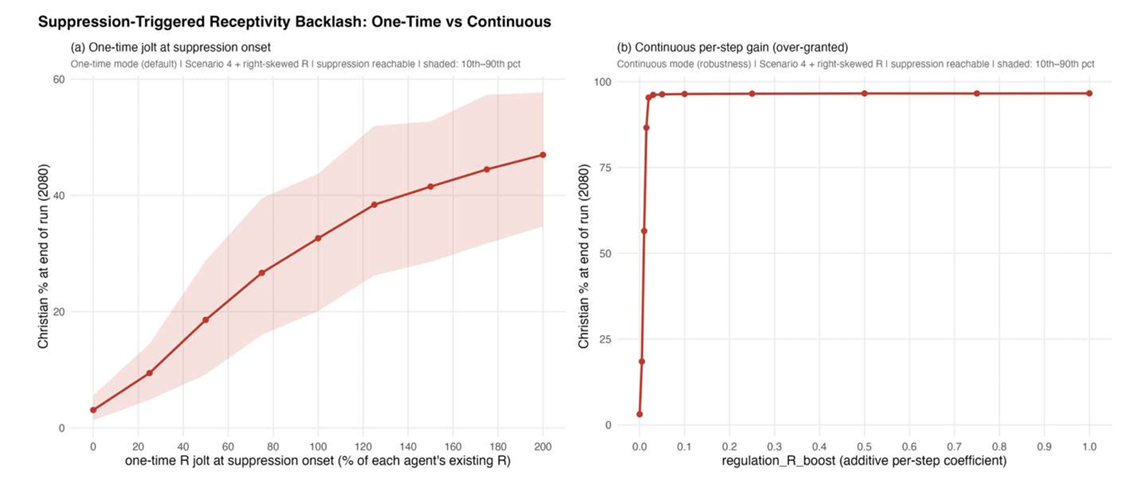
We model the mechanism in two forms. The one-time form is what the theory licenses: each crackdown delivers a single bounded jolt to non-Christian receptivity. Running Scenario 4 with the right-skewed distribution, and lowering the persecution threshold so that suppression is reachable, we sweep the jolt from none to an implausibly large 200%. The 2080 Christian share rises from 3.1 percent to at most 47.0 percent, the band in Figure 3 a showing the 10th to 90th percentile across replications. Even an extreme one-time boost leaves Christianity short of a majority, which closes the structural-sufficiency objection that some implementation of the persecution effect might sustain majority growth.
The continuous form, by contrast, adds to receptivity on every timestep suppression is active, so the effect compounds across the run. This variant does break the ceiling: the 2080 share is 18.4 percent at a per-step gain of 0.005 and 56.5 percent at 0.01, and it saturates near 96 percent above 0.03, behaving as a tipping switch rather than a graded dial (Figure 3 b). But it does so only by manufacturing demand without limit, raising receptivity into its upper bound year after year. That is an assumption neither Yang nor Stark and Wang advances, and it confirms rather than refutes our central point: the projected growth is recoverable only by building in inexhaustible demand creation.
The strict church effect is real but bounded
The strict-church thesis receives partial support. As Table 3 shows, strict denominations dominate Christianity’s internal market under both free and regulated conditions, and regulation sharpens this to the point of eliminating all but the strictest group. Selective retention, receptivity boosts at conversion, and social reinforcement remove marginal believers within the first decades regardless of environment. But the contrast is instructive: under free markets Christianity is large and moderately committed, under regulation small and maximally committed. Strictness intensifies commitment among those it recruits; it does not reach beyond the receptive pool. The thesis correctly predicts which denominations win the internal competition but cannot predict aggregate growth.
The intergenerational channel
The receptivity ceiling set by the distribution operates as a short-run constraint, while intergenerational transmission governs the long-run equilibrium. Varying the post-2012 secular cohort factor from no decline to an 80 percent reduction in transmission, under Scenario 4 with the right-skewed distribution, leaves early growth unchanged, with all levels converging near 8 to 10 percent by 2020 as the existing high-receptivity pool converts. The trajectories then diverge: with no secular decline Christianity peaks at 12.2 percent and holds near 12 percent to 2080, whereas under a 60 to 80 percent reduction, the range plausibly corresponding to China’s enforcement environment, the long-run share settles at 4.5 to 5.7 percent. Even with no transmission loss at all, the regulated share peaks at only just under a quarter of the free-market figure for the same distribution. The secular factor thus sets where within the demand ceiling the trajectory stabilizes; it does not create the ceiling.8
Pattern-level validation
Three comparisons anchor the validation (Table 4). Survey syntheses estimate the Christian share at 2 to 5 percent around 2020 (Hackett & Tong 2025), cohort analyses document stagnating or declining affiliation across birth cohorts (Zhou et al. 2024), and the broader-definition World Christian Encyclopedia gives roughly 7 percent as an upper bound (Johnson & Zurlo 2020). Under the regulated scenarios with right-skewed receptivity the model produces 8.5 to 9.6 percent in 2020, and about 0.5 percent under the normal distribution. The model also tracks the convert share, which starts near 100 percent and falls to about 57 percent by 2020, consistent with survey evidence that most Chinese Christians are first-generation converts.9
| Free, Christian + Nones (%) | Free, Christian + Passive NC (%) | Free, Christian + Active NC (%) | Regulated, Christian + Passive NC (%) | Regulated, Christian + Active NC (%) | Empirical Range | |
|---|---|---|---|---|---|---|
| Normal \(R\) | 3.2 | 1.8 | 1.4 | 0.5 | 0.4 | |
| Bimodal \(R\) | 3.6 | 2.0 | 1.6 | 0.6 | 0.5 | |
| Right-skewed \(R\) | 46.9 | 52.3 | 58.4 | 9.6 | 8.5 | |
| Left-skewed \(R\) | 0.0 | 0.0 | 0.0 | 0.0 | 0.0 | |
| Empirical Source | ||||||
| CGSS + CFPS | 2%–5% | |||||
| CFPS | 2% | |||||
| Johnson and Zurlo | 7% | |||||
Note: Model simulation values are mean Christian population share (%) at simulation year 2020 across 100 replications. Columns 4 and 5 (regulated) are the empirically relevant comparison for China. The empirical range of 2% to 7% is bracketed by the normal-\(R\) regulated output (about 0.5%) and the right-skewed-\(R\) regulated output (about 8.5% to 9.6%).
Robustness across parameters
We assessed robustness with one-at-a-time sensitivity analyses on more than twenty parameters; Table 5 summarizes the key results.10 Among the supply-side mechanisms, the solidarity boost shows a threshold effect, raising the final share from 7.0 to 9.6 percent as it rises from zero to 0.25 and flat thereafter, because surviving Christians already sit at the receptivity ceiling; the deterrence penalty has no detectable effect, since marginal Christians have already exited through retention; the base conversion probability has the largest supply-side effect, from 1.0 percent at 0.1 to 55.8 percent at 0.9, but its baseline of 0.3 is already generous relative to any empirical per-encounter rate; and reducing switching costs to zero raises the share only to 12.9 percent. The most consequential parameter relative to its plausible range is a demand-side one: the secular erosion rate of unaffiliated receptivity, which moves the outcome from 52.2 percent at zero to 1.5 percent at 0.03, a swing comparable to the largest supply-side effect but produced across a parameter range twenty-five times narrower. The supply-side theory has no answer to what this rate is, because it assumes demand is constant, which is equivalent to setting it to zero. Population size has no meaningful effect, and a mega-test that sets every adjustable parameter to its most Christianity-favorable value still leaves the receptivity distribution the dominant determinant of the outcome. Repeating the solidarity, conversion-probability, and switching-cost sweeps under the normal and bimodal distributions confirms that these results are not artifacts of conditioning on the favorable case: the persecution-linked mechanisms never engage because the Christian share never reaches the persecution trigger, switching costs are inert, and even a conversion probability of 0.9 lifts the 2080 share to at most 3.3 percent (online supplement).
The denomination-level parameters behave the same way. Varying the Charismatic profile directly, and compressing all five denominations’ strictness and evangelism profiles toward their common mean, leaves the composition result intact: even when the profiles retain only a quarter of their Table 1 differences, the strictest denomination still ends with 99.9 percent of surviving Christians, and when Charismatic retention is lowered to the Evangelical level the dominance simply transfers to Evangelicals. Which group survives follows the strictness ordering, not the particular values. The aggregate consequence is instructive: because the surviving church’s entry threshold sets the width of the conversion funnel, shifting survival to the easier-entry Evangelicals roughly doubles the regulated share, from 9.6 to about 18 percent, and the most favorable denominational configuration tested – easy entry combined with maximal retention: it reaches 22.6 percent, still far from a majority (full results in the online supplement).
| Parameter | Baseline | Range Tested | Final Christian % |
|---|---|---|---|
| Tier 1: Supply-side mechanisms | |||
| Solidarity boost | 0.5 | 0 to 2.0 | 7.0 to 9.6 |
| Deterrence penalty | \(-0.5\) | 0 to \(-1.5\) | 9.6 at all levels |
| Conversion probability (\(\beta\)) | 0.3 | 0.1 to 0.9 | 1.0 to 55.8 |
| Switching cost multiplier | \(1\times\) | \(0\times\) to \(2\times\) | 7.5 to 12.9 |
| Tier 2: Structural assumptions | |||
| \(R\) decay (\(\delta\)) | 0.01 | 0 to 0.03 | 1.5 to 52.2 |
| Evangelism intensity | \(1\times\) | \(0.5\times\) to \(3\times\) | 1.1 to 61.0 |
| Regulation intensity | 0.5 | 0.2 to 1.0 | 0.1 to 33.1 |
| Network degree (\(k\)) | 15 | 5 to 30 | 2.8 to 12.3 |
| Initial Christian share | 0.5% | 0.25% to 3% | 5.6 to 17.8 |
| Cross-conversion probability | 0.15 | 0.05 to 0.4 | 5.5 to 21.7 |
| Persecution impact (Christian) | 0.3 | 0.1 to 0.9 | 4.2 to 13.7 |
| \(R\) drift rate (\(\gamma\)) | 0.03 | 0 to 0.1 | 7.9 to 10.1 |
| Population size (\(N\)) | 5000 | 5,000 to 20,000 | 9.1 to 9.6 |
| Network homophily | 0.5 | 0.2 to 0.7 | 8.4 to 10.3 |
| Persecution threshold | 0.05 | 2% to 30% | 6.9 to 12.5 |
| Persecution impact (NC) | 0.1 | 0 to 0.5 | 9.6 at all levels |
Note: All results are under Scenario 4 (regulated, passive NC) with right-skewed \(R\) distribution, 100 replications per level. Final Christian % is the Christian population share at 2080. Full results for all parameters, including individual sensitivity plots, are reported in the online supplement.
Structural realism and global sensitivity
Two final checks address the concern that these results depend on the baseline network or on holding other parameters fixed. Re-running the regulated, right-skewed condition on progressively more realistic topologies, ending in a community-structured network with realistic clustering, a right-skewed degree distribution, and a degree-receptivity coupling, raises the ceiling under simple contagion from 9.6 percent to 18.9 percent: added realism roughly doubles the ceiling but does not approach a majority, and the community result is highly variable across replications. Under a complex-contagion rule, where adoption requires a critical mass of neighbors rather than a single contact, the ceiling falls to 3 to 5 percent, below the baseline. Across all topologies and adoption rules the regulated ceiling ranges from single digits to about 19 percent and never approaches majority status. Finally, a global sensitivity analysis jointly perturbing twelve parameters by Latin hypercube sampling returns the same ordering as the one-at-a-time tests: the mean of the receptivity distribution dominates, with a partial rank correlation of 0.98 and a total-order Sobol index of 0.84, virtually all of it a main effect rather than an interaction. The largest supply-side share is five times smaller (evangelism intensity, total-order index 0.16, mostly interaction with demand rather than main effect), and no network parameter reaches a variance share above 0.02. The one network parameter reliably different from zero, the degree-receptivity coupling (partial rank correlation of 0.43), governs where receptivity sits in the network and is thus itself a demand parameter. The ceiling therefore cannot be attributed to any configuration of supply-side or structural settings; it survives joint perturbation of every mechanism the theory specifies.
Discussion
This study asked a single, structural question: can the supply-side theory of religion, when its mechanisms are formalized and granted every advantage, generate the sustained Christian growth its proponents project for China? The question matters beyond the academia. Some news and commentary still cite the projection of China being the largest Christian nation by around 2030, and the survey-based findings that challenge it remain largely confined to scholarly venues. When an unresolved dispute is taken up selectively in public, projections circulate well ahead of the evidence, which is part of what makes formal testing timely.
The results point consistently in one direction: the supply-side mechanisms are real but bounded by the demand they assume. Reaching the 48 to 59 percent peaks the model can produce requires that most of the population already carry positive latent demand before any evangelism occurs. That is a claim about the demand side, not a result that follows from supply-side logic, and its proponents would need to defend it explicitly rather than treat demand as universally constant, which is what the framework asserts.
One possible objection deserves a direct answer that some basic feature of our implementation, rather than the theory itself, caps growth, so that a different formalization would have succeeded where ours did not. Three features of the analysis speak against this. First, the ceiling is not the product of a particular parameter setting. Across the parameter sensitivity analysis and a mega-test that sets every adjustable mechanism to its most favorable value at once, the receptivity distribution remains the dominant determinant of the outcome. Second, the global sensitivity analysis shows the demand signal dominating as a main effect, with a partial rank correlation of 0.98 and a total-order variance share of 0.84 with negligible interaction, so the ceiling cannot be hidden in some untried combination of supply-side settings. Third, where added realism could plausibly have lifted the ceiling, through richer network structure, we tested it, and it did not approach a majority. The one configuration that does break the ceiling is the over-granted continuous persecution boost, which lifts growth only by manufacturing demand without limit. The pattern is therefore what follows whenever demand is allowed to vary, and it is overcome only by an assumption the theory does not license. We cannot prove that no formalization could escape it, but we have shown that escape requires building in the very thing at issue, abundant latent demand.
The simulation also speaks directly to the parallel between contemporary China and the late Roman Empire (F. Yang 2016b). The claim is that persecution paradoxically drives growth by purifying the church, hardening its survivors, and somehow shifting or boosting religious demand of the general population. Our model implements both channels, a solidarity boost for high-receptivity Christians and a deterrence penalty for the marginal, and the net effect is always negative. The historical parallel is in any case contested: historians broadly hold that Christianity reached majority status in Rome only after Constantine’s imperial patronage, not through persecution alone. China is not the new Rome, not because the commitment of Chinese Christians is in doubt, but because the condition that actually produced Roman Christianization, a state church, has never operated in China as the analogy requires.
The regulated dynamics of the model also match how evangelization actually operates under restriction. Ethnographies of unregistered churches describe diffusion through kinship, friendship, and workplace ties, small study groups, mutual aid, and healing prayer rather than through publicly visible missionary institutions, with congregations subdividing and localizing as regulation tightened after 2012 (Cao 2010; Sun 2017; Yang 2005). This is the world the model’s regulated scenarios describe: conversion flows only through personal networks. And because relational evangelism may partly evade enforcement, the sensitivity analysis sweeps regulation intensity to as low as 0.2. No level of enforcement within the sweep changes the qualitative outcome.
The strict-church thesis, by contrast, receives a solid but still partial support. The supply-side theory tells us who wins among existing consumers; it is silent on how many consumers exist. Our findings suggest that the explosive early growth is a transient phase, the one-time absorption of the existing high-receptivity pool, rather than a sustainable trajectory. In this the model formalizes the account in Yang’s own earlier work (Yang 2005), where the reform-era surge reflects the absorption of a finite, historically specific audience rather than an open-ended climb.
Our composition result also connects to the club-goods account of religious extremism. Iannaccone & Berman (2006) and Makowsky (2012) show that strict groups thrive where they can substitute club goods for public goods the state fails, or declines, to provide. Regulation that suppresses organized religion without addressing the demand for those goods thus selects for precisely the strictest, most self-contained organizational forms. Our simulation reproduces this logic endogenously: under regulation the surviving church is not merely smaller but maximally strict, with Charismatics holding 97 to 99 percent of a shrunken market (Table 3). The environment most supportive of strict religious groups, on this reading, is a highly regulated market with limited substitutes for the club goods such groups provide—although in our results this composition effect never translates into aggregate growth. It is telling that the form the model leaves standing is the charismatic one: the ethnographic record of Chinese Christianity under pressure describes precisely such indigenous, Pentecostal-inflected communities (Lian 2010), not the white-Protestant congregationalism from which the projections’ imagery derives.
Taken together, the results align more closely with the survey-based scholarship and with Yang’s earlier position than with the high projections. The simulation offers independent computational evidence that a plateau of 2 to 5 percent need not be an artifact of underreporting or respondent fear. It is also what the supply-side theory’s own mechanisms predict when they operate on a population with finite and declining demand under state regulation. This reframes what a higher projection would require: an additional mechanism, beyond those formalized here, capable of generating sustained growth that the theory’s core logic does not supply. Concretely, any account predicting continued growth must specify where new Christians come from once missionary work is heavily regulated, intergenerational transmission is declining, and the existing receptive pool has largely been absorbed. We have given the theory its most favorable possible test, and the invitation is genuine: any alternative formalization that can generate sustained rapid growth from the theory’s own mechanisms under empirically plausible conditions would be real theoretical progress, whether it supports or challenges what we report.
The stakes extend beyond the size of China’s Christian population. The general result is about how diffusion works when demand is heterogeneous: supply-side mechanisms, competition, strictness, organizational vigor, and even the productive effects of regulation, can sort and intensify existing demand, but they cannot create it, and the distribution of latent demand sets a ceiling that no configuration of supply reaches past. Stated in the terms introduced above: competition, strictness, and organizational vigor efficiently absorb whatever congregational demand exists; they cannot transmute transactional demand into congregational commitment—and it is congregational commitment, not religious practice in general, that the projections require. China is a particularly sharp demonstration because the supply-side projections were made there most explicitly, but the lesson generalizes to any account that explains the spread of a belief or practice by the vigor of its promoters while treating receptivity as constant. Where demand is heterogeneous and partly fixed, the supply side governs who adopts and how committed they become, not how many. For the sociology of religion specifically, this locates the live empirical question precisely: not how vigorously religion is supplied, but how the distribution of religious demand is formed and how it shifts across cohorts. That is the quantity the supply-side framework leaves unspecified, and the one our results identify as decisive.
Limitations and future directions
The model has several limitations. Receptivity is exogenously distributed and relatively stable. In reality demand may respond to historical shocks, and a model that endogenizes how receptivity forms could test whether such shocks lift the ceiling. The model does not represent organizational innovation or the emergence of new religious movements, though it already grants Christianity maximal evangelism and the most favorable competitive structure. The secular cohort factor conflates state restriction of religious socialization with broader secularization, and future work could separate the two channels. Cross-religion conversion is one-directional toward Christianity by scope: exit to transactional practice is modeled as exit to None, and what the model genuinely cannot represent is a state-permitted congregational revival within Buddhism or the redemptive societies. The model also operates nationally, so it cannot capture the regional or ethnic dynamics that may produce locally rapid growth. The five denominational categories impose Western typologies on an institutionally fluid Chinese Christianity, although the results depend on variation in strictness rather than on the labels themselves.
Islam is a deliberate limitation of this study. It appears in the model only as a closed population: ascriptively bounded, transmitting membership across generations at a near-complete rate, recruiting no one, and—through a prohibitive switching cost—losing effectively no one. We do not analyze it further, and the choice is intentional. The supply-side literature whose claims we test makes no growth projections about Chinese Islam and treats the Islamic market as segmented from the religious market of the Han majority; our scope inherits that boundary rather than correcting it. The unexamined counterfactual is worth naming: Islam carries the strictest profile of any supplier in the model, and on the theory’s own strict-church logic, an Islam permitted to compete freely for the unaffiliated would be a formidable congregational rival. What the Chinese religious market would look like under free Islamic competition is an open question the released code can address without modification, by activating Islamic recruitment in the scenario parameters; we leave it to future work.
The network omits long-range weak ties such as digital evangelism. This is a deliberate boundary choice rather than an oversight, and its direction favors the theory. Weak ties are not part of the supply-side mechanisms, so omitting them removes no claim the theory makes, and their likely effect runs against it: conversion is plausibly a complex contagion requiring reinforcement from several committed contacts, and complex contagions spread poorly across the long, weak ties that carry simple ones (Centola & Macy 2007). Adding weak ties would therefore tend to lower the ceiling, consistent with our complex-contagion result, where the regulated ceiling falls below the baseline once adoption requires a critical mass of neighbors. Digital evangelism follows the same logic: it can broaden exposure but cannot create the latent receptivity the model identifies as the binding constraint. Excluding both is thus the conservative choice. Separately, the receptivity drift rate produces only modest variation in outcomes, confirming that the ceiling is not an artifact of the social-reinforcement mechanism.
Supply-side theorists might object that their framework was never meant for specific population forecasts. That is reasonable in general, but Yang (2016a) and Stark & Wang (2015) made quantitative predictions, and the model evaluates whether the theory’s mechanisms can produce them. Extension to other high-regulation settings would test generalizability. The sensitivity analyses spanning more than twenty parameters, the mega-test, and the publicly available model address concerns about unexplored parameter combinations. Despite these limits, the central finding is robust: the supply-side mechanisms are real but bounded by the distribution of religious demand, and the theory’s verbal predictions outrun what its formalized logic can support.
Model Documentation
The model is implemented in R (version 4.6.1) and depends only on the dplyr, tidyr, and ggplot2 packages. The complete source code, the ODD protocol document, and the master script that regenerates every result, table, and figure in this article (batch_run_whole_codes.R) are available in our OSF repository (https://osf.io/cjnk6/overview?view_only=241c2ec63bdb4042aa0c7353411a9483). The repository includes the seven boundary-condition verification tests (verification.R), which can be run independently of the main analysis, together with the saved results objects, summary tables, and figures for all reported analyses. All analyses use 100 replications per condition with fixed random seeds, so every number reported in this article can be reproduced exactly.
Appendix
The supporting information file accompanying the article can be accessed by clicking here.Notes
- It is worth noting that in a recent interview with the Center for Christian Virtue, Yang delivered a somewhat mixed message. While he conceded that Christians in China may currently account for a relatively modest share of the population (“I am thinking Christians in China maybe around 5 to 7 percent”), he nonetheless maintained his long-standing prediction that “China will become the largest Christian nation very soon, and that very soon can be one decade or three decades” (Yang 2026).↩︎
- Although Catholic missionaries had been present in China since the late Ming dynasty, Protestant missions began only in 1807, with Robert Morrison’s arrival. During most of the Qing dynasty, missionary work was tightly restricted. Catholic missions faced legal suppression after 1724, while early Protestant activity was largely limited to Macao and Guangzhou. Before the late Qing expansion, most Catholic communities were found in a few coastal and treaty-port areas, with some older Catholic communities in the interior. Christianity therefore remained small and grew slowly during this period (Yang 1967).↩︎
- The most relevant and recent discussion I found are two: Klein (2011) and Yan et al. (2025). But both focus on how western missionaries convert Chinese who believed in folk religions before 1949.↩︎
- Yang’s widely circulated claims of 160 million by 2025 derive from a 2014 press interview (Keck 2014) rather than the peer-reviewed address, a distinction worth preserving since the two are often conflated.↩︎
- At the end of the 2005 article, Yang himself judged confident predictions of a Christian majority “presumptuous” given the limited channels of evangelism and religious education after the Mao era. While his later writing extrapolates from recent trends in a more open-ended way, even as it continues to cite the 2005 study.↩︎
- We use mainline protestant and Three-Self protestant interchangeably in this paper for convenience. Unlike north American mainline Protestantism, which denotes a theological-cultural tradition, the Three-Self Protestantism is a state-administered body that all registered Protestant congregations in China are required to join. It is treated here as “mainline” in the sense of state-approved and institutionally regulated, not in the doctrinal sense familiar to north American and broader western audiences. Evangelical or charismatic congregations that are actively proselytizing in China typically operate outside the TSPM in unregistered house churches.↩︎
- No nationally representative survey of religious affiliation exists for China circa 1980. Christianity and Islam estimates draw on government figures and statistics (MacInnis 1989), respectively. However, the 1982 governmental data is flawed as well: it does not provide a specific denominational breakdown, especially when it comes to Protestant Christianity. Therefore, following the uninformative prior principle in Bayesian reasoning (Gelman et al. 1995), I assume an equal split across five Christian denominations: Evangelical protestant, Charismatic protestant, Mainline (Three-Self) protestant, Catholic, and other Christian, each constituting one-fifth of the Christian population. Buddhism, Folk Religion, and Daoism shares are arbitrarily estimated by a linear back-projecting from the Chinese General Social Survey (2006–2011) and the China Family Panel Studies (2012–2016), adjusted downward to reflect post-Cultural Revolution institutional destruction. Model results are not sensitive to the precise NC breakdown, as all NC groups function as passive competitors; the critical parameters are the Christian starting share and the R distribution.↩︎
- Full trajectories for all five levels are in the online supplement (Figure S2).↩︎
- Full trajectory is in the online supplement (Figure S3).↩︎
- The full dose-response curves, including the Tier 1 four-panel display, are in the online supplement (Figure S4).↩︎
References
BENDER, C. (2013). Religion on the Edge: De-Centering and Re-Centering the Sociology of Religion. Oxford University Press.
BRAUNSTEIN, R., Kucinskas, J., Steensland, B., & Winchester, D. (2026). Religion unbundled: Toward a twenty-first-century paradigm for the sociology of American religion. American Sociological Review, 91(4), 623–650. [doi:10.1177/00031224261453543]
BRETHERTON, R., & Dunbar, R. (2020). Dunbar’s number goes to church: The social brain hypothesis as a third strand in the study of Church growth. Archive for the Psychology of Religion, 42(1), 63–76. [doi:10.1177/0084672420906215]
CAO, N. (2010). Constructing China’s Jerusalem: Christians, Power, and Place in Contemporary Wenzhou. Stanford University Press.
CARVALHO, J.-P., Iyer, S., & Rubin, J. (2019). Advances in the Economics of Religion. Cham: Springer.
CENTOLA, D., & Macy, M. (2007). Complex contagions and the weakness of long ties. American Journal of Sociology, 113(3), 702–734. [doi:10.1086/521848]
CHATTOE, E. (2006). Using simulation to develop testable functionalist explanations: A case study of church survival. The British Journal of Sociology, 57(3), 379–397. [doi:10.1111/j.1468-4446.2006.00116.x]
CHAVES, M. (1994). Secularization as declining religious authority. Social Forces, 72(3), 749–774. [doi:10.2307/2579779]
COOK, S. (2017). The Battle for China’s Spirit: Religious Revival, Repression, and Resistance under Xi Jinping. Bloomsbury Publishing PLC.
DUNBAR, R. I. M. (1993). Coevolution of neocortical size, group size and language in humans. Behavioral and Brain Sciences, 16(4), 681–694. [doi:10.1017/s0140525x00032325]
EDMONDS, B., Le Page, C., Bithell, M., Chattoe-Brown, E., Grimm, V., Meyer, R., Montañola-Sales, C., Ormerod, P., Root, H., & Squazzoni, F. (2019). Different modelling purposes. Journal of Artificial Societies and Social Simulation, 22(3), 6. [doi:10.18564/jasss.3993]
EPSTEIN, J. M. (2012). Generative Social Science: Studies in Agent-Based Computational Modeling. Princeton University Press.
FAN, J., Friedman, D., Gair, J., Iyer, S., Redlicki, B., & Velu, C. (2021). A simulation study of how religious fundamentalism takes root. Journal of Economic Behavior & Organization, 192, 465–481. [doi:10.1016/j.jebo.2021.10.017]
FRANCIS-TAN, A. (2023). Economy of shadows: The effects of restrictive regulation on religiosity in China. Journal for the Scientific Study of Religion, 62(3), 624–647.
FROESE, P. (2008). The Plot to Kill God: Findings from the Soviet Experiment in Secularization. University of California Press. [doi:10.1525/9780520942738]
GANTLEY, M. J., McKeown, J. P., & Jiménez, Á. V. (2022). Dunbar’s number and the stability of religious social networks. In Y. Lior & J. Lane (Eds.), The Routledge Handbook of Evolutionary Approaches to Religion (p. 111). Routledge. [doi:10.4324/b23047-11]
GELMAN, A., Carlin, J. B., Stern, H. S., & Rubin, D. B. (1995). Bayesian Data Analysis. Chapman and Hall/CRC.
GORE, R., Lemos, C., Shults, F. L., & Wildman, W. J. (2018). Forecasting changes in religiosity and existential security with an agent-based model. Journal of Artificial Societies and Social Simulation, 21(1), 4. [doi:10.18564/jasss.3596]
GRIMM, V. (2020). The ODD protocol: An update with guidance to support wider and more consistent use. Ecological Modelling, 428, 109105. [doi:10.1016/j.ecolmodel.2020.109105]
HACKETT, C. (2023). China’s Christian population appears to have stopped growing after rising rapidly in the 1980s and ’90s. Pew Research Center, 12 December 2023: https://www.pewresearch.org/short-reads/2023/12/12/chinas-christian-population-appears-to-have-stopped-growing-after-rising-rapidly-in-the-1980s-and-90s/.
HACKETT, C., & Tong, Y. (2025). The growth of Christianity in China may have come to an end. Socius, 11, 23780231241310469. [doi:10.1177/23780231241310469]
IANNACCONE, L. R. (1994). Why strict churches are strong. American Journal of Sociology, 99(5), 1180–1211. [doi:10.1086/230409]
IANNACCONE, L. R. (1995). Risk, rationality, and religious portfolios. Economic Inquiry, 33(2), 285–295. [doi:10.1111/j.1465-7295.1995.tb01863.x]
IANNACCONE, L. R., & Berman, E. (2006). Religious extremism: The good, the bad, and the deadly. Public Choice, 128(1), 109–129. [doi:10.1007/s11127-006-9047-7]
IANNACCONE, L. R., & Makowsky, M. D. (2007). Accidental atheists? Agent-based explanations for the persistence of religious regionalism. Journal for the Scientific Study of Religion, 46(1), 1–16. [doi:10.1111/j.1468-5906.2007.00337.x]
JOHNSON, T. M., & Zurlo, G. A. (2020). World Christian Encyclopedia. Edinburgh University Press.
KANG, J. (2016). House Church Christianity in China: From Rural Preachers to City Pastors. Cham: Springer. [doi:10.1007/978-3-319-30490-8]
KECK, Z. (2014). Is Communist China Christianity’s future?
KLEIN, T. (2011). Conversion to Protestant Christianity in China and the “supply-side model”: Explaining changes in the Chinese religious field. Religion, 41(4), 595–625. [doi:10.1080/0048721x.2011.624694]
LIAN, X. (2010). Redeemed by Fire: The Rise of Popular Christianity in Modern China. Yale University Press. [doi:10.12987/yale/9780300123395.001.0001]
MACINNIS, D. E. (1989). Religion in China Today: Policy and Practice. Orbis Books.
MAKOWSKY, M. D. (2011). A theory of liberal churches. Mathematical Social Sciences, 61(1), 41–51. [doi:10.1016/j.mathsocsci.2010.10.001]
MAKOWSKY, M. D. (2012). Emergent extremism in a multi-agent model of religious clubs. Economic Inquiry, 50(2), 327–347. [doi:10.1111/j.1465-7295.2009.00262.x]
MAKOWSKY, M. D. (2019). When average is irrelevant: Computational modeling of religious groups. In Advances in the Economics of Religion (pp. 61–72). Cham: Springer. [doi:10.1007/978-3-319-98848-1_4]
NATIONAL Bureau of Statistics of China. (2021). Main data of the seventh national population census.
ONG, I. (2023). Have China’s Christians peaked? Pew researches the data debate.
PEW Research Center. (2023). Measuring religion in China: Many Chinese adults practice religion or hold religious beliefs, but only 1 in 10 formally identify with a religion.
PUGA-GONZALEZ, I., LeRon Shults, F., Gore, R., & Talmont-Kaminski, K. (2025). The rise and fall of religion: An agent-based model of secularisation, security and prosociality. PLoS One, 20(11), e0327674. [doi:10.1371/journal.pone.0327674]
STARK, R., & Finke, R. (2000). Acts of Faith: Explaining the Human Side of Religion. University of California Press. [doi:10.1525/9780520924345]
STARK, R., & Wang, X. (2015). A Star in the East: The Rise of Christianity in China. Templeton Foundation Press.
STOLZ, J., Lipps, O., Voas, D., & Antonietti, J.-P. (2024). Can we explain the generation gap in churchgoing? Journal for the Scientific Study of Religion, 63(4), 809–829.
SUN, Y. (2017). The rise of Protestantism in Post-Mao China: State and religion in historical perspective. American Journal of Sociology, 122(6), 1664–1725. [doi:10.1086/691718]
VOAS, D., & Chaves, M. (2016). Religion is in decline in the West, and America is no exception.
WILDMAN, W. J., Shults, F. L., Diallo, S. Y., Gore, R., & Lane, J. (2020). Post-supernatural cultures: There and back again. Secularism and Nonreligion, 9. [doi:10.5334/snr.121]
YAN, J., Wang, Z., & Ge, Y. (2025). Missionaries and modernization in China: Navigating cultural conflict and historical legacy. Humanities and Social Sciences Communications, 12(1), 1164. [doi:10.1057/s41599-025-05554-9]
YANG, C. K. (1967). Religion in Chinese Society: A Study of Contemporary Social Functions of Religion and Some of Their Historical Factors. University of California Press. [doi:10.2307/jj.8501504]
YANG, F. (2005). Lost in the market, saved at McDonald’s: Conversion to Christianity in Urban China. Journal for the Scientific Study of Religion, 44(4), 423–441. [doi:10.1111/j.1468-5906.2005.00295.x]
YANG, F. (2006). The red, black, and gray markets of religion in China. The Sociological Quarterly, 47(1), 93–122. [doi:10.1111/j.1533-8525.2006.00039.x]
YANG, F. (2010). Religion in China under Communism: A Shortage Economy Explanation. Journal of Church and State, 52(1), 3–33. [doi:10.1093/jcs/csp042]
YANG, F. (2016a). Exceptionalism or Chinamerica: Measuring religious change in the globalizing world today. Journal for the Scientific Study of Religion, 55(1), 7–22. [doi:10.1111/jssr.12253]
YANG, F. (2016b). The growth and dynamism of Chinese Christianity. In A. D. Hertzke & T. S. Shah (Eds.), Christianity and Freedom; Volume 2: Contemporary Perspectives (pp. 161–190). Cambridge University Press. [doi:10.1017/cbo9781316408643.007]
YANG, F. (2018). The cross of Chinese Christians and their resistance to suppression. Review of Religion and Chinese Society, 5(1), 1-4
YANG, F. (2026). The rise of Christianity in China with Dr. Fenggang Yang.
ZHOU, D., Lai, X., & Li, L. (2024). Changing religious affiliation in the Chinese Mainland: A cohort perspective. Review of Religious Research, 66(4), 486–511. [doi:10.1177/0034673x241256659]