When Contact Backfires and When It Does Not: A Computational Model of the Opinion Dynamics of Intergroup Attitudes

,
and
aUniversity of Groningen, Netherlands; bArriva Nederland, Netherlands
Journal of Artificial
Societies and Social Simulation 29 (4) 4
<https://www.jasss.org/29/4/4.html>
DOI: 10.18564/jasss.6172
Received: 30-Jul-2025 Accepted: 31-Jul-2026 Published: 31-Oct-2026
Abstract
Concerns about affective polarization have renewed interest in intergroup contact as a means to improve outgroup attitudes. However, contact is only one factor in a broader set of interconnected processes during social interactions. We present a computational agent-based model of intergroup attitude dynamics, incorporating both the effects of interpersonal intergroup contact and social influence by ingroup peers, accounting for changing relationships. We use the model to explore potential threats to positive outcomes of intergroup contact, such as entrenched xenophobia, common in protracted conflicts. Simulations imply that, while intergroup interactions can improve outgroup attitudes, they may also exacerbate affective polarization. Paradoxically, deeply entrenched xenophobia and strong contributions of outgroup attitudes to overall bias can attenuate polarization by reducing negative interactions or causing internal splits within groups. These findings highlight the complex interplay between contact, social influence, and network dynamics in shaping intergroup attitudes in conflict settings.Introduction
Recent research and public debate on political and societal polarization increasingly focus on affective polarization, a process in which subgroups within a population develop negative feelings towards each other (Iyengar et al. 2019). Affective polarization can deepen mutual distrust, worsening disagreements and conflicts of interest between and within groups (Harel et al. 2024; Rekker & Harteveld 2024). Studies indicate that affective polarization between political camps is more pronounced and consistent (Gentzkow 2016) than opinion polarization on specific political or societal issues (Bramson et al. 2016; Gidron et al. 2023).
Scholars of affective polarization have recently become interested in intergroup contact as a possible remedy (Iyengar et al. 2019). The core idea of intergroup contact theory is that when members of different groups enter positive interpersonal interactions, people generalize these experiences to less prejudice about the outgroup as a whole (Allport 1954; Boin et al. 2021; Pettigrew 2021; Pettigrew & Tropp 2006; Stark et al. 2013). This powerful idea has been supported and refined by a broad range of scientific studies and brought forth intervention programs that help improve intergroup attitudes in various contexts, including those with significant intergroup tensions (Al Ramiah et al. 2014; Beelmann & Heinemann 2014; Lemmer & Wagner 2015).
However, from recent empirical research we know that other processes occurring in real-life interpersonal interactions can interfere with intergroup contact. Less straightforward results are observed when positive and negative contact co-occur (Arnadóttir et al. 2018; Laurence & Bentley 2018). Further, ingroup members exert social influence on their peers’ outgroup attitudes (Abrams & Hogg 1990; Tajfel 1982), potentially undermining the positive effects of intergroup contact (Bracegirdle et al. 2022; Khuu et al. 2023). Crucially, interpersonal relations in which intergroup contact happens are themselves subject to change, where cross-group relations could be especially vulnerable due to ingroup homophily, a preference for interactions with similar others (McPherson et al. 2001).
To theorize whether intergroup contact can explain the emergence of, or mitigate, affective polarization when interacting with these interrelated processes, we aim to simulate how affective polarization arises from the “bottom up”, that is, from the complex dynamics of multiple individuals interacting simultaneously. There have been hitherto few attempts in contact theory research to view interpersonal intergroup interactions as one of many building blocks of emerging macro patterns (but see Heinke et al. 2013; Aguiar & Parravano 2015; Chiang 2021; Urselmans & Phelps 2018). Computational agent-based models of opinion dynamics are a powerful theoretical tool to do just that (Flache et al. 2017; Sobkowicz 2009), showing in particular how opinion polarization or mutually negative outgroup attitudes can arise from elementary processes of social influence without anyone striving for these outcomes (Baldassarri & Bearman 2007; Baumann et al. 2020; Dandekar et al. 2013; Flache 2018; Flache & Macy 2011; Macy et al. 2021; Mäs & Flache 2013).
At the same time, existing agent-based models of opinion dynamics are not well connected to the intergroup contact literature. Several models explore opinion dynamics in multigroup settings, incorporating intergroup bias – a tendency to evaluate the ingroup more favorably than outgroups (e.g., Feliciani et al. 2017, 2023; Mäs et al. 2013). However, most of these models assume that such bias is “hardwired”, having constant influence on who is preferred as interaction partner and how negative outgroup interactions are perceived. A frequent outcome of these studies is polarization along the lines of salient group boundaries. However, if intergroup bias can be “unlearned”, as proposed by intergroup contact theory, the potential for reducing affective polarization and hostility may be greater than these models suggest (see, e.g., Bhavnani & Miodownik 2009).
In this study, we aim to bridge the gap between intergroup contact theory and agent-based modelling of opinion dynamics by developing and analyzing a computational model of intergroup attitude change between two groups. Our model combines interpersonal contact and four additional dynamics: influence from the ingroup, changing interpersonal relations, changing ingroup attitudes, and impact of negative contact. We further contribute to contact theory by investigating which macro-patterns of intergroup attitudes, including affective polarization, arise through interpersonal intergroup encounters under different theoretical assumptions and exogenous conditions. Our results indicate that, while the positive effects of intergroup contact can remain surprisingly resilient under adverse conditions, intergroup contact can also backfire and intensify affective polarization under other circumstances.
The section Theoretical framework covers the theoretical foundation of our model, formulates specific research questions for computational experiments, and outlines our modeling framework. The section Model details the formal model, while the section Results presents the results of the computational experiments. In Discussion and conclusion, we discuss the new insights, limitations, and future perspectives arising from this study.
Theoretical Framework
Micro-level processes
Individuals’ attitudes towards groups are affected not only by outgroup contacts, but also by social influence among ingroup peers, a process sometimes called socialization (Bracegirdle et al. 2022; Rivas-Drake et al. 2018; van Zalk et al. 2013; Zingora, Stark, & Flache 2020; Zingora & Flache 2026). This poses a challenge to intergroup contact theory. People typically have an intergroup bias, a tendency to favor their ingroup over outgroups (Hewstone et al. 2002). As a result, ingroup influence promoting less favorable attitudes toward the outgroup may counteract the positive effects of outgroup contacts.
Further, social contexts differ in the availability of opportunities to seek or avoid interaction with in- or outgroups. Factors such as residential or school segregation (Hewstone et al. 2018; Schlueter et al. 2018), organizational structures, and occupational mixing (McDonald et al. 2009) can determine whether intergroup contact can occur at all or could be avoided. When given the choice, people often exhibit homophily (McPherson et al. 2001) – a tendency to favor interactions with members of the ingroup (Leszczensky & Pink 2019; Rivas-Drake et al. 2018) – and limit contact with outside groups when possible (Paolini et al. 2018). Therefore, cross-group social relations may gradually dissolve due to homophily and outgroup avoidance.
Both ingroup socialization and selection of interaction partners could also work the other way. Research on indirect and extended contact (Munniksma et al. 2013; Wright et al. 1997; Zhou et al. 2019) has shown that individuals’ attitudes can be affected by hearing about positive contact experiences of ingroup peers, even if they did not have such experiences of their own. Similarly, positive intergroup contact experiences can strengthen the inclination to engage in further intergroup contact (Paolini et al. 2018). In short, ingroup influence and changing interpersonal relations can both foster and undermine positive effects of intergroup contact.
Our model further accounts for the changing of ingroup attitudes in addition to outgroup attitudes, because attitudes towards the ingroup interact with processes shaping attitudes towards outgroups. Ingroup interactions can reinforce identification with the ingroup and intergroup bias (Petersen et al. 2004; Yip et al. 2013). Conversely, individuals may develop negative attitudes towards their own group, particularly when it holds low social status or is seen as violating important personal norms (Becker & Tausch 2014; Veelen et al. 2020). If an individual interacts with outgroup members who view their own group negatively, the contact may even harm the individual’s attitude toward that outgroup. Additionally, attitudes toward the ingroup can influence which interpersonal contacts occur, as stronger ingroup identification promotes ingroup homophily (Leszczensky & Pink 2019).
Finally, our model incorporates not only positive but also potential negative effects of both within- and between-group interactions on outgroup attitudes, drawing from diverse studies conducted in schools, neighbourhoods, and various social contexts (Laurence & Bentley 2018; Rivas-Drake et al. 2018; Stark et al. 2013, 2015; van Zalk et al. 2013; Zingora et al. 2020). While positive interactions with ingroup members may increase agreement on prejudice towards the outgroup, negative interactions with ingroup peers can lead individuals to view their own group more critically and be more open to influence from and interactions with the outgroup. Negative outgroup interactions worsen prejudice (Schäfer et al. 2021) but can also entail more outgroup avoidance, which in turn results in less negative experiences, potentially mitigating the effects of negative contact over time.
The modelling framework: Intergroup contact and social influence
Drawing on a broad literature on agent-based models of opinion dynamics (for reviews, see Flache et al. 2017; Sobkowicz 2009; Starnini et al. 2026), we model intergroup contact through social influence, assuming it can be both positive and negative. Positive, or assimilative, social influence reduces opinion differences between individuals while negative, or repulsive, influence increases those differences. These assumptions reflect fundamental psychological processes as described in Heider’s balance theory (1967) or Festinger’s theory of cognitive dissonance (1962). Importantly, both ingroup and outgroup attitudes are subject to social influence from ingroup and outgroup members1.
Figure 1 shows schematically how we incorporate intergroup contact into a social influence framework that allows combining it with changing interpersonal relations, out- and ingroup influence, and the dynamics of ingroup attitudes. Individual agents are assumed to hold two attitudes, one towards their own group and one towards the other group, which range from negative to positive. This is consistent with the usage of one-dimensional scales in studies of intergroup attitude dynamics, such as the feeling thermometer (Weisberg & Rusk 1970), which derive the one-dimensional measure from computing the difference between in- and outgroup attitudes. The arrows in the figure show which of the attitudes of two interacting agents (called Ego and Alter) is influenced in which type of interaction. The attitude towards a particular group is influenced by the interaction partner’s attitude towards the same group.
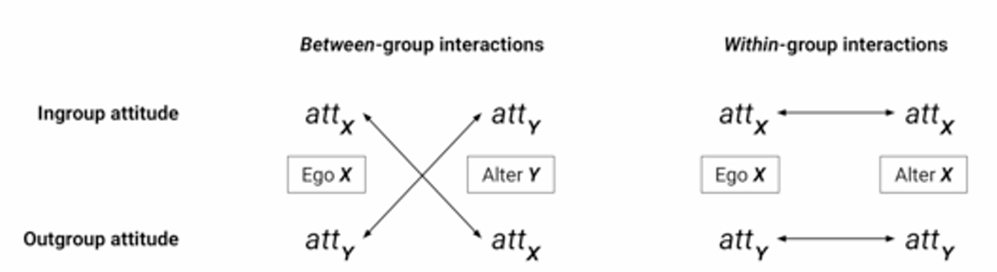
In between-group contact (Figure 1, left), Ego’s opinion about its outgroup is affected by the corresponding opinion of Alter, for whom this is the ingroup opinion. In a positive encounter, both agents will decrease their disagreement and move their attitude closer towards that of their counterpart, in a negative encounter their disagreement increases. To see how a positive intergroup interaction matches the process of intergroup contact, consider the initial situation of an intergroup bias, where individuals have a more favorable view of their own group compared to the outgroup. Following a positive between-group interaction, both agents will think more positively about the outgroup. They will also think less positively about their own group – but we assume that influence on the ingroup attitude is not as strong, as ingroup attitudes are more strongly anchored in the individual self than outgroup attitudes (Robbins & Krueger 2005). After a negative interaction, both agents will think less positively about the outgroup and more positively about their ingroup.
Within-group encounters mirror between-group interactions (Figure 1, right). In the situation of initial intergroup bias, agents will agree on more negative views on the outgroup and positive views on the ingroup. However, if an agent has previously had positive interactions with outgroup members and developed more positive outgroup attitudes, she will spread those attitudes to her peer through positive interactions, reflecting the effects of extended contact. Conversely, in a negative interaction between an Ego who does not have intergroup bias and a biased ingroup Alter, the Ego experiences repulsive influence and Ego’s ingroup attitude worsens while the outgroup attitude further improves. For the Alter, if this ingroup interaction is also experienced as negative, the ingroup attitude will become even better and the outgroup attitude will worsen.
Whether agents experience an interaction as positive or negative is, in this modelling framework, crucial for the outcome of the interaction. We assume that the valence of interaction is shaped by several forms of bias, which allows linking it to key aspects of the social context in which the social influence processes unfold. These biases will be discussed next.
Intergroup bias
In addition to the initial macro-level intergroup bias, characterized by higher average ingroup attitudes compared to outgroup attitudes (Hewstone et al. 2002), we assume three forms of bias that guide individual behavior.
First, ingroup homophily or xenophobia: Ingroup members are more likely to be chosen as interaction partners, while outgroup members are avoided, and interactions with ingroup members are more likely to be perceived as positive. Bias coming from demographic differences can be seen as structurally rooted, given exogenously by such aspects of societal structure as steep ethnic hierarchies (Hagendoorn 1995), historical prejudices that are institutionally reinforced (Duckitt & Mphuthing 1998), vivid or salient group boundaries (Gaertner & Dovidio 2014). In what follows, we will refer to this form of bias as xenophobia.
The second manifestation of bias resides in one’s attitudes towards both groups. Bias coming from attitudes is not rigid as it changes whenever attitudes change through social influence, in particular in intergroup contact. When this form of bias is dominant, the only factor determining the desirability and valence of contact is an individual’s own intergroup attitudes, regardless of group belonging and other factors. In what follows, we will refer to this as attitudinal bias.
The third manifestation of bias connects Ego’s openness to influence from Alter to attitude similarity between Alter and Ego, an assumption common to many opinion dynamics models which reflects psychological research showing that individuals consider others with more similar attitudes generally more positively (Byrne 1971). This implies in particular that agents prefer to interact and are more easily influenced by others who have similar attitudes to theirs regarding ingroup as well as outgroup (see, e.g., Aguiar & Parravano 2015). When this form of bias is dominant, the only factor determining the desirability and valence of contact is whether the individuals hold similar attitudes. In what follows, we will refer to this as opinion distance.
We assume that two aspects of interactions can be affected by bias: whether individuals prefer or avoid certain interactions and whether the interactions that happen are perceived as positive or negative. Preferential selection of ingroup members is consistent with earlier formal models of opinion dynamics in multigroup settings. However, we additionally assume that an agent is more likely to interact with another agent with whom she disagrees less (opinion distance), and whose group she likes more (attitudinal bias). This implies in particular that as agents’ outgroup attitudes improve, for example due to positive intergroup contact, they have a higher likelihood to interact with outgroup members, possibly even preferring outgroup interactions to ingroup interactions. In terms of perception, we assume that to the extent that agents exhibit a persistent xenophobic bias, between-group interactions are more likely experienced negatively than within-group ones. In addition, agents are more likely to experience an interaction negatively if they disagree more with the interaction partner in terms of attitudes, and like the interaction partner’s group less (whether it’s the ingroup or the outgroup).
The formalization of our model is presented in the section Model. In what follows, we discuss how this model leads us to a set of questions guiding the simulation experiments conducted in this study.
Research questions: How strong and how entrenched can intergroup bias be before contact backfires?
To explore when intergroup contact mitigates polarization despite intergroup bias, we begin with a baseline where xenophobia dominates, and intergroup attitudes influence contact indirectly through opinion distance. In this pessimistic scenario, xenophobic bias persists regardless of improved attitudes. We then adjust the role of xenophobia to identify conditions under which contact can improve outgroup attitudes despite lingering persistent bias.
Next, we introduce attitudinal bias and manipulate the relative weight of the xenophobic and attitudinal bias in one’s interactions. By this, we explore how the macro-pattern of outgroup attitudes changes across the gradient of the simulated environments, ranging from one where intergroup bias is mostly xenophobia-driven and persistent to one where it is mostly attitude-driven and variable in response to positive outgroup contacts or influence from ingroup peers with positive attitudes towards the outgroup.
Without formal model analysis, it is impossible to obtain a clear theoretical intuition on how intergroup attitudes and affective polarization change in our model due to the complex interaction of various factors, including intra- and intergroup social influence, both positive and negative, and evolving social relationships. Therefore, we formulate a theoretical question guiding the design of our simulation experiments:
RQ1: How do intergroup attitudes change depending on the degree to which intergroup bias is xenophobia-driven or intergroup attitude-driven?
Even when intergroup bias is deeply entrenched (in the case of xenophobia) or individuals primarily choose interaction partners based on their own intergroup attitudes (in the case of attitudinal bias), not all outgroup interactions are impossible or negative. If individuals can choose their interactions but cannot completely avoid outgroup encounters, the outgroup contacts that occur are likely those with the least potential for being negative. Depending on how much undesirable contact can be avoided, varying weights of the bias components may lead to different macro outcomes. This raises a further question for our simulation experiments:
RQ2: How are these changes affected if possibilities for selecting preferred interaction partners are limited?
Model
The model developed here2 considerably extends an earlier version proposed by Flache (2018). We initiate a population of \(N\) agents3, equally distributed over two groups \(g_i \in \{0,1\}\)4, where group membership is fixed. Each of \(N\) agents \(i\) has an attitude towards group 0, \(att_0\), and an attitude towards group 1, \(att_1\). This represents an ingroup attitude (\(att_0\) if \(g\)=0, \(att_1\) if \(g\)=1) and an outgroup attitude (\(att_1\) and \(att_0\), respectively) per agent. Attitudes range between 0 and 1: The higher the value of \(att_X\), the more positively an agent views group \(X\). Consequently, negative interactions with members of \(X\) become less likely, and members of \(X\) are less likely to be avoided.
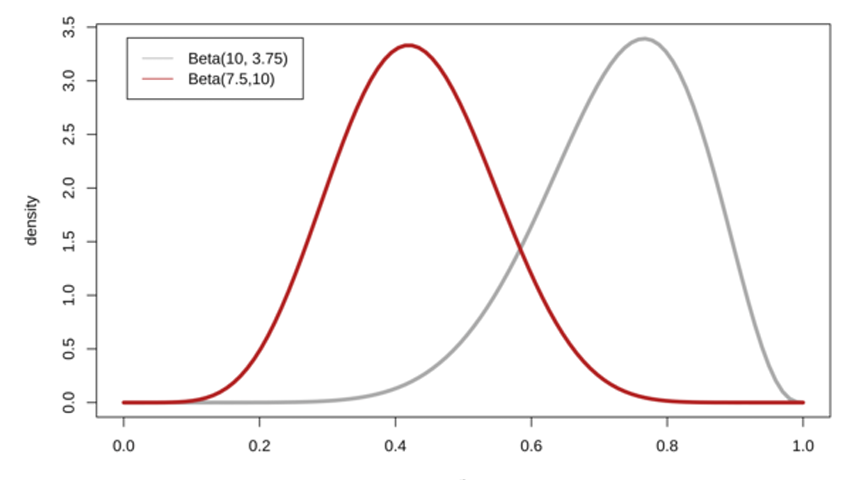
Implementing intergroup bias, agents in both groups are initialized to think more positively about the ingroup than about the outgroup. Technically, the initial ingroup attitude is drawn from a Beta-distribution with the probability density function Beta(\(\alpha_{IN}\), \(\beta_{IN}\)), and the initial outgroup attitude – from Beta(\(\alpha_{OUT}\), \(\beta_{OUT}\)). Figure 2 shows the initial distribution of attitudes in the baseline scenario that we use for most of the simulation experiments in this paper (\(\alpha_{IN}\) = 10, \(\beta_{IN}\) = 3.75, \(\alpha_{OUT}\) = 7.5, \(\beta_{OUT}\) = 10), reflecting the assumptions that agents generally favor the ingroup (\(\mu \approx 0.73\)) and view the outgroup slightly negatively (\(\mu \approx 0.43\)), while there is random variation between individuals. Since the attitudes are drawn independently, they are not correlated within agents, so the extent of ingroup bias varies between agents while there is some ingroup bias on the group level.
The interaction process
Table 1 gives a schematic overview of the interaction process in the simulation. Dynamics of the model unfold in a sequence of consecutive interaction events, consisting of a social selection phase and an influence phase. The interaction event occurring at "time point" \(t\) in our model is the \(t\)-th event in the sequence. In the social selection phase of every interaction event, one out of \(N\) population members is selected with probability \(1/N\) for initiating an interaction. This focal agent \(i\) then picks one of out \(N-1\) other agents in the population as an interaction partner. The probability for selecting a particular alter \(j\) depends on how much \(i\) and \(j\) (dis)agree on the two issues \(att_0\) and \(att_1\), whether they belong to the same group, and on \(i\)’s attitude towards \(j\)’s group. The exact selection procedure is described further below.
| 1. Assign group membership g and initial \(att_0\) and \(att_1\) to every agent, based on population composition and Beta distributions | |
| Repeat the following simulation event until simulation stops: | |
| 2. Pick an agent \(i\) at random | |
| 3. Social selection phase. Agent \(i\) selects one interaction partner \(j\) from the entire population: | |
| 3.1. Compute for every other agent \(k\) in the population the attractiveness as potential interaction partner for \(i\) as the based on the discrepancy \(d_{ik}\) \((0 \leq d \leq 1)\) as given in Equations 3 and 4 | |
| 3.2. Select one out of \(N-1\) others as an interaction partner \(j\). The more attractive \(j\) is for \(i\), the more likely \(j\) will be picked. Probabilities are calculated based on Equation 5 | |
| 4. Influence phase. Opinion adjustment \(i-j\): | |
| 4.1. For both \(i\) and \(j\): Compute discrepancies \(d_{ij}\), \(d_{ji}\) with the other agent \((0 \leq d \leq 1)\) as given in Equations 3 and 4 | |
| 4.2. Social influence: adapt for both agents \(att_0\) and \(att_1\) as given in Equations 1 and 2 | |
| Go back to “Repeat until …” | |
Once \(i\) and \(j\) have been paired, both agents adapt their attitudes to both groups in the social influence phase. If the interaction is evaluated positively, then both agents move their attitude \(att_X\) closer to the \(att_X\) of the interaction partner. If the interaction is evaluated negatively, then both agents change \(att_X\) so as to move away from the \(att_X\) of the interaction partner. An influence weight \(w_{ij} \ (-1 \leq w_{ij} \leq +1)\) controls whether the interaction with \(j\) is evaluated positively (\(w > 0\)), negatively (\(w < 0\)), or neutrally (\(w = 0\)). Equations 1 and 2 formalize this process.
| \[att_{0i,t+1} = att_{0it}+\mu w_{ijt} \ (att_{0jt}-att_{0it})\] | \[(1)\] |
| \[att_{1i,t+1} = att_{1it}+\mu w_{ijt} \ (att_{1jt}-att_{1it})\] | \[(2)\] |
The rate of change \(\mu\) in Equations 1 and 2 scales how much agent \(i\)’s attitude can shift towards or away from agent \(j\)’s attitude in a given interaction. This value is lower for ingroup (\(\mu_{in} = 0.25\)) than for outgroup (\(\mu_{out} = 0.75\)) attitudes, reflecting that ingroup attitudes may be harder to adjust than outgroup attitudes. In addition, should an attitude change lead to a value \(att_{Xk,t+1}\) that falls outside of the interval \([0,1]\), then the resulting new attitude value is set to the interval boundary nearest to \(att_{Xk,t+1}\), where \(X \in \{0,1\}\). Formally, if we denote for a moment the l.h.s. expressions of Equations 1 and 2 as \(att_{Xk,t+1}^{/}\), then the new value resulting after the influence interaction is set to \(att_{Xk,t+1} = max(0,min(1,att_{Xk,t+1}^{/}))\). For readability, we did not explicate this extra step in equations 1 and 2, but implemented it in the model code.
Influence weights \(w\) can change over time and are computed prior to social influence based on the discrepancy \(d_{ijt}\) which \(i\) perceives at time point \(t\) towards \(j\) (\(0 \leq d_{ij} \leq +1\), as follows from Equation 35). Discrepancy is translated into the influence weight by a non-linear function so that more perceived discrepancy leads to a lower influence weight \(f\)6, as given by Equation 2:
| \[w_{ijt} = f(d)=\left\{ \begin{aligned} \left( \frac{d_{th}-d}{d_{th}} \right)^S, \ d < d_{th} \\ -\left( \frac{d-d_{th}}{1-d_{th}} \right)^S, \ d \geq d_{th} \\ \end{aligned} \right. \] | \[(3)\] |
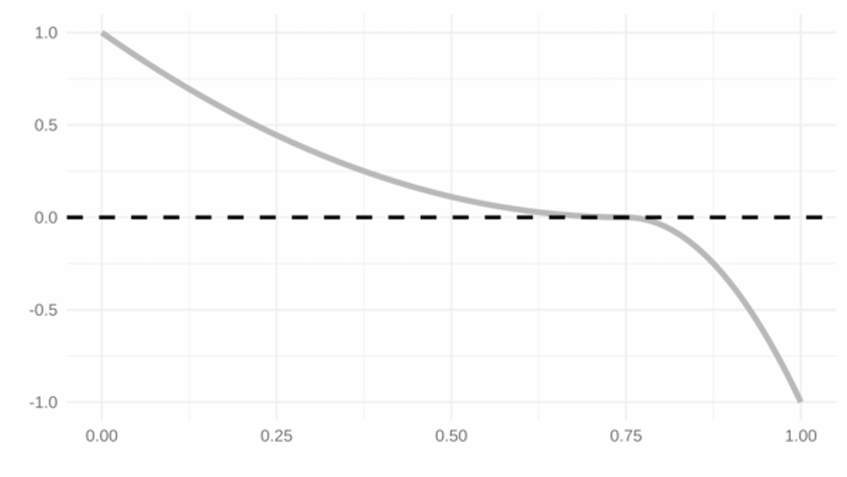
More technically, \(f\) yields a weight that is positive if discrepancy falls below the threshold level of \(d_{th}\)7. The weight turns negative once discrepancy exceeds this threshold. With \(s > 1\), changes in discrepancy close to the threshold level have only a relatively small impact on the weight such that the influence weight is close to zero in this region. The weight changes more steeply as \(d\) approaches the boundaries of its theoretically possible range. Figure 3 shows the influence weight function that we use in the baseline scenario and Experiment 1, with \(s=2\) and \(d_{th}=0.75\).
Discrepancy \(d_{ijt}\) is computed as given in Equation 3.
| \[d_{ijt}=\beta_A |g_j(1 - att_{1it}) + (1 - g_j) (1-att_{0it}) | + \beta_X |(g_j - g_i)| + \beta_D dis_{ijt} \] | \[(4)\] |
| \[dis_{ijt}=\frac{1}{2} | (att_{0jt} - att_{0it} )| + \frac{1}{2}|(att_{1jt} - att_{1it})| \] | \[(5)\] |
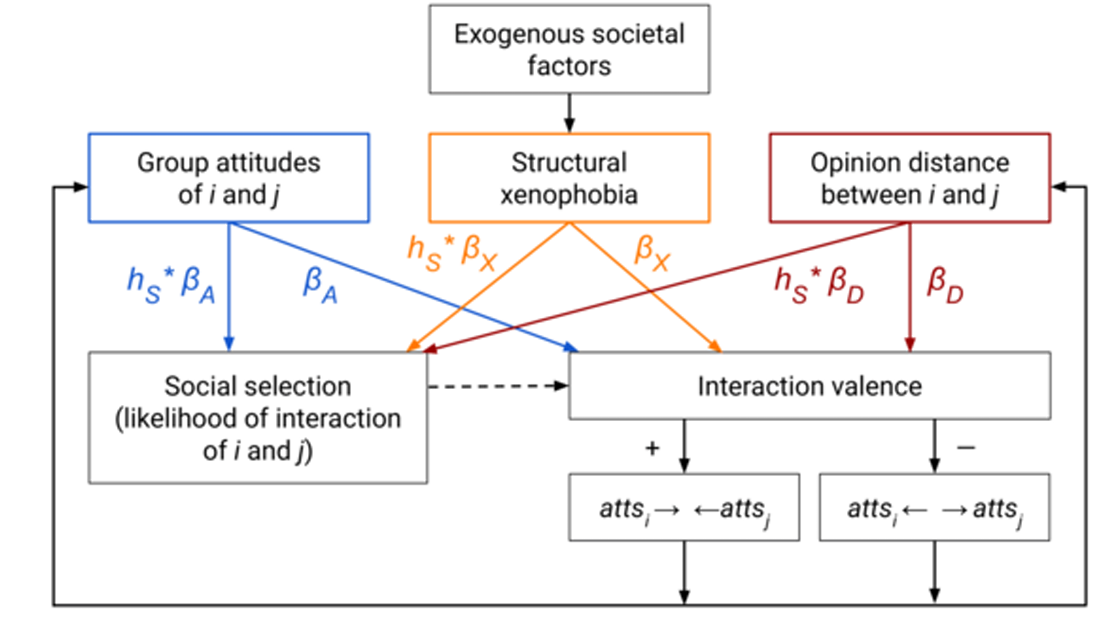
The parameters \(\beta_X\), \(\beta_A\), and \(\beta_D\) in Equation 4 are central for the design of the simulation experiments in our study. They scale the relative contributions that, respectively, xenophobia (\(\beta_X\)), (reverse of) attitude of \(i\) towards \(j\)’s group (\(\beta_A\))8, and opinion distance (\(\beta_D\)) make to \(i\)’s perceived discrepancy with \(j\). We impose the constraint \(\beta_X + \beta_A + \beta_D = 1\) so that the value of a parameter can be interpreted as the share of the overall impact of social influence on intergroup attitudes that can be attributed to the three components.
Social selection model
We incorporate social selection assuming that the more attractive a potential interaction partner \(j\) is from \(i\)’s point of view, the more likely \(i\) will pick \(j\) for an interaction. The preference \(\textit{pref}_{ijt}\) agent \(i\) has for agent \(j\) as a potential interaction partner is based on the discrepancy between \(i\) and \(j\), thus \(\textit{pref}_{ijt} = 1 - d_{ijt}\). The stronger agent \(i\)’s preference for interaction with agent \(j\), the more likely \(j\) is chosen – all other things being equal. More precisely, the selection of an interaction partner is governed by Equation 5, which defines the probability of a specific \(j\) to be selected in a draw of exactly one out of \(N-1\) available other agents in the population.
| \[{interaction} \, {probability}_{ijt} = \frac{{\textit{pref}}_{ijt}^{h_S}}{\sum_{j,i \neq j}^{N} {\textit{pref}}_{ijt}^{h_S}} \] | \[(6)\] |
The parameter \(h_S\) in Equation 5 scales how much preferences weigh on interaction probabilities. With \(h_S=0\), all agents have the same probability of being selected for an interaction, regardless of \(i\)’s preferences. Broadly, the larger \(h_S\), the larger is the difference in likelihood of being chosen for an interaction by agent \(i\) between highly preferred and less preferred other agents \(j\). The parameter \(h_S\) allows to scale in our simulation experiments the extent to which agents can enact their preferences in choosing interaction partners.
Figure 4 summarizes the relevant components of the interaction process between agents i and j in the model.
Outcome measures
Throughout most simulation experiments in this paper, we use two outcome measures to describe how model dynamics affect intergroup attitudes.
First, we measure how average ingroup attitudes in the population develop over time alongside with changes of average outgroup attitudes. Formally, average outgroup attitudes \(\overline{att_{out,t}}\) and average ingroup attitudes \(\overline{att_{in,t}}\) at time point \(t\) of an agent \(i\) belonging to group \(g_i \in \{0,1\}\) are measured as:
| \[\begin{gathered} \overline{att_{out,t}} = \sum_{i = 1}^{i = N}g_iatt_{0it} + (1 - g_i)att_{1it} \\ \overline{att_{in,t}} = \sum_{i = 1}^{i = N}g_iatt_{1it} + (1 - g_i)att_{0it} \end{gathered}\] | \[(7)\] |
To assess affective polarization, we measure the extent to which attitudes about groups in the population differ between group 0 and group 1. The outcome measure affPol reflects the distance between the average attitudes of both groups towards the same attitude dimension (0 or 1), averaged across both attitude dimensions:
| \[\textit{affPol} = \frac{1}{2}\left(\left|\overline{att_{0,t}^0} - \overline{att_{0,t}^1}\right| + \left|\overline{att_{1,t}^0} - \overline{att_{1,t}^1}\right|\right) \] | \[(8)\] |
It should be noted that the measure we propose here overlaps with an important established measure in the empirical literature on affective polarization, the feeling thermometer-based affective polarization measure proposed by (Iyengar et al. 2019). This measure quantifies the gap between the average attitudes about in- and outgroup in both groups, capturing mutual ingroup bias. More precisely, the two measures yield equal results for a situation that typically is associated with affective polarization: both groups have favorable attitudes towards the ingroup and much less favorable attitudes towards the outgroup. However, this is not the only form of affective polarization that our model is capable of generating and that can be of substantive interest. As we show in the Results section of this paper, our model also can generate outcomes in which the groups strongly differ in their attitudes towards in- and outgroup, but do not necessarily exhibit ingroup bias. Moreover, also “asymmetric” affective polarization can arise in which in one group agents like their ingroup less than the outgroup, while in the other this is reversed. While groups then still strongly disagree in how to evaluate each other, this disagreement would not be captured by the feeling thermometer measure. To distinguish “typical” affective polarization from other forms, we therefore use our measure of between-group disagreement in intergroup attitudes, while always also reporting average between in- and outgroup attitudes to give the complete picture.
Results
Baseline scenario and design of the experiments
Our baseline scenario features a population of two equally large groups with enough members to allow for differentiation in social selection, while keeping the total number of individuals small enough to make the simulation experiments computationally tractable. We assume that individual preferences influence partner selection (\(h_S = 1\)), the xenophobia component has a mild but noticeable effect in the overall bias (\(\beta_X=0.375\)), and changes of intergroup attitudes do not impact interactions (\(\beta_A = 0\)).
The simulation experiments address our two research questions. We begin with a scenario where intergroup bias is driven by xenophobia (Experiment 1). In this scenario, while social influence can alter intergroup attitudes, it cannot entirely suppress the tendency to avoid intergroup interactions or perceive them negatively compared to within-group interactions. Here we assume \(\beta_A = 0\) and vary the weight of the xenophobia component in the overall bias (\(\beta_X\)).
In Experiment 2, we explore a scenario where both xenophobia and attitudinal bias play a role. We increase the combined weight of xenophobia and attitudinal bias \(\beta_X + \beta_A\) in the overall bias, while varying the relative weight of the structurally rooted bias component, \(sx = \beta_X /(\beta_X + \beta_A)\).
Further, we conduct a set of tests varying the degree to which social selection of preferred interaction partners is constrained (\(h_S\), Experiments 1.2 and 2.2). With \(h_S=0\), interaction partners are chosen randomly, regardless of individual preferences. This could, for example, reflect a workplace setting where teams are formed based on professional skills, independent of group membership or personal attitudes toward groups. With \(h_S=1\), the likelihood of selecting an interaction partner increases linearly with an individual’s preference, allowing for interactions with less preferred partners. In contrast, only the most attractive partners are likely to be chosen when \(h_S=5\).
Table 2 gives an overview on the baseline scenario and the variations in Experiments 1 and 210.
| Symbol | Parameter | Baseline value | Variation in experiments |
|---|---|---|---|
| \(N\) | number of agents (50% group 0, 50% group 1) | 110 (55/55) | fixed |
| \(\mu\) | rate of change | \(\mu_{in} = 0.25\), \(\mu_{out} = 0.75\) | fixed |
| \(s\) | steepness of the influence weight function | 2 | fixed |
| \(d_{th}\) | discrepancy threshold for negative influence | 0.75 | Experiment 2: 0.5 |
| \(\beta_X\) | impact of xenophobia, based on group belonging | 0.375 | Experiment 1: \([0..1]\) |
| \(\beta_A\) | impact of intergroup attitude | 0 | Experiment 2: \([0..1]\) |
| \(\beta_D\) | impact of interindividual attitude difference | \(1 - \beta_X\) | Experiment 1: \(1 - \beta_X\) Experiment 2: \(1-(\beta_X + \beta_A)\) |
| \(sx\) | relative weight of the structurally rooted bias component | – | Experiment 2: \(\beta_X /(\beta_X + \beta_A)\) |
| \(h_S\) | impact of individual preferences on social selection | 1 | Experiments 1.2, 2.2: \(h_S \in \{0, 1, 5\}\) |
| \(Beta(\alpha, \beta)\) | initial attitude distributions | Ingroup: \(\alpha = 10, \beta = 3.75\) Outgroup: \(\alpha = 7.5, \beta = 10\) |
fixed |
Baseline scenario
In the baseline scenario, improvements in outgroup attitudes through contact have no lasting effect on future interactions (\(\beta_A = 0\)). At the same time, the relatively low weight of xenophobia in the overall bias makes negative interactions between members from different groups possible but also not very likely in the initial situation, and there is sufficient room for between-group encounters given \(h_S = 1\).
Figure 5 shows how individual attitudes towards in- and outgroup change over time in a single run starting from the baseline scenario. Broadly speaking, it conveys a positive message for intergroup contact theory. “Contact works” despite xenophobia, initial intergroup bias, and ingroup social influence. Average outgroup attitudes improve from approximately 0.43 to around 0.65. Simultaneously, ingroup attitudes decline from an average of about 0.73 to the same level as the improved outgroup attitudes, 0.65. This pattern reflects the impact of largely positive social influence both within and between groups.
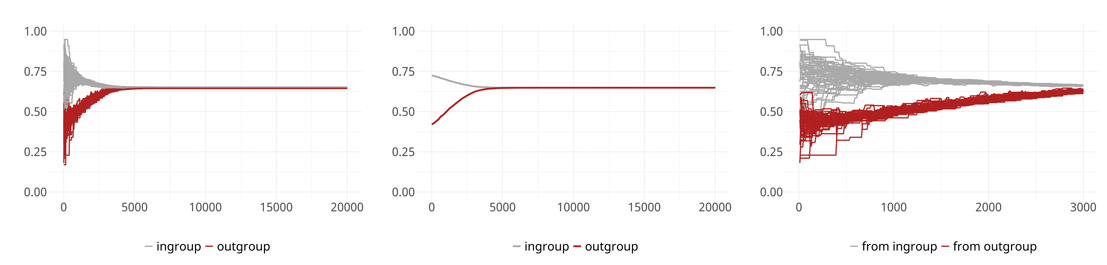
In the early phase of the process (Figure 5 c) individuals quickly align with the average initial attitude of their own group because interactions mainly occur within groups. This is due to a preference for ingroup members over outgroup members in social selection, all other things being equal, and the relatively low initial disagreement within groups. As a result, positive influence within groups quickly leads to near-consensus on both ingroup and outgroup attitudes. This consensus still reflects intergroup bias, a more positive attitude towards the ingroup than towards the outgroup.
Once intragroup consensus is established, intragroup social influence can no longer alter individuals’ attitudes. However, interactions between groups can still affect attitudes, as there is still disagreement. From this point onward, the attitudes of members of different groups gradually converge, where both groups shift less in their ingroup attitude and more in their outgroup attitude. This convergence occurs because after ingroup consensus was formed, the attitude disagreement within all possible between-group encounters has diminished sufficiently to avoid negative interactions, making in addition interactions between groups more likely.
Experiment 1: How does more entrenched xenophobia affect intergroup contact and affective polarization?
Having seen the positive effects on outgroup attitudes with the baseline weight of xenophobic bias, we now explore the boundary conditions of this effect. In Experiment 1.1, we varied \(\beta_X\) from 0 to 1 in steps of 0.025, conducting 100 independent realizations per level of \(\beta_X\).
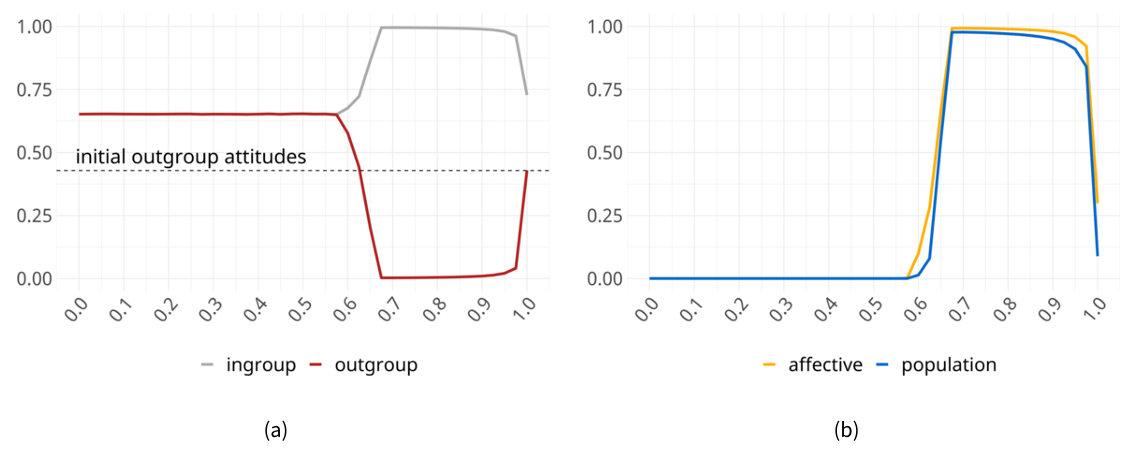
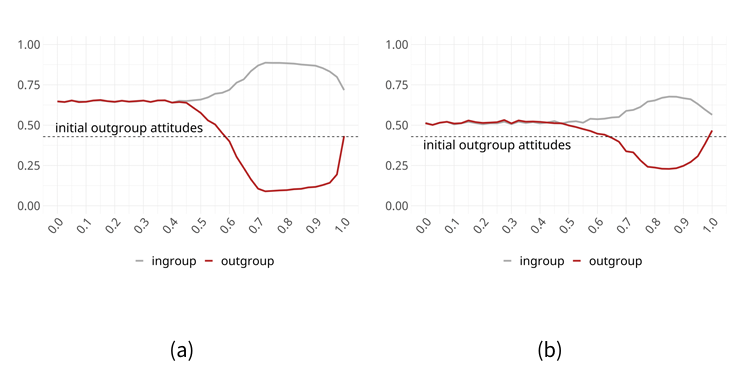
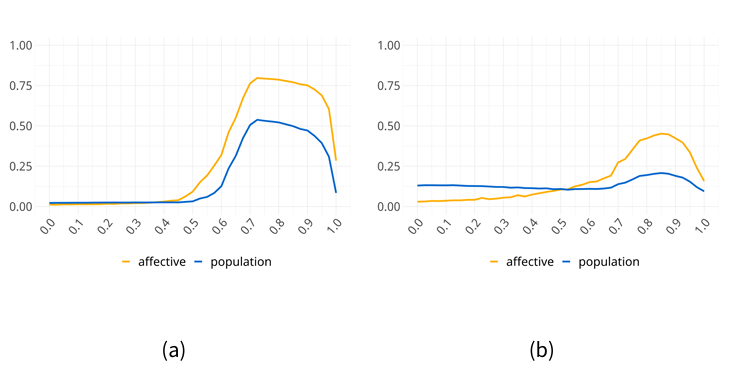
Figure 6 presents the results for average ingroup and outgroup attitudes (left) and for affective and population polarization (right) . It confirms a non-linear effect of xenophobia and clearly distinguishes between regions of the parameter space where “contact works”, “contact backfires”, and where negative contact is suppressed by outgroup avoidance. See in Figure 7 how individual in-and outgroup attitudes change under moderately strong (\(\beta_X = 0.55\)), strong (\(\beta_X = 0.75\)), and extremely strong xenophobia (\(\beta_X = 0.975\)).
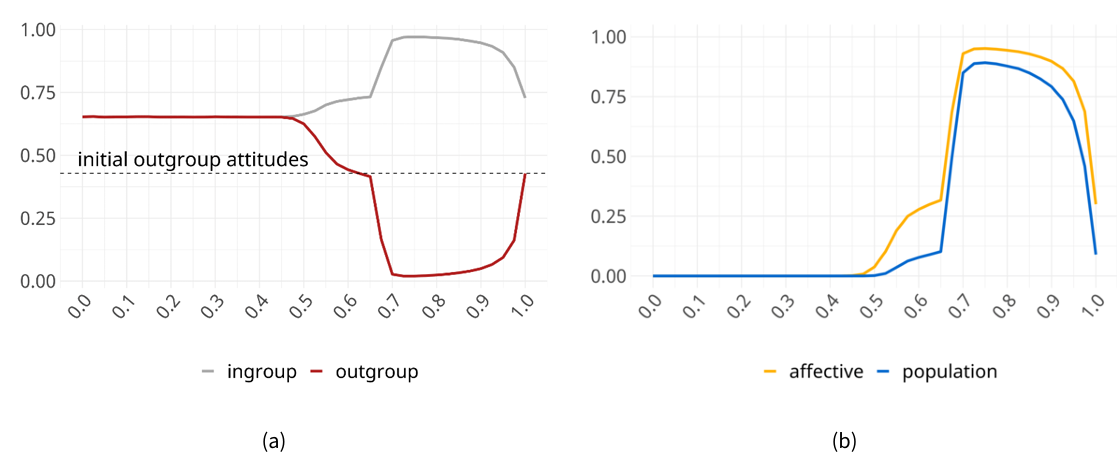
Below approximately \(\beta_X = 0.5\), outgroup attitudes improve over time towards about \(\overline{att_{out}} = 0.65\), considerably exceeding the initial average of about 0.43 (dashed grey line). Here, “contact works”. At the same time, the formation of consensus across the two groups on how to view group 0 and group 1, respectively, implies that ingroup attitudes slightly deteriorate, from an initial level of about \(\overline{att_{in}} = 0.73\) to 0.65, matching the other groups’ outgroup attitude. Correspondingly, both polarization measures are at zero in this region of the parameter space.
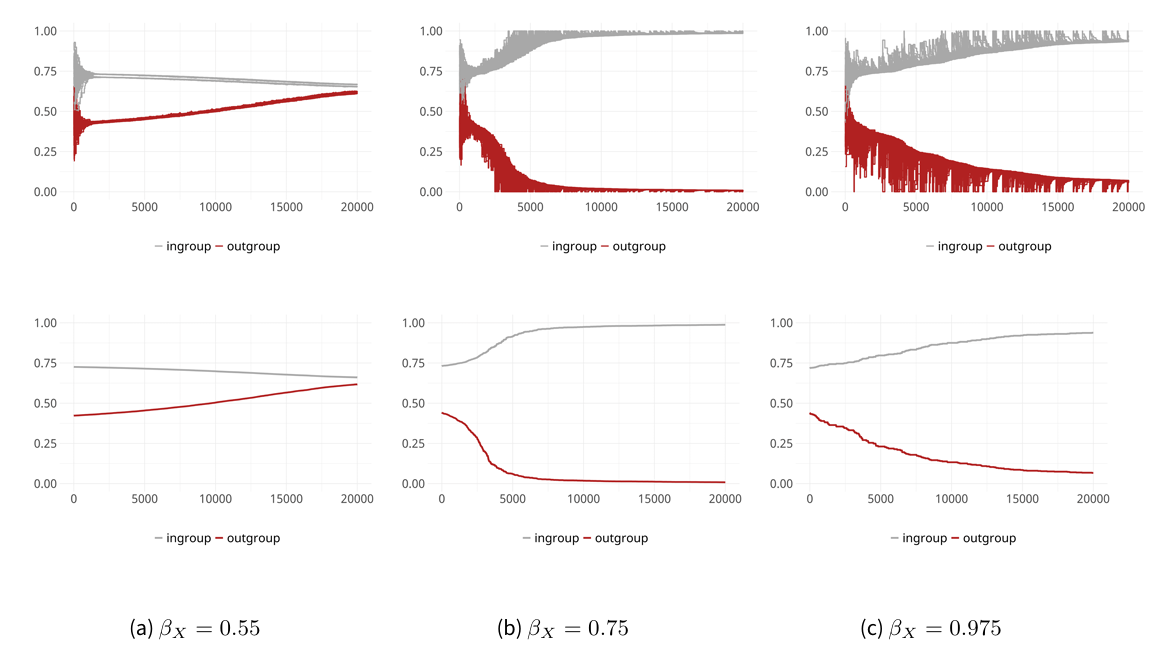
By contrast, between approximately \(\beta_X = 0.5\) and \(\beta_X = 0.65\) we find that the improvement of outgroup attitudes gradually breaks down as the weight of xenophobia increases, accompanied by improving ingroup attitudes. This entails a slight increase of both forms of polarization, but not yet a failure of contact, as outgroup attitudes in the final state of the simulation are still more favorable than they were at the outset (see Figure 7 a for an example of a single run with \(\beta_X = 0.55\)). There is no further improvement of outgroup attitudes after 10.000 simulation events at \(\beta_X \cong 0.65\).
Beyond this weight of xenophobia we observe a dramatic change of the dynamics. Outgroup attitudes \(\overline{att_{out}}\) plummet to almost the lowest possible level of 0, while ingroup attitudes soar towards almost the maximum of 1 (see Figure 7 b for an example of a single run with \(\beta_X = 0.75\)). Intergroup attitudes are now strongly biased towards the ingroup and against the outgroup. Correspondingly, both forms of polarization sharply increase close to their maximum. The close match of the two polarization measures further shows that virtually all disagreement occurs between groups and not within them.
This occurs because encounters between members of different groups are often negative, even with minor disagreements. With \(\beta_X = 0.75\), even a small disagreement of about 0.3 is sufficient to create a negative influence weight (\(w\)) during intergroup interactions. Consequently, once between-group interactions begin after the initial phase of intragroup consensus formation, agents distance themselves from outgroup members, strengthening ingroup attitudes and worsening outgroup attitudes.
This effect intensifies when “radicalized” agents, shaped by prior negative intergroup interactions, influence less polarized ingroup peers. At high \(\beta_X\), ingroup interactions remain positive even with significant disagreement, pulling moderate individuals toward more extreme attitudes. The combined effect of negative intergroup and positive intragroup interactions drives a self-reinforcing cycle of growing affective polarization.
Finally, at about \(\beta_X = 0.75\) we see the expected tipping point, beyond which outgroup attitudes again improve when the weight of xenophobia increases, while ingroup attitudes decline (see Figure 7 c for an example of a single run with \(\beta_X = 0.975\)). Polarization measures drop again to almost zero when the weight of xenophobia reaches the maximal value (\(\beta_X = 1\)).
The observed increase in affective polarization due to a stronger impact of xenophobia aligns with previous research using similar models (Feliciani et al. 2017, 2023; Flache 2018). However, Figure 6 also points to a non-linear effect that, to our knowledge, has not been demonstrated before. It cannot be explained merely by negative social influence (higher \(\beta_X\) making negative between-group interactions more likely), as we would see higher levels of affective polarization with increasing \(\beta_X\). Instead, the results reflect a complex interplay between the dual effects of xenophobia on both influence and social selection. While a higher \(\beta_X\) increases the likelihood that between-group interactions are perceived negatively, it also enhances outgroup avoidance by reducing the attractiveness of outgroup members as interaction partners. Paradoxically, this extremely strong outgroup avoidance helps preventing the negative spiral of increasingly negative outgroup attitudes in our simulations.
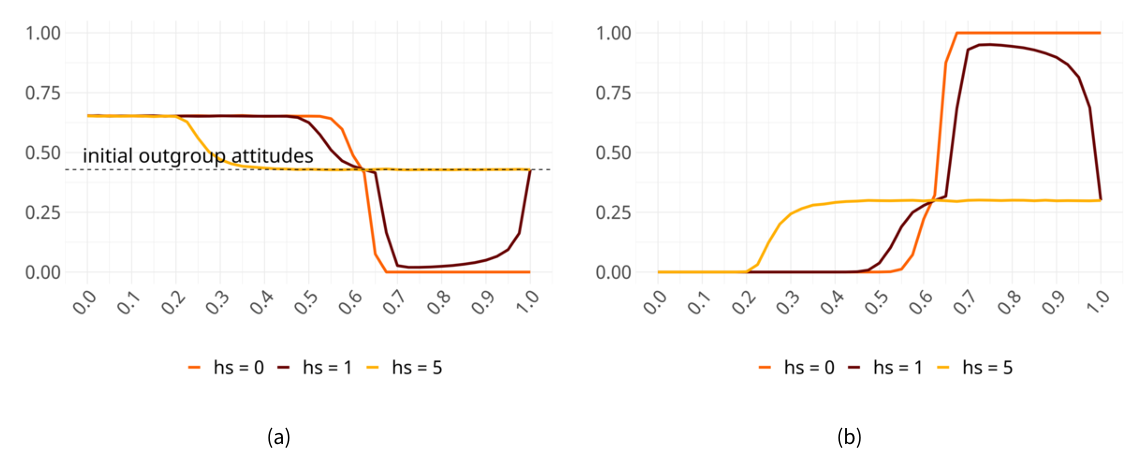
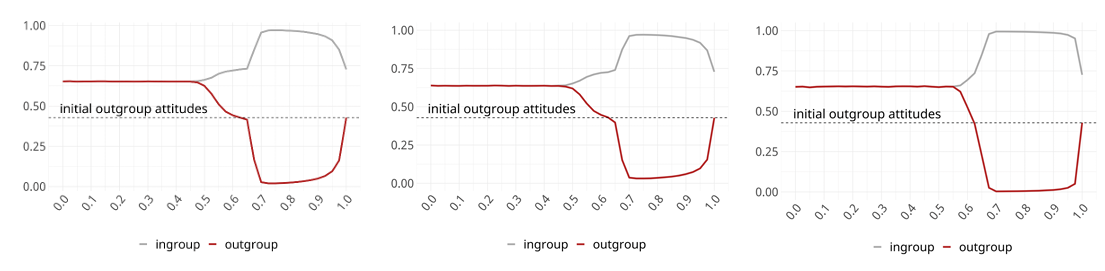
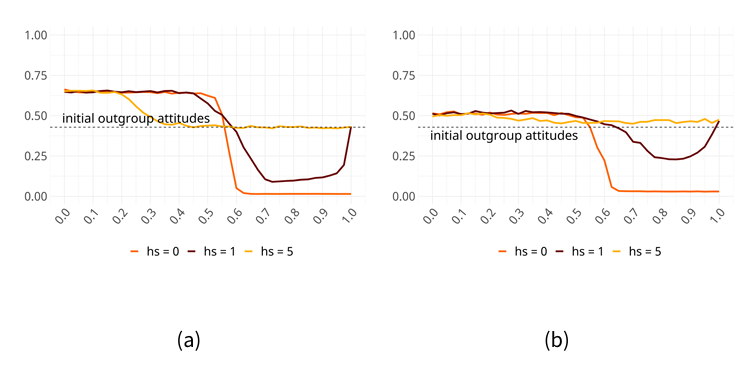
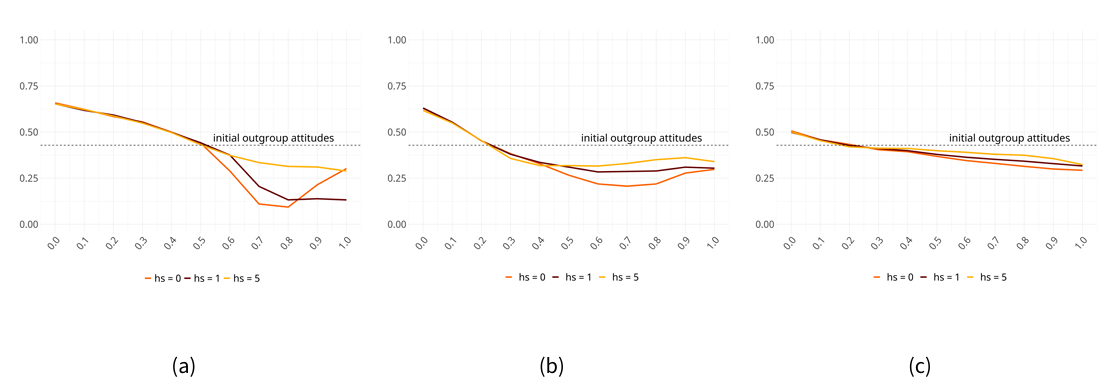
Figure 811 shows how the results of Experiment 1.1 change if we vary the extent to which individuals can act on their preferences for social selection. Using the same design as in Experiment 1.1 (ceteris paribus), we conducted Experiment 1.2 with three different values of the parameter \(h_S \in \{0, 1, 5\}\). Notably, in Experiment 1.2, higher \(\beta_X\) leads individuals to prefer ingroup interactions more, while the lower \(h_S\), the less likely agents who want to avoid outgroup interactions will succeed in doing so.
Figure 8 confirms our interpretation that the non-linear effect of increasing \(\beta_X\) can be attributed to the footrace between more negative between-group interactions and more outgroup avoidance. The non-linearity shows up most clearly when preferences for outgroup avoidance can be enacted, but do not entirely suppress interactions across group boundaries (\(h_S=1\)). When social selection is purely random (\(h_S=0\)), only two regions can be distinguished, one in which “contact works” and one in which affective polarization is nearly maximal and outgroup attitudes are maximally negative.
Finally, when xenophobia has a strong impact on social selection (\(h_S=5\)), we find that contact still “works” as long as the weight of xenophobia is only mild, but there is no longer a positive effect at higher levels of \(\beta_X\). Instead, outgroup attitudes move towards the average of their initial distribution within one’s own group, reflecting that social influence takes place entirely within groups due to outgroup avoidance. As a result, contact fails to work but there is also no affective polarization in this region of \(\beta_X\) when \(h_S=5\).
Experiment 2: How does mixing xenophobia and attitudinal bias affect intergroup contact and affective polarization?
Building on insights from Experiment 1, we now address a more complex and arguably empirically more relevant question. In real societies, we believe, social interactions are affected by bias driven by a mix of xenophobia and attitudinal bias. While xenophobia is entrenched and resistant to change through intergroup contact, attitudinal bias can be “unlearned”. To investigate under what conditions contact "works" or "backfires" as the mix of these biases changes, we varied the share \(sx\) of xenophobia within the combined influence of xenophobia and intergroup attitudes on intergroup bias, \(\beta_{XA} = \beta_A + \beta_X\), where \(sx = \beta_X / \beta_{XA}\). We conducted a ceteris-paribus replication of Experiments 1.1 and 1.2 in which we varied the effect of the total weight of both components, \(\beta_{XA}\), fixing \(sx\) at three different levels (\(sx\) = 0.05, 0.5, 0.95). Throughout these experiments, we maintained the constraint \(\beta_X + \beta_A + \beta_D = 1\) so that \(\beta_D = 1 - \beta_{XA}\). The threshold value \(d_{th}\) was set to 0.512.
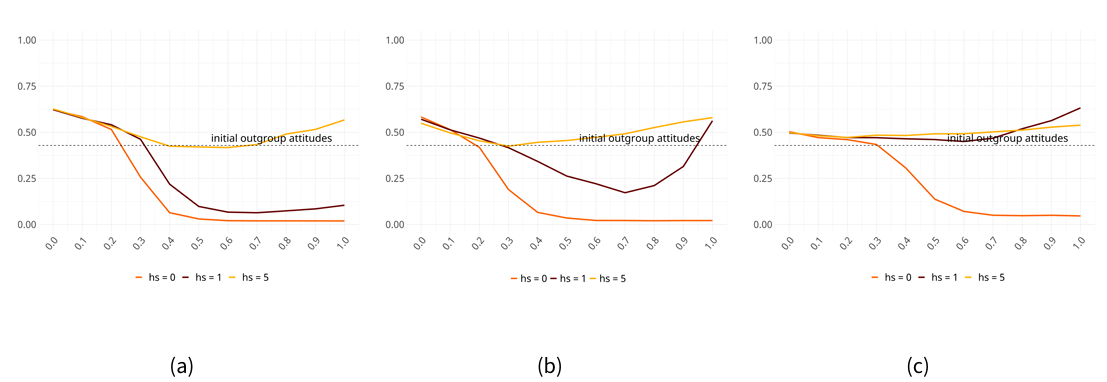
Figure 9 presents the results of Experiment 2.1 with \(d_{th}=0.5\). To facilitate comparison across the three different ratios \(sx\), the horizontal axes in Figure 9 are scaled in terms of \(\beta_{XA}\). The figure highlights a non-linear effect of \(\beta_{XA}\) on intergroup attitudes, showing that this non-linearity appears at both very low and very high shares of bias driven by xenophobia, but not at an intermediate share of \(sx = 0.5\). At both extremes of \(sx\), “contact works” if intergroup bias is below a critical level. Affective polarization increases with moderate to high intergroup bias but declines when bias becomes extremely strong.
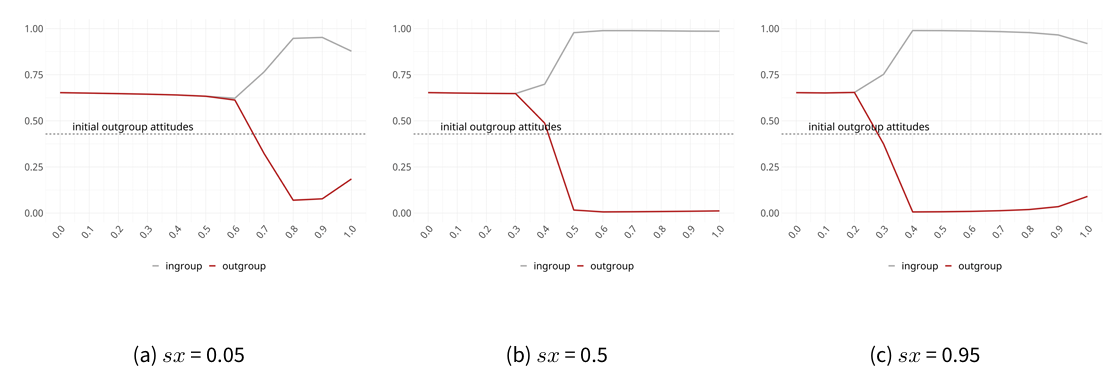
This pattern arises from the interplay of two mechanisms through which intergroup bias affects intergroup attitudes. In Experiment 1, we found that moderate xenophobia leads to more negative interactions between groups, increasing affective polarization, while extreme xenophobia suppresses interactions between groups, lowering affective polarization. This is evident in Figure 9 c for \(sx = 0.95\).
For predominantly attitudinal bias (\(sx=0.05\)), the effect pattern is similar (Figure 9 a), but the mechanism differs. Initial heterogeneity in intergroup attitudes can lead to a split within each group, where “ingroup lovers” develop negative attitudes toward the outgroup, while “ingroup critics” develop positive attitudes. As the attitudinal bias increases, “ingroup lovers” become more prevalent in the intermediate range of \(\beta_{XA}\), explaining the trend in affective polarization in Figure 9. However, at very high levels of \(\beta_{XA}\), interaction likelihood and valence are so much determined by initial attitudes that affective polarization is mitigated by internal group splits. Appendix C provides a more detailed explanation of this mechanism.
Finally, Figure 9 b shows how these two different mechanisms can partially neutralize each other. At \(sx = 0.5\), groups no longer divide internally when both \(\beta_X\) and \(\beta_A\) move towards their maximum (of \(\beta_X = \beta_A = 0.5\)), because xenophobia pushes all group members into the same direction in the opinion space despite the initial heterogeneity of attitudes. At the same time, the maximal weight of xenophobia that is possible here is not large enough to entirely prevent between-group interactions. As a consequence, xenophobia fails to suppress negative interactions, resulting in the disappearance of the non-linear effect.
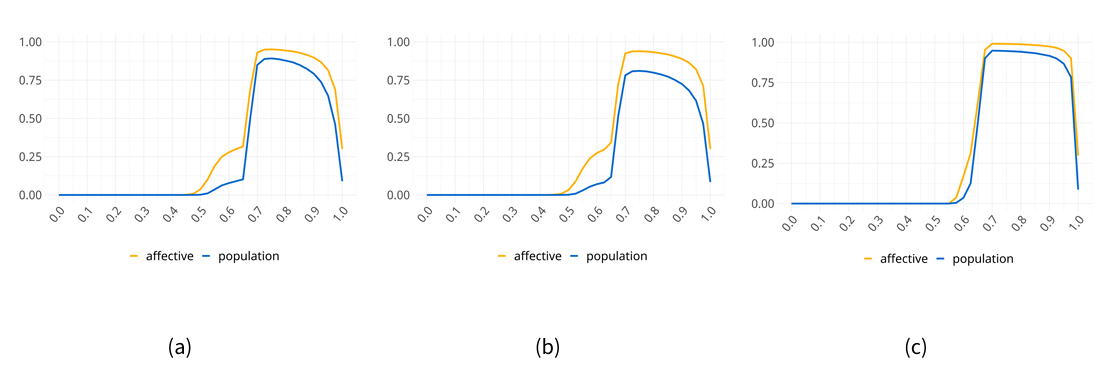
Further experiments confirm that variations in the relative contributions of xenophobia and intergroup attitudes to overall bias produce similar non-linear effects at both ends of the spectrum, though with some notable differences. Figure 10 shows a ceteris-paribus replication of Experiment 1.2, using \(d_{th} = 0.5\) and varying \(sx\) across three levels: 0.05, 0.5 and 0.95. As in Experiment 1.2, we also varied the extent to which agents can act on their preferences in the social selection of interaction partners (\(h_S\)).
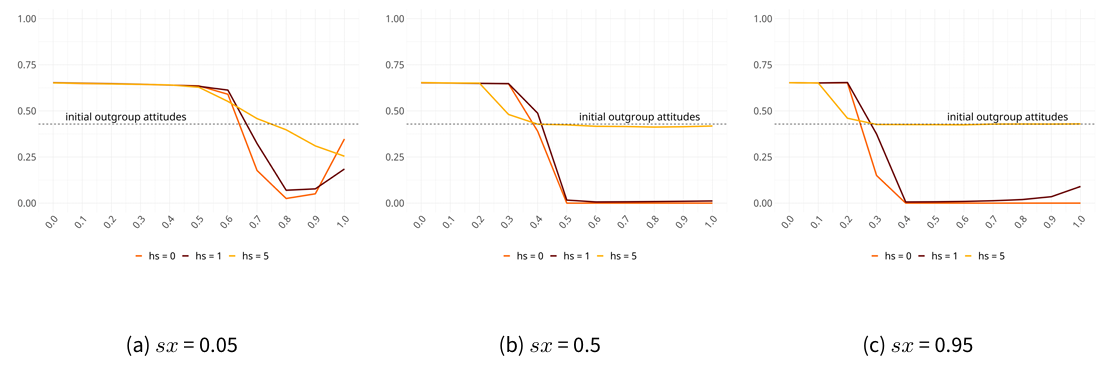
Three key results are consistent across the different levels of \(\beta_X / \beta_{XA}\). First, “contact works” despite some initial intergroup bias, xenophobia, negative interactions, and outgroup avoidance. Average outgroup attitudes improve from an initial level of about 0.43 to approximately 0.65, provided \(\beta_{XA}\) does not exceed a critical level. Second, when \(\beta_{XA}\) surpasses this critical level, outgroup attitudes decline rapidly, indicating affective polarization. Finally, outgroup attitudes deteriorate the least when social selection is most strongly driven by agents’ preferences (\(h_S=5\)).
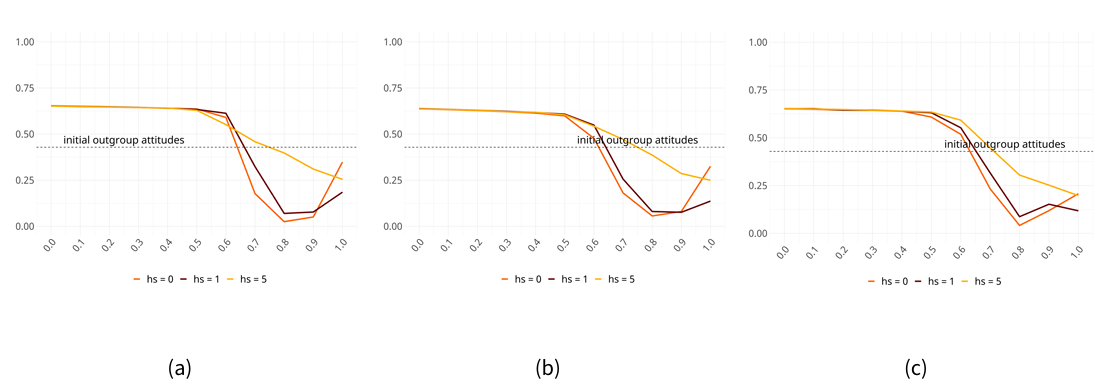
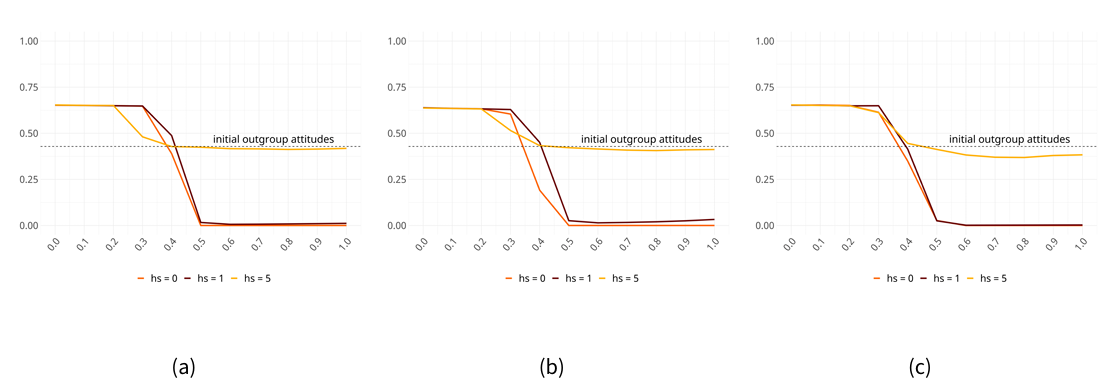
Yet, the two mechanisms we found to mitigate affective polarization generate characteristic differences in how exactly the effects of \(h_S\) and \(\beta_{XA}\) interact. In Figure 10 a we see that when the weight of intergroup attitudes in overall bias is large, outgroup attitudes improve the most when individuals are paired at random for social interactions (\(h_S=0\)). Figure 10 c, however, shows this improvement only for an intermediate level of \(h_S\), and there is no non-linearity at all to be seen in Figure 10 b. The reason is that more frequent between-group interactions can deepen the divide between outgroup-lovers and outgroup-haters within groups when interactions are mainly driven by intergroup attitudes, thereby reducing affective polarization. At the other end of the spectrum, with \(sx = 0.95\), stronger outgroup avoidance (a larger weight of xenophobia) minimizes negative interactions. This explains why at this level of \(sx\) affective polarization rebounds at high levels of \(\beta_{XA}\) only when \(h_S\) is intermediate (\(h_S=1\)), and not when outgroup avoidance is impossible (\(h_S =0\)) or so strong that negative interactions cannot occur at all (\(h_S=5\)).
Discussion and Conclusion
Decades of research into interpersonal intergroup contact support a simple yet powerful idea: positive interactions between members of different groups can lead to improved intergroup attitudes. However, only recently has research begun to delve into how intergroup contact interacts with various micro-level processes, revealing a more complex picture. To explore theoretically the macro-level consequences of the interplay of these individual-level processes, we proposed and analyzed an agent-based model that combines the effects of intergroup contact with intra-group influence, social selection driven by homophily and (dis)liking of groups, as well as both positive and negative interactions.
Our analyses suggest that the positive effects of intergroup contact on intergroup attitudes are robust even under a wide range of adverse conditions. These include persistent intergroup bias fueled by entrenched xenophobia, individuals’ tendencies to avoid outgroup interactions, and repulsive responses to outgroup attitudes during negative encounters. Furthermore, when intergroup bias can be unlearned – a key assumption of intergroup contact theory but not of many opinion dynamics models of intergroup interactions – the conditions under which contact has the expected positive effects become significantly less restrictive in our computational experiments.
However, our simulation studies also point to the limits to this optimistic picture. Intergroup encounters can backfire, potentially contributing to the emergence of affective polarization when xenophobia becomes too strong or when interactions are overly influenced by biased outgroup attitudes. Our model further suggests two hypotheses for future exploration. Counterintuitively, extremely strong xenophobia might reduce affective polarization by suppressing interactions between groups altogether. Similarly, when interpersonal interactions are primarily driven by intergroup attitudes, groups may split into factions, with some favoring and others disliking the outgroup. This could also mitigate affective polarization between groups, possibly at the price of strong polarization within groups, dividing the population as a whole into those who like outgroups and those who do not.
This study represents a first step toward the theoretical integration of multiple processes in interpersonal interaction in a model of the collective dynamics of intergroup attitudes, For this, we needed to make several simplifying assumptions. We focus on only two groups of relatively small sizes, and there is no social network that would structurally constrain individuals’ opportunities for interaction. While previous computational studies suggest that the main dynamics of our model may be quite robust even if these simplifications are relaxed (Feliciani et al. 2023; Flache & Macy 2011), this remains an area for future exploration.
Another avenue for future research involves exploring alternative assumptions about the influence process itself. The social influence component in our model falls within a broader class of models that combine assimilative and repulsive influences (Baldassarri & Bearman 2007; Huet & Deffuant 2010; Macy et al. 2003, 2021). Repulsive influence plays a key role in driving the extreme between-group polarization observed in our simulation experiments. Yet, while there is ample empirical support for assimilative influence, the evidence for repulsive influence is less clear. Controlled laboratory experiments have at times found little convincing evidence for repulsive influence (Mäs & Flache 2013; Takács et al. 2016), but have also suggested that it can occur when disagreement and perceived ideological differences between interaction partners are strong (Keijzer et al. 2024). Similarly, empirical field studies have observed repulsive influence under specific conditions (Bail et al. 2018; Kozitsin 2023; Liu & Srivastava 2015; Tang et al. 2026).
Future work should therefore explore how the results of our simulation experiments might change if repulsive influence is less easily triggered in social interactions or when alternative assumptions about influence processes, as studied in the literature, are incorporated or combined with the current model. These alternatives include “bounded confidence” (Deffuant et al. 2000; Hegselmann & Krause 2002; Liu et al. 2023), which assumes that influence is limited by a lack of similarity, or reinforcing influence (Dandekar et al. 2013; Feliciani et al. 2021; Mäs et al. 2013), where individuals tend to become more extreme when exposed to attitudes that align with their own, while becoming more moderate when exposed to opposing views. Reinforcing influence, in particular, may lead to new insights, as it suggests that intragroup interactions could induce affective polarization even in the absence of negative encounters between groups (Mäs et al. 2013; Mäs & Flache 2013; Loseva et al. 2026).
Finally, the model presented here assumes that group identities are fixed. However, social identity theory and research on the formation of social and ethnic boundaries (Wimmer 2008) demonstrate that individuals can change their identification with social categories. Moreover, outsiders can alter their perception of which group someone belongs to and of the salience of social distinctions in society. Future research should consider the possibility that individuals may modify their identification with and perception of social categories. For example, individuals who develop a negative view of their own group may no longer see themselves as members of that ingroup or may not be perceived as “proper” ingroup members by others, thereby diminishing the influence these “renegades” have on their ingroup.
While further exploration is necessary, we hope to have demonstrated how computational agent-based modeling can help theoretically unravel the complexity of the collective-level consequences of multiple social interaction processes that may interfere with positive intergroup contact. Our model employs rather pessimistic, yet empirically grounded, assumptions about negative interactions and outgroup avoidance. The positive message is that, despite these assumptions, the complex interactions captured in the model still generate a macro-level improvement in intergroup attitudes, even under adverse conditions. At the same time, our work highlights potential pitfalls of intergroup contact, showing how it could inadvertently contribute to the emergence of affective polarization, and identifies new conditions under which intergroup contact might be an effective remedy against the spectre of affective polarization.
Acknowledgments
All authors gratefully acknowledge financial support for this work from the Dutch Research Council (NWO) under the Open Competition SSH – NWO grant scheme, grant number 406.18.SW.038. Further, we thank the editor and anonymous reviewers of JASSS, as well as members of the research groups "Norms and Networks" at the Sociology Department of the University of Groningen, and participants of various workshops and conferences where earlier versions were presented, for providing helpful comments and suggestions.Appendix A. Measure for Population Polarization
A key outcome measure in our experiments is affective polarization (affPol). A low affPol value (close to zero) does not necessarily mean that there is no polarization in the population. The population could split into two opposing factions within both groups. For example, ingroup critics might align with outgroup critics, creating a split across both groups. To address this, we also use a measure of population polarization (popPol) to account for this possibility. The measure is computed by modifying a measure previously used by Flache (2018) to assess population polarization as follows:
| \[popPol_t = \frac{2}{N^2} \sum_{ij,i \neq j}^{i = N, j = N} \left(\left| att_{0jt} - att_{0it}\right| - \overline{|att_{0kt} - att_{0mt}|}\right)^2 + \left( \left| att_{1jt} - att_{1it}\right| - \overline{|att_{1kt} - att_{1mt}|} \right)^2 \] | \[(9)\] |
popPol quantifies the variance of pairwise disagreements in the population, averaged across both attitudes. Specifically, \(\overline{|att_{Xkt} - att_{Xmt}|}\) represents the average pairwise disagreement on issue \(X\) between all pairs of agents (\(k, m\)) at time \(t\). The measure reaches its maximum value of 1 when the population is divided into two equally sized factions with maximal disagreement on both dimensions and full agreement within each faction. It scores zero when there is consensus on both issues within the population.
Appendix B. Discrepancy Threshold
In this Appendix, we discuss the value of discrepancy threshold \(d_{th}\) introduced in Equation 2.
Empirical studies of negative influence suggest that such influence occurs only if discrepancy between interaction partners is very high (Keijzer et al. 2024). Given that, we assume throughout most of our simulations that the discrepancy threshold \(d_{th}\) at which influence becomes negative is higher than the midpoint of the discrepancy scale. Therefore, in the baseline scenario and throughout Experiment 1 the threshold takes the value of \(d_{th} = 0.75\) (see Table 2).
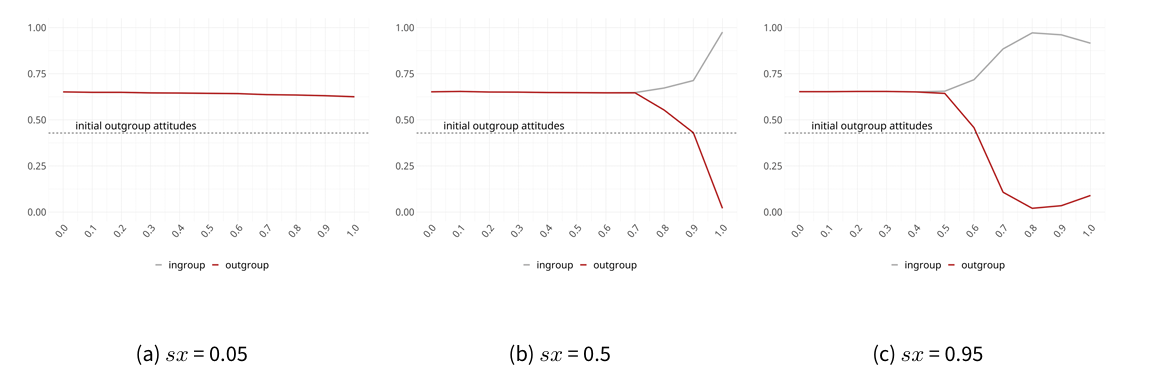
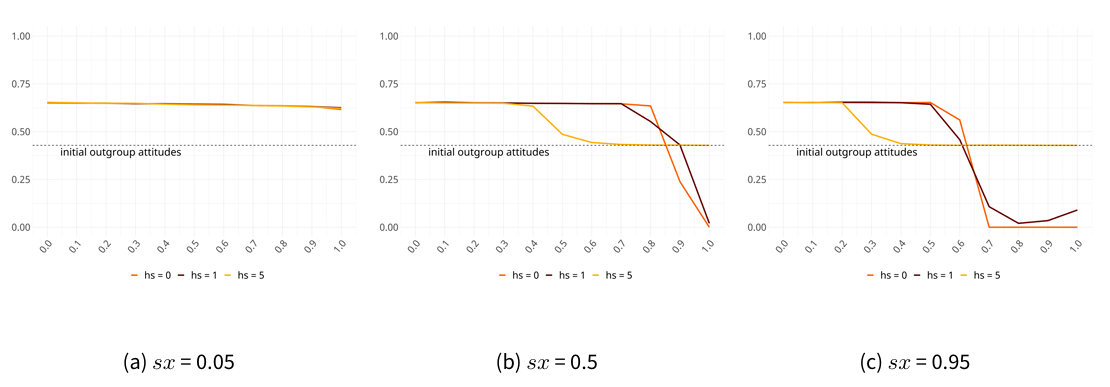
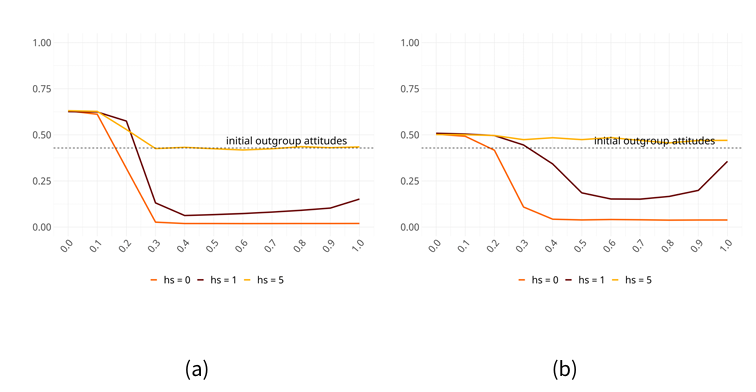
However, in the first run of Experiment 2, we found that intergroup bias has minimal impact on emergent outgroup attitudes and affective polarization when the bias is predominantly attitudinal (\(sx\) = 0.05). In sharp contrast to Experiment 1, we observed that “contact always works” in this region of the parameter space. While this finding is important in itself, it obscures some instructive structural similarities between the effects of xenophobia and attitudinal bias. Probing deeper into the reasons for the contrasting results, we found that effects of predominantly xenophobic and predominantly attitudinal intergroup bias become similar when the threshold for negative interactions \(d_{th}\) is less restrictive than in our baseline scenario. Appendix C offers a detailed explanation of this finding, including additional experiments that explore the extreme case of entirely attitudinal intergroup bias (\(\beta_X = 0\)) at different levels of the threshold \(d_{th}\). In a nutshell, when bias is mainly attitudinal, the likelihood of negative interactions in between-group encounters is very low with \(d_{th}=0.75\), because in our baseline scenario initial intergroup bias is relatively mild. However, when we decrease the threshold for negative interactions to \(d_{th}=0.5\), even primarily attitudinal intergroup bias again affects outcomes. This led us to modify the baseline scenario for Experiment 2 by setting \(d_{th}=0.5\).
Below, we report the results of this experiment under baseline conditions. We find that intergroup bias effects on contact and polarization remain largely robust when bias is driven by xenophobia, but diminish for \(d_{th}=0.5\) when bias is primarily attitudinal.
Appendix C. The Case of Purely Attitudinal Bias with Different Discrepancy Thresholds
Experiments 1.1 and 1.2 were based on the extremely pessimistic assumption that positive intergroup contact has no impact, meaning that bias is deeply entrenched and does not alter the likelihood or valence of between-group interactions, even as intergroup attitudes improve. In Experiment 2, we relaxed this assumption and examined the effects of a varying mix of xenophobia and attitudinal bias. In this section, we delve deeper into the extreme case of purely attitudinal bias (\(\beta_X = 0\)), providing a more detailed explanation of why the effects of attitudinal intergroup bias are structurally similar to those of xenophobic bias when \(d_{th}=0.5\), but diverge when \(d_{th}=0.75\).
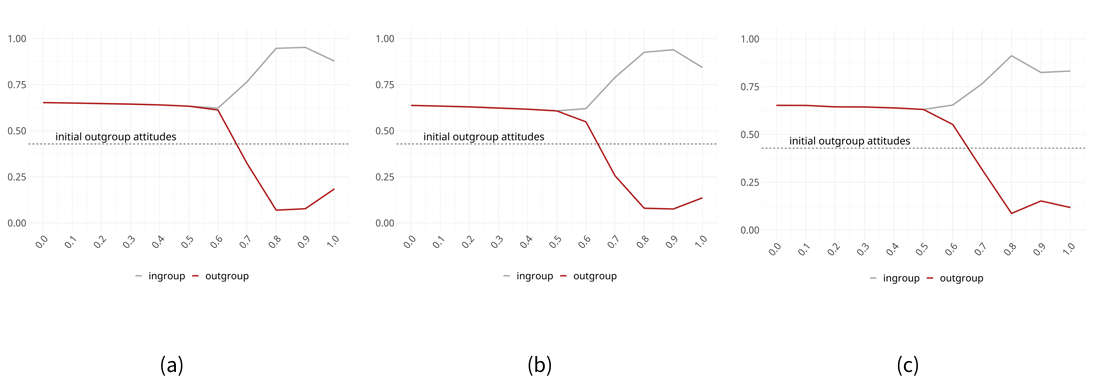
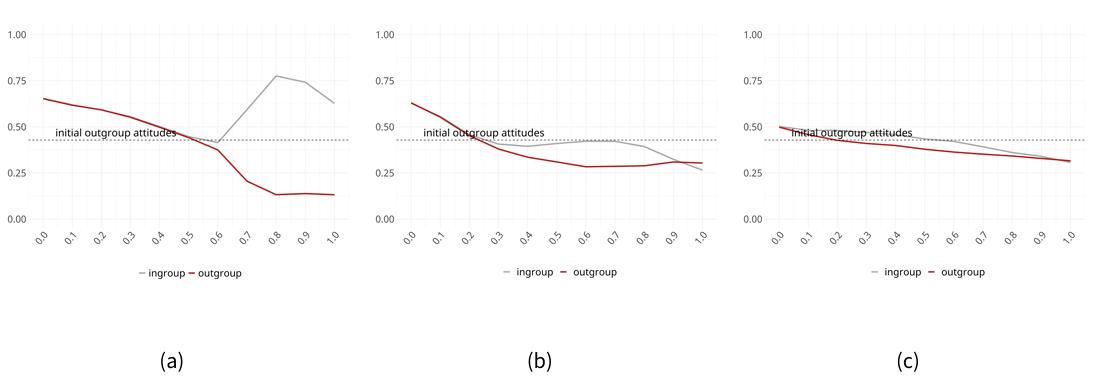
To establish a benchmark, we replicated Experiment 1.1 with one variation. Instead of increasing the weight of xenophobia (\(\beta_X\)) from 0 to 1, we now increase the weight of intergroup attitudes (\(\beta_A\)), while keeping \(\beta_X= 0\). All other parameters of the baseline scenario and the experimental design remain unchanged. Figure 13 a illustrates how varying \(\beta_A\) affects average intergroup attitudes after 10.000 simulation events in this experiment.
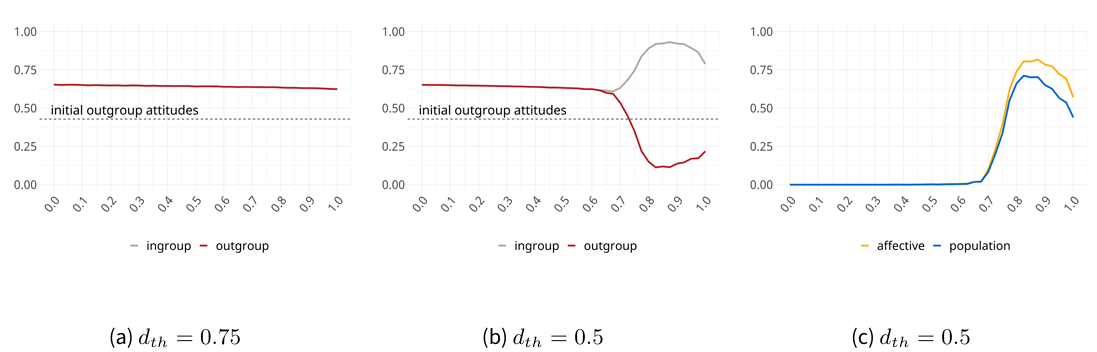
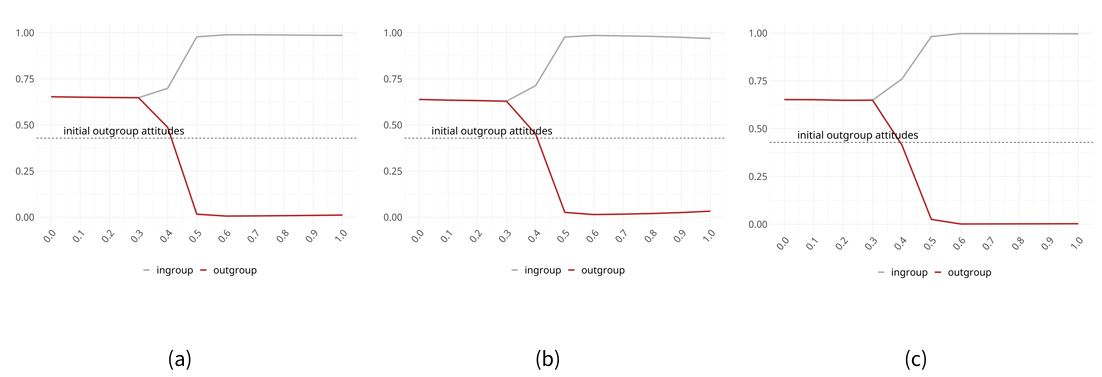
Figure 13a shows that \(\beta_A\) has, at best, a very weak effect on outgroup attitudes. The average outgroup attitudes decrease slightly, from about 0.65 to approximately 0.625, as \(\beta_A\) increases from 0 to 1. In stark contrast to Experiment 1.1, we find that “contact always works.” Even when influence and selection are entirely driven by intergroup attitudes (\(\beta_A= 1\)), affective polarization does not emerge, despite the presence of an initial intergroup bias.
The main reason for this difference is that the initial intergroup bias is relatively mild. According to Equation 3, the negative impact of a given weight of xenophobia (\(\beta_X\)) on perceived discrepancy with an outgroup member is always smaller than the negative impact of an unfavorable outgroup attitude \(\beta_A (1 - att_{Xit})\) at the same level of \(\beta_A\), unless an individual’s outgroup attitude is maximally negative (\(att_{Xit} = 0\)). In our baseline scenario, however, the average initial outgroup attitude is about \(att_{Xit} = 0.43\). This means that, for an average individual in our benchmark scenario, a disagreement of at least 0.942 is required before the influence weight becomes negative, which is well above the expected initial disagreement between members of different groups in this scenario.
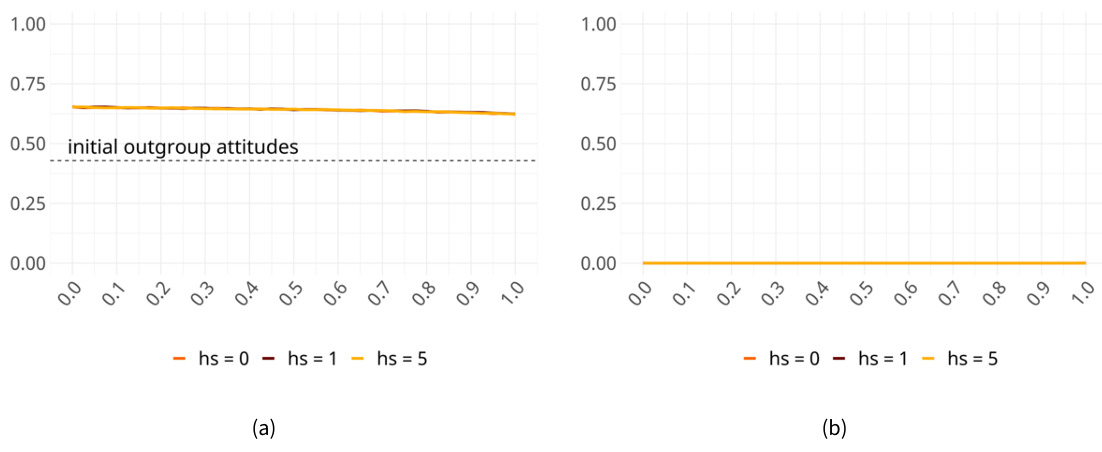
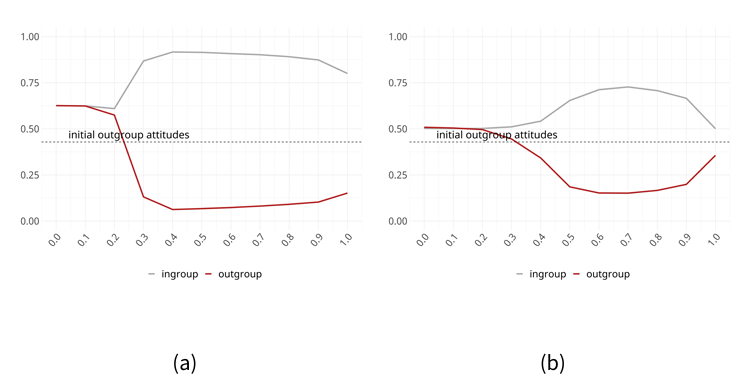
These results suggest that little affective polarization can be expected when varying both \(\beta_A\) and the impact of agents’ preferences on social selection. To test this, we conducted ceteris-paribus replications of Experiment 1.2, setting \(\beta_X\) to 0 while varying \(\beta_A\) from 0 to 1. The results, shown in Figures 14 and 14_t05, confirm that “contact works” regardless of the value of \(\beta_A\), even when varying the extent to which preferences for interaction partners can be enacted (parameter \(h_S\)).
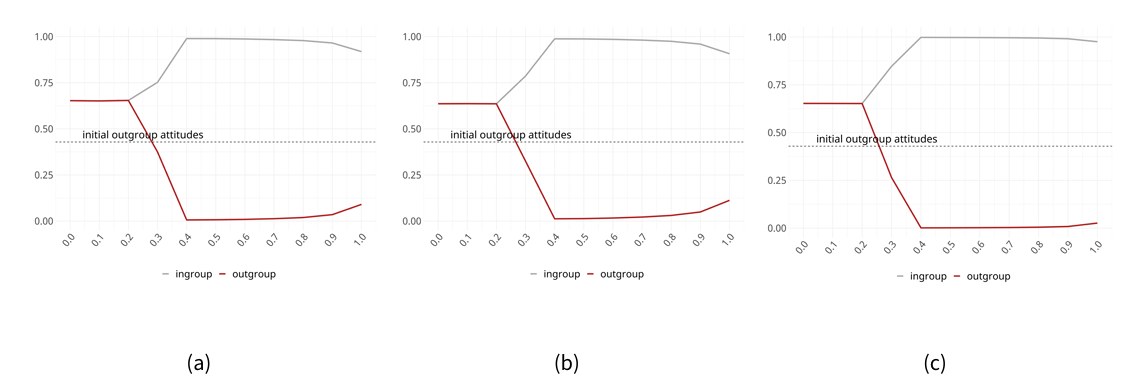
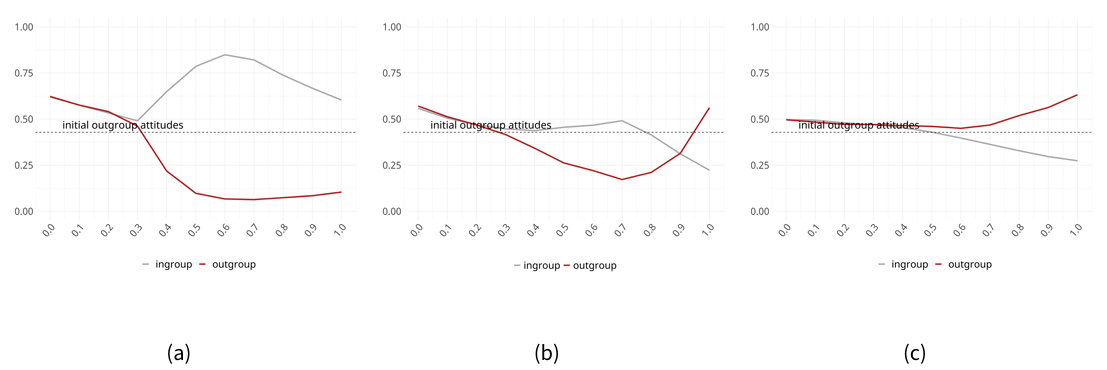
Analysis of why affective polarization is nearly impossible in these experiments highlights a crucial condition for a spiral of mutually increasing negative outgroup attitudes to emerge, even in the absence of xenophobia (\(\beta_X = 0\)). This condition is the likelihood of negative interactions during between-group encounters. To test this, we reduced the discrepancy threshold at which influence weights turn negative from \(d_{th}=0.75\) (the baseline scenario) to \(d_{th}=0.5\). Under this revised threshold, the disagreement needed to trigger a negative interaction between an average individual in the baseline scenario (with \(\beta_A= 0.375\)) and an outgroup member is reduced to 0.542. While negative interactions remain unlikely, they become more probable as \(\beta_A\) increases.
Figures 13b and 13c illustrate that with a lower threshold of \(d_{th} = 0.5\), the effect of a greater contribution of intergroup attitudes to overall bias mirrors the effect of xenophobia observed in Experiment 1.1. For \(\beta_A\) values below approximately 0.675, “contact works.” However, beyond this point, we observe a sudden shift to affective polarization. Similar to Experiment 1.1, affective polarization diminishes again as \(\beta_A\) approaches its theoretical maximum, beyond approximately \(\beta_A = 0.9\).
In Experiment 1, we observed that outgroup avoidance is the prime reason why extremely strong, entrenched xenophobia can mitigate affective polarization. The dynamics are very different when intergroup bias is based purely on attitudes, even though the final outcomes can appear similar. Specifically, the heterogeneity in individuals’ initial intergroup attitudes leads to complex and varied trajectories in their development when these attitudes influence how social interactions unfold. In this scenario, it becomes possible for groups to internally split between members with initially more favorable attitudes and those with less favorable attitudes toward their own group. Consequently, as the influence of intergroup attitudes on the valence and likelihood of both inter- and intra-group encounters increases, it becomes less likely that a clear pattern of affective polarization arises. This explains why Experiment 2.1 shows a non-linearity similar to that observed in Experiment 1.1, albeit for different reasons.
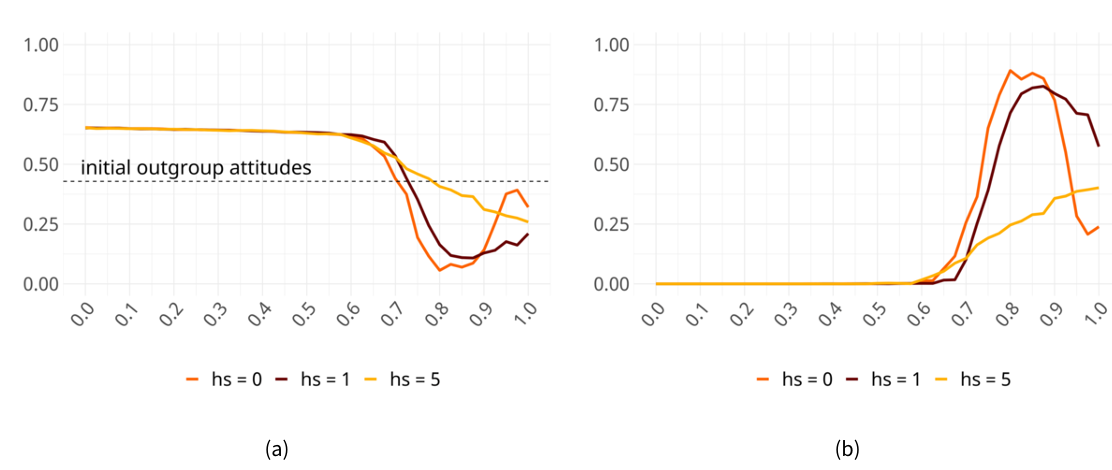
Figure 13_ind_runs illustrates this phenomenon with a representative simulation run involving a large contribution of intergroup attitudes to overall bias (\(\beta_A = 0.975\)).
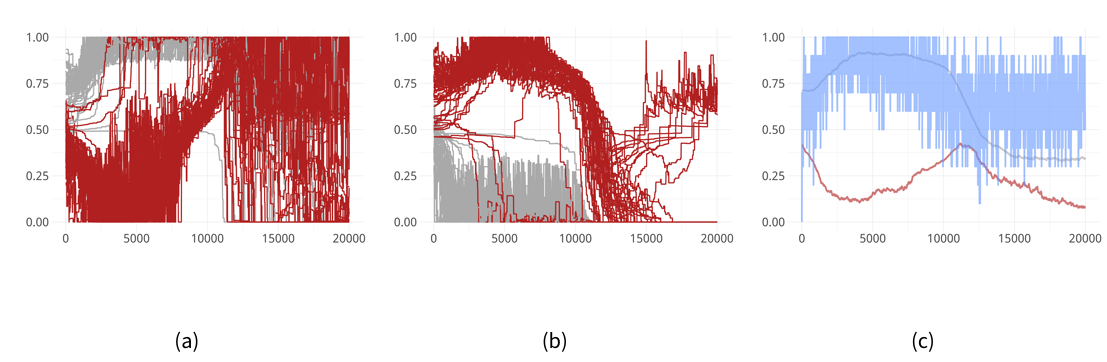
Initially, as shown in Figure 16, both groups trend toward affective polarization, with majorities in each group developing favorable ingroup attitudes and negative outgroup attitudes. This trend reflects the initial intergroup bias, which, given the strong impact of intergroup attitudes, induces outgroup avoidance and negative between-group interactions for most members. However, as Figure 13_ind_runs c illustrates, some between-group interactions still occur in this early phase, unlike in scenarios with deeply entrenched xenophobia.
After about 4,000 simulation events, the strong intergroup bias in group 1 suddenly collapses. Almost all members of group 1 begin to view their own group critically and later develop favorable attitudes toward group 0. This rapid shift is driven by initial “ingroup critics” in group 1, represented by a few red lines that moved to the “opposite camp” in Figures 13_ind_runs a and 13_ind_runs b, who by random chance had a sufficiently negative view of their own group to distance themselves from the majority and seek interaction with outgroup members. These individuals are influenced by the more favorable attitudes that group 0 members hold toward their own group, transforming them from “ingroup critics” into “ingroup haters and outgroup lovers.”
Paradoxically, while these individuals dislike their own group, the majority of group 1 members do not share this sentiment and continue to seek interaction with, and be positively influenced by, this renegade minority. Consequently, the majority of group 1 members eventually align with the minority’s views, even as the renegade minority remains resistant to influence from their fellow group members due to their negative view of their own group.
The shift in the majority of group 1 triggers a further rapid change. As shown in Figure 13_ind_runs a, after approximately 10.000 simulation events, some members of both groups begin to develop negative attitudes toward group 0, initiating a phase of erratic attitude fluctuations within both groups. This turmoil arises from a dilemma faced by group 0 members, who suddenly find that most members of group 1 share their favorable view of group 0 but prefer to disagree with them due to their negative view of group 1. This situation leads to a sudden shift in attitudes among some group 0 members, which in turn influences some members of group 1, who continue to have positive feelings toward group 0.
The dynamic has not settled into a stable pattern even after 20.000 simulation events. As demonstrated by a longer run, which extended to 50.000 simulation events13, both groups remained internally divided, indicating that the system does not reach equilibrium within the observed timeframe.
The run depicted in Figure 16 is representative of a broader pattern observed when there is initial heterogeneity in intergroup attitudes and these attitudes significantly contribute to the overall bias. The greater this contribution, the higher the likelihood that groups will internally split into members who hold favorable views of their own group and those who strongly dislike it. Additionally, there is a potential for the emergence of “universal critics,” individuals who harbor strong negative attitudes toward both their own group and the outgroup. In the simulation shown in Figure 13_ind_runs, the majority of group 1 members fall into this category, along with a minority from group 0.
Both the internal division within groups and the emergence of ingroup critics as well as universal critics impede the formation of clear patterns of affective polarization.
Appendix D. Robustness Checks
This Appendix presents a series of analyses testing the robustness of our core findings in Experiments 1 and 2 against variations in population size and composition, as well as the inclusion of random deviations in the social influence processes in our model, and a higher number of simulation events.
We replicated Experiment 1.1 (Figure 6) with 50.000 simulations events (i.e., allowing the simulation to run five times as long). This yielded qualitatively the same non-linearity in the effects of \(\beta_X\), but the effects were more pronounced (see Figure 6_rob).
A set of experiments relaxed the assumption of equal group sizes, making one group take 75% and the other 25% of the population, while keeping other conditions constant. The results remained nearly identical to those obtained with equally sized groups (see Figures 18 b– 26 b).
One more set of experiments reduced the population size to \(N = 30\), while maintaining equal group sizes. Most qualitative results from Experiments 1 and 2 were replicated, but some subtle effects changed. Specifically, the finding that very strong intergroup bias reduced affective polarization, even when driven predominantly by attitudinal bias (small \(sx\)), was not consistently replicated (see Figures 21, 23 ). We suspect that the reason is that with the relatively small subgroups of size 15, there is less room for the internal groups splits that previously induced a decline of affective polarization. For the same reason, we believe, the effects of the extent to which social selection preferences can be enacted (\(h_S\)) on outgroup attitudes and affective polarization were less pronounced in the smaller population of \(N = 30\), particularly when intergroup bias was mainly attitudinal (small \(sx\), see Figure 24 ).
Finally, we added to agents’ attitudes small levels of random deviation from the outcomes of the social influence process implemented in the model (see Section 2.1). Technically, noise was introduced by adding to agents’ attitudes after an interaction a random number, drawn from a normal distribution with mean value zero and standard deviation \(\sigma\) (white noise). Equations ¿eq:eq1A? to 9 formalize how the implementation of Equations 1 and 2 was modified for the purposes of this robustness test:
| \[\begin{gathered} att_{0i,t+1} = att_{0it}+\mu w_{ijt} \ (att_{0jt}-att_{0it}) + \xi \\ att_{1i,t+1} = att_{1it}+\mu w_{ijt} \ (att_{1jt}-att_{1it}) + \xi \\ \text{where } \xi \sim \mathcal{N}(0,\,\sigma^{2}) \end{gathered}\] | \[(10)\] |
Following the addition of the random noise term, attitudes exceeding interval boundaries were capped to the nearest interval boundary of the unit interval \([0,1]\). We found that adding this random noise did not lead to qualitative changes in the results when the noise level was low. However, some qualitative effects diminished or disappeared entirely when the noise exceeded a critical threshold. Broadly, random variation of 1–3% of the attitude scale did not affect the qualitative effects of our experiments, but higher levels of noise sometimes changed the results (see Figures 18_noise– 35).
Replication of Experiment 1: Effect of the contribution of xenophobia to overall bias (\(\beta_X\))

Replication of Experiment 2: Effect of the joint contribution of xenophobia and attitudinal bias to overall bias (\(\beta_{XA}\))
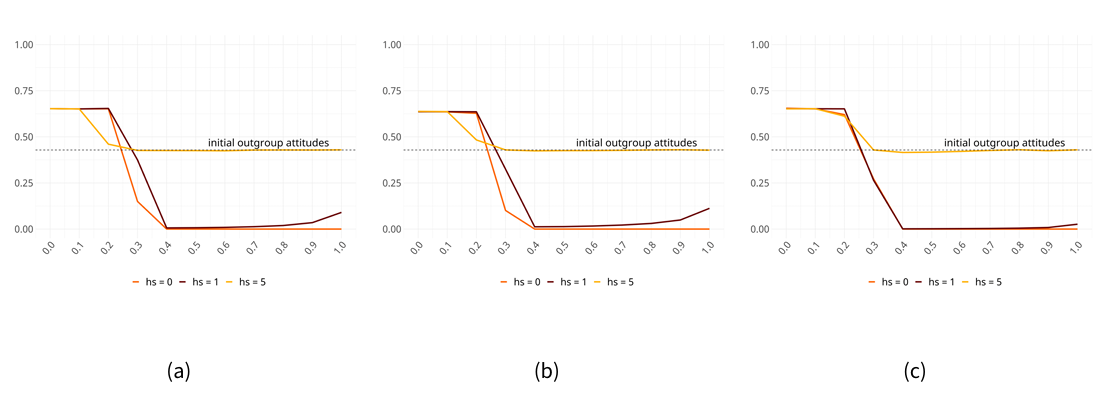
Replication of Experiment 1: Effect of the contribution of xenophobia to overall bias (\(\beta_X\))
Replication of Experiment 2: Effect of the joint contribution of xenophobia and attitudinal bias to overall bias (\(\beta_{XA}\))
Notes
- Note that intergroup contact theory predominantly focuses on effects of contact on outgroup attitudes. The opinion dynamics framework we use here naturally leads us to extend influence to both in- and outgroup attitudes↩︎
- The model has been implemented in NetLogo (Wilensky 1999). The code and documentation are available open access on ComSES: https://www.comses.net/codebases/a1b89f1d-f99b-41d7-8054-9db4a1b0aed6/releases/1.0.0/↩︎
- In the main experiments, we keep N fixed at 110, with 55 agents per group, for computational tractability. Other population sizes are tested during robustness checks (see Appendix D).↩︎
- Groups are equally large to disentangle choice homophily (based on preferences) from opportunities for intergroup interaction, which is based on relative group size. Other relative group sizes are tested during robustness checks (see Appendix D).↩︎
- It can be guaranteed that \(d_{ijt}\) falls between zero and one because the three weighted terms and weights themselves in Equation 3 are all expressed within boundaries [0;1], and the weights sum up to 1.↩︎
- Following the notion of the zone of indifference introduced in Jager & Amblard (2005), we employ a quadratic function \((s = 2)\) to represent the idea that, when the discrepancy is near the threshold value, changes in discrepancy have little impact on the influence weight.↩︎
- See Appendices B and C for comments on and robustness tests varying the discrepancy threshold value.↩︎
- \(i\)’s attitude towards \(j\)’s group matters here inasmuch as this attitude contributes to the discrepancy between these agents, i.e., the corresponding term in the equation is greater when \(i\)’s attitudes towards \(j\) are less positive. Therefore, the reverse of the attitude is used.↩︎
- To control for the possibility that polarization occurs, but not between the two groups, we report an additional outcome measure called population polarization. Appendix A explains how the measure is computed.↩︎
- For the model parameters that remain fixed throughout the experiments, Appendix D presents robustness analyses that test the main results for different parameter settings of the baseline scenario.↩︎
- Here and in the following analyses, we observed that affective polarization and population polarization are closely linked, indicating that almost all polarization is between the two groups. For clarity, from here on the figures show only the measure of affective polarization.↩︎
- See Appendix B for the discussion of the threshold value in Experiment 2 and the robustness check with the baseline threshold value↩︎
- Conducted with the same random seed and same parametrization.↩︎
References
ABRAMS, D., & Hogg, M. A. (1990). Social identification, self-categorization and social influence. European Review of Social Psychology, 1(1), 195–228. [doi:10.1080/14792779108401862]
AGUIAR, F., & Parravano, A. (2015). Tolerating the intolerant: Homophily, intolerance, and segregation in social balanced networks. Journal of Conflict Resolution, 59(1), 29–50. [doi:10.1177/0022002713498708]
ALLPORT, G. W. (1954). The Nature of Prejudice. Addison-Wesley.
AL Ramiah, A., Hewstone, M., Little, T. D., & Lang, K. (2014). The influence of status on the relationship between intergroup contact, threat, and prejudice in the context of a nation-building intervention in Malaysia. Journal of Conflict Resolution, 58(7), 1202–1229. [doi:10.1177/0022002713492634]
ARNADÓTTIR, K., Lolliot, S., Brown, R., & Hewstone, M. (2018). Positive and negative intergroup contact: Interaction not asymmetry. European Journal of Social Psychology, 48(6), 784–800.
BAIL, C. A., Argyle, L. P., Brown, T. W., Bumpus, J. P., Chen, H., Hunzaker, M. B. F., Lee, J., Mann, M., Merhout, F., & Volfovsky, A. (2018). Exposure to opposing views on social media can increase political polarization. Proceedings of the National Academy of Sciences, 115(37), 9216–9221. [doi:10.1073/pnas.1804840115]
BALDASSARRI, D., & Bearman, P. (2007). Dynamics of political polarization. American Sociological Review, 72(5), 784–811. [doi:10.1177/000312240707200507]
BAUMANN, F., Lorenz-Spreen, P., Sokolov, I. M., & Starnini, M. (2020). Modeling echo chambers and polarization dynamics in social networks. Physical Review Letters, 124(4), 048301. [doi:10.1103/physrevlett.124.048301]
BECKER, J. C., & Tausch, N. (2014). When group memberships are negative: The concept, measurement, and behavioral implications of psychological disidentification. Self and Identity, 13(3), 294–321. [doi:10.1080/15298868.2013.819991]
BEELMANN, A., & Heinemann, K. S. (2014). Preventing prejudice and improving intergroup attitudes: A meta-analysis of child and adolescent training programs. Journal of Applied Developmental Psychology, 35(1), 10–24. [doi:10.1016/j.appdev.2013.11.002]
BHAVNANI, R., & Miodownik, D. (2009). Ethnic polarization, ethnic salience, and civil war. Journal of Conflict Resolution, 53(1), 30–49. [doi:10.1177/0022002708325945]
BOIN, J., Rupar, M., Graf, S., Neji, S., Spiegler, O., & Swart, H. (2021). The generalization of intergroup contact effects: Emerging research, policy relevance, and future directions. Journal of Social Issues, 77(1), 105–131. [doi:10.1111/josi.12419]
BRACEGIRDLE, C., Reimer, N. K., Zalk, M. van, Hewstone, M., & Wölfer, R. (2022). Disentangling contact and socialization effects on outgroup attitudes in diverse friendship networks. Journal of Personality and Social Psychology, 122(1), 1–15. [doi:10.1037/pspa0000240]
BRAMSON, A., Grim, P., Singer, D. J., Fisher, S., Berger, W., Sack, G., & Flocken, C. (2016). Disambiguation of social polarization concepts and measures. The Journal of Mathematical Sociology, 40(2), 80–111. [doi:10.1080/0022250x.2016.1147443]
BYRNE, D. (1971). The Attraction Paradigm. Academic Press.
CHIANG, Y.-S. (2021). Indirect reciprocity for mitigating intergroup hostility: A vignette experiment and an agent-based model on intergroup relations between Mainland Chinese and Taiwanese. Journal of Conflict Resolution, 65(2-3), 403–426. [doi:10.1177/0022002720962209]
DANDEKAR, P., Goel, A., & Lee, D. T. (2013). Biased assimilation, homophily, and the dynamics of polarization. Proceedings of the National Academy of Sciences, 110(15), 5791–5796. [doi:10.1073/pnas.1217220110]
DEFFUANT, G., Neau, D., Amblard, F., & Weisbuch, G. (2000). Mixing beliefs among interacting agents. Advances in Complex Systems, 03(01n04), 87–98. [doi:10.1142/s0219525900000078]
DUCKITT, J., & Mphuthing, T. (1998). Group identification and intergroup attitudes: A longitudinal analysis in South Africa. Journal of Personality and Social Psychology, 74(1), 80–85. [doi:10.1037//0022-3514.74.1.80]
FELICIANI, T., Flache, A., & Mäs, M. (2021). Persuasion without polarization? Modelling persuasive argument communication in teams with strong faultlines. Computational and Mathematical Organization Theory, 27(1), 61–92. https://doi.org/10.1007/s10588-020-09315-8 [doi:10.1007/s10588-020-09315-8]
FELICIANI, T., Flache, A., & Tolsma, J. (2017). How, when and where can spatial segregation induce opinion polarization? Two competing models. Journal of Artificial Societies and Social Simulation, 20(2), 6. [doi:10.18564/jasss.3419]
FELICIANI, T., Tolsma, J., & Flache, A. (2023). Ethnic segregation and spatial patterns of attitudes: Studying the link using register data and social simulation. Journal of Computational Social Science, 6, 877–921. [doi:10.1007/s42001-023-00216-9]
FESTINGER, L. (1962). A Theory of Cognitive Dissonance. Stanford University Press.
FLACHE, A. (2018). About renegades and outgroup haters: Modeling the link between social influence and intergroup attitudes. Advances in Complex Systems, 21(06n07), 1850017. [doi:10.1142/s0219525918500170]
FLACHE, A., & Macy, M. W. (2011). Small worlds and cultural polarization. The Journal of Mathematical Sociology, 35(1–3), 146–176. [doi:10.1080/0022250x.2010.532261]
FLACHE, A., Mäs, M., Feliciani, T., Chattoe-Brown, E., Deffuant, G., Huet, S., & Lorenz, J. (2017). Models of social influence: Towards the next frontiers. Journal of Artificial Societies and Social Simulation, 20(4), 2. [doi:10.18564/jasss.3521]
GAERTNER, S., & Dovidio, J. F. (2014). Reducing Intergroup Bias: The Common Ingroup Identity Model. Psychology Press.
GENTZKOW, M. (2016). Polarization in 2016 [White Paper]. Toulouse Network of Information Technology. https://web.stanford.edu/~gentzkow/research/PolarizationIn2016.pdf
GIDRON, N., Adams, J., & Horne, W. (2023). Who dislikes whom? Affective polarization between pairs of parties in Western democracies. British Journal of Political Science, 53(3), 997–1015. [doi:10.1017/s0007123422000394]
HAGENDOORN, L. (1995). Intergroup biases in multiple group systems: The perception of ethnic hierarchies. European Review of Social Psychology, 6(1), 199–228. [doi:10.1080/14792779443000058]
HAREL, T. O., Nir, N., Vandermeulen, D., Maoz, I., & Halperin, E. (2024). A threat to cohesion: Intragroup affective polarization in the context of intractable intergroup conflict. Journal of Conflict Resolution, 69(2–3). [doi:10.1177/00220027241247033]
HEGSELMANN, R., & Krause, U. (2002). Opinion dynamics and bounded confidence: Models, analysis and simulation. Journal of Artificial Societies and Social Simulation, 5(3), 2.
HEIDER, F. (1967). Attitudes and Cognitive Organization. In M. Fishbein (Ed.), Readings in Attitude Theory and Measurement (pp. 39–41). John Wiley & Sons, Inc.
HEINKE, D., Carslaw, G., & Christian, J. (2013). An agent-based simulation of destigmatization (DSIM): Introducing a contact theory and self-fulfilling prophecy approach. Journal of Artificial Societies and Social Simulation, 16(4), 10. [doi:10.18564/jasss.2244]
HEWSTONE, M., Ramiah, A. A., Schmid, K., Floe, C., Zalk, M. van, Wölfer, R., & New, R. (2018). Influence of segregation versus mixing: Intergroup contact and attitudes among White-British and Asian-British students in high schools in Oldham, England. Theory and Research in Education, 16(2), 179–203. [doi:10.1177/1477878518779879]
HEWSTONE, M., Rubin, M., & Willis, H. (2002). Intergroup bias. Annual Review of Psychology, 53(1), 575–604. [doi:10.1146/annurev.psych.53.100901.135109]
HUET, S., & Deffuant, G. (2010). Openness leads to opinion stability and narrowness to volatility. Advances in Complex Systems, 13(03), 405–423. [doi:10.1142/s0219525910002633]
IYENGAR, S., Lelkes, Y., Levendusky, M., Malhotra, N., & Westwood, S. J. (2019). The origins and consequences of affective polarization in the United States. Annual Review of Political Science, 22(1), 129–146. [doi:10.1146/annurev-polisci-051117-073034]
JAGER, W., & Amblard, F. (2005). Uniformity, bipolarization and pluriformity captured as generic stylized behavior with an agent-based simulation model of attitude change. Computational & Mathematical Organization Theory, 10(4), 295–303. [doi:10.1007/s10588-005-6282-2]
KEIJZER, M., Mäs, M., & Flache, A. (2024). Polarization on social media: Micro-level evidence and macro-level implications. Journal of Artificial Societies and Social Simulation, 27(1), 7. [doi:10.18564/jasss.5298]
KHUU, T. V., Schaefer, D. R., Umaña-Taylor, A. J., & Ryan, A. M. (2023). The limitations of intergroup friendship: Using social network analysis to test the pathways linking contact and intergroup attitudes in a multigroup context. Socius, 9. [doi:10.1177/23780231231161048]
KOZITSIN, I. V. (2023). Opinion dynamics of online social network users: A micro-level analysis. The Journal of Mathematical Sociology, 47(1), 1–41. [doi:10.1080/0022250x.2021.1956917]
LAURENCE, J., & Bentley, L. (2018). Countervailing contact: Community ethnic diversity, anti-immigrant attitudes and mediating pathways of positive and negative inter-ethnic contact in European societies. Social Science Research, 69, 83–110. [doi:10.1016/j.ssresearch.2017.09.007]
LEMMER, G., & Wagner, U. (2015). Can we really reduce ethnic prejudice outside the lab? A meta-analysis of direct and indirect contact interventions. European Journal of Social Psychology, 45(2), 152–168. [doi:10.1002/ejsp.2079]
LESZCZENSKY, L., & Pink, S. (2019). What drives ethnic homophily? A relational approach on how ethnic identification moderates preferences for same-ethnic friends. American Sociological Review, 84(3), 394–419. [doi:10.1177/0003122419846849]
LIU, C. C., & Srivastava, S. B. (2015). Pulling closer and moving apart: Interaction, identity, and influence in the u.s. Senate, 1973 to 2009. American Sociological Review, 80(1), 192–217. [doi:10.1177/0003122414564182]
LIU, S., Mäs, M., Xia, H., & Flache, A. (2023). Job done? Future modeling challenges after 20 years of work on bounded-confidence models. Journal of Artificial Societies and Social Simulation, 26(4), 8. [doi:10.18564/jasss.5137]
LOSEVA, A., Steglich, C., & Flache, A. (2026). Simulating downward spirals of interethnic hostility in empirical school networks. Network Science, 14, e21. [doi:10.1017/nws.2026.10042]
MACY, M. W., Kitts, J. A., Flache, A., & Benard, S. (2003). Polarization in dynamic networks: A Hopfield model of emergent structure. In R. Breiger, K. Carley, & P. Pattison (Eds.), Dynamic Social Network Modeling and Analysis (pp. 162–173). The National Academies Press.
MACY, M. W., Ma, M., Tabin, D. R., Gao, J., & Szymanski, B. K. (2021). Polarization and tipping points. Proceedings of the National Academy of Sciences, 118(50), e2102144118. [doi:10.1073/pnas.2102144118]
MÄS, M., & Flache, A. (2013). Differentiation without distancing. Explaining bi-polarization of opinions without negative influence. PLoS One, 8(11), e74516.
MÄS, M., Flache, A., Takács, K., & Jehn, K. A. (2013). In the short term we divide, in the long term we unite: Demographic crisscrossing and the effects of faultlines on subgroup polarization. Organization Science, 24(3), 716–736.
MCDONALD, S., Lin, N., & Ao, D. (2009). Networks of opportunity: Gender, race, and job leads. Social Problems, 56(3), 385–402. [doi:10.1525/sp.2009.56.3.385]
MCPHERSON, M., Smith-Lovin, L., & Cook, J. M. (2001). Birds of a feather: Homophily in social networks. Annual Review of Sociology, 27(1), 415–444. [doi:10.1146/annurev.soc.27.1.415]
MUNNIKSMA, A., Stark, T. H., Verkuyten, M., Flache, A., & Veenstra, R. (2013). Extended intergroup friendships within social settings: The moderating role of initial outgroup attitudes. Group Processes & Intergroup Relations, 16(6), 752–770. [doi:10.1177/1368430213486207]
PAOLINI, S., Harwood, J., Hewstone, M., & Neumann, D. L. (2018). Seeking and avoiding intergroup contact: Future frontiers of research on building social integration. Social and Personality Psychology Compass, 12(12), e12422. [doi:10.1111/spc3.12422]
PETERSEN, L.-E., Dietz, J., & Frey, D. (2004). The effects of intragroup interaction and cohesion on intergroup bias. Group Processes & Intergroup Relations, 7(2), 107–118. [doi:10.1177/1368430204041397]
PETTIGREW, T. F. (2021). Advancing intergroup contact theory: Comments on the issue’s articles. Journal of Social Issues, 77(1), 258–273. [doi:10.1111/josi.12423]
PETTIGREW, T. F., & Tropp, L. R. (2006). A meta-analytic test of intergroup contact theory. Journal of Personality and Social Psychology, 90(5), 751–783. [doi:10.1037/0022-3514.90.5.751]
REKKER, R., & Harteveld, E. (2024). Understanding factual belief polarization: The role of trust, political sophistication, and affective polarization. Acta Politica, 59, 643–670. [doi:10.1057/s41269-022-00265-4]
RIVAS-DRAKE, D., Saleem, M., Schaefer, D. R., Medina, M., & Jagers, R. (2018). Intergroup contact attitudes across peer networks in school: Selection, influence, and implications for cross-group friendships. Child Development, 90(6), 1898–1916. [doi:10.1111/cdev.13061]
ROBBINS, J. M., & Krueger, J. I. (2005). Social projection to ingroups and outgroups: A review and meta-analysis. Personality and Social Psychology Review, 9(1), 32–47. [doi:10.1207/s15327957pspr0901_3]
SCHÄFER, S. J., Kauff, M., Prati, F., Kros, M., Lang, T., & Christ, O. (2021). Does negative contact undermine attempts to improve intergroup relations? Deepening the understanding of negative contact and its consequences for intergroup contact research and interventions. Journal of Social Issues, 77(1), 197–216.
SCHLUETER, E., Ullrich, J., Glenz, A., & Schmidt, P. (2018). From segregation to intergroup contact and back: Using experiments and simulation to understand the bidirectional link. European Journal of Social Psychology, 48(1), 17–32. [doi:10.1002/ejsp.2284]
SOBKOWICZ, P. (2009). Modelling opinion formation with physics tools: Call for closer link with reality. Journal of Artificial Societies and Social Simulation, 12(1), 11.
STARK, T. H., Flache, A., & Veenstra, R. (2013). Generalization of positive and negative attitudes toward individuals to outgroup attitudes. Personality and Social Psychology Bulletin, 39(5), 608–622. [doi:10.1177/0146167213480890]
STARK, T. H., Mäs, M., & Flache, A. (2015). Liking and disliking minority-group classmates: Explaining the mixed findings for the influence of ethnic classroom composition on interethnic attitudes. Social Science Research, 50, 164–176. [doi:10.1016/j.ssresearch.2014.11.008]
STARNINI, M., Baumann, F., Galla, T., Garcia, D., Iñiguez, G., Karsai, M., Lorenz, J., & Sznajd-Weron, K (2026). Opinion dynamics: Statistical physics and beyond. Reviews of Modern Physics, 98 (3), 035004. [doi:10.1103/j1zg-ddqv]
TAJFEL, H. (1982). Social Psychology of Intergroup Relations. Annual Review of Psychology, 33(1), 1–39. [doi:10.1146/annurev.ps.33.020182.000245]
TAKÁCS, K., Flache, A., & Mäs, M. (2016). Discrepancy and disliking do not induce negative opinion shifts. PLoS One, 11(6), e0157948.
TANG, T., Snijders, T. & Flache, A. (2026). An empirical and simulation investigation of bounded confidence and negative influence in opinion dynamics using Stochastic Actor-Oriented Model. Journal of Artificial Societies and Social Simulation, 28, 2, 1. [doi:10.18564/jasss.5566]
URSELMANS, L., & Phelps, S. (2018). A Schelling model with adaptive tolerance. PLOS ONE, 13(3), e0193950. [doi:10.1371/journal.pone.0193950]
VAN Zalk, M. H. W., Kerr, M., VAN Zalk, N., & Stattin, H. (2013). Xenophobia and tolerance toward immigrants in adolescence: Cross-influence processes within friendships. Journal of Abnormal Child Psychology, 41(4), 627–639. [doi:10.1007/s10802-012-9694-8]
VEELEN, R. van, Veldman, J., Van Laar, C., & Derks, B. (2020). Distancing from a stigmatized social identity: State of the art and future research agenda on self‐group distancing. European Journal of Social Psychology, 50(6), 1089–1107.
WEISBERG, H. F., & Rusk, J. G. (1970). Dimensions of candidate evaluation. American Political Science Review, 64(4), 1167–1185. [doi:10.2307/1958364]
WILENSKY, U. (1999). NetLogo [Http://ccl.northwestern.edu/netlogo/]. Center for Connected Learning; Computer-Based Modeling. http://ccl.northwestern.edu/netlogo/
WIMMER, A. (2008). The making and unmaking of ethnic boundaries: A multilevel process theory. American Journal of Sociology, 113(4), 970–1022. [doi:10.1086/522803]
WRIGHT, S. C., Aron, A., McLaughlin-Volpe, T., & Ropp, S. A. (1997). The extended contact effect: Knowledge of cross-group friendships and prejudice. Journal of Personality and Social Psychology, 73(1), 73–90. [doi:10.1037/0022-3514.73.1.73]
YIP, T., Douglass, S., & Shelton, J. N. (2013). Daily intragroup contact in diverse settings: Implications for Asian adolescents’ ethnic identity. Child Development, 84(4), 1425–1441. [doi:10.1111/cdev.12038]
ZHOU, S., Page-Gould, E., Aron, A., Moyer, A., & Hewstone, M. (2019). The extended contact hypothesis: A meta-analysis on 20 years of research. Personality and Social Psychology Review, 23(2), 132–160. [doi:10.1177/1088868318762647]
ZINGORA, T., & Flache, A. (2026). Who is most influential? Adolescents’ intergroup attitudes and peer influence within a social network. Group Processes & Intergroup Relations, 23(5), 684–709. [doi:10.1177/1368430219869460]
ZINGORA, T., Stark, T. H., & Flache, A. (2020). Effects of Friendship Influence and Normative Pressure on Adolescent Attitudes and Behaviors. Personality and Social Psychology Bulletin, 52(10), 3216–3234. [doi:10.1177/01461672251366388]