Harmonising Theory and Empirics: The THEMP Approach for Developing, Testing and Exploring Social Simulation Models

,
and
aInstitute For Future Studies, Stockholm, Sweden; bStockholm University, Stockholm, Sweden; cInstitute of Cognitive Sciences and Technologies, National Research Council, Rome, Italy
Journal of Artificial
Societies and Social Simulation 29 (4) 6
<https://www.jasss.org/29/4/6.html>
DOI: 10.18564/jasss.6211
Received: 19-Nov-2025 Accepted: 21-Sep-2026 Published: 31-Oct-2026
Abstract
This paper details an approach for explicitly integrating theoretical and empirical elements in the development and testing of agent-based social simulations for theory development. With empirically calibrated or data-driven agent-based models (ABMs) increasingly becoming the standard, discussions often dichotomise between empirical and theoretical approaches. We argue that many social simulation modellers inherently combine theory and empirics without a language to articulate this synergy. This paper outlines an approach that explicitly integrates theory and empirics during the process of ABM development and testing to support theorising. It illustrates the approach through an example ABM that investigates the role of norms and risk in addressing collective social dilemmas.Introduction
Agent-based modelling (ABM) is considered a powerful tool for developing and advancing theory in the social sciences. It offers a way to explore how complex social phenomena arise from the interdependence and interactions of individual actions situated in their environment where traditional analytic approaches fall short, and, as many have argued, is a tool that should be utilised more (Grimm et al. 2024; Lorscheid et al. 2019). Many have highlighted its added value for theory development in the social sciences, for example, in psychology (Eberlen et al. 2017; Hughes et al. 2012; Smaldino et al. 2015; Smith & Conrey 2007), criminology (Gerritsen & Elffer, 2020; Groff & Badham, 2020), geography (Sun et al. 2023), economics (Chávez‐Juárez 2017), sustainability science (Schlüter et al. 2019, 2022; Secchi et al. 2024), and sociology (Bianchi & Squazzoni 2015; Bruch & Atwell 2013; Chattoe-Brown 2013). Hence, the importance of ABM for theory development is widely acknowledged, yet as the way the field has matured and increasingly incorporated empirical data, we have observed that model descriptions often highlight data and methods over theory, unintentionally leaving the role of theory in the modelling process implicit. This inadvertently makes the role of theory less prominent and inhibits the interplay between theory and empirics required to develop good explanations.
In its earliest applications, social simulation was primarily used for theory development (Conte & Paolucci 2014; Gilbert & Troitzsch 2005; Troitzsch 2013), to understand how complex phenomena emerge from the feedback between micro-level interactions and the macro-level patterns they produce. These phenomena were difficult to reproduce with traditional mathematical or analytical models (Heckbert et al. 2010). These models demonstrated the explanatory potential of social simulation, but often remained distant from the real world. Nowadays, partially because of a rapid increase in data availability and improved computing power, the focus has shifted almost completely to empirical models – models in close(r) connection to the phenomenon we aim to explain or relate to (Boero & Squazzoni 2005; Bruch & Atwell 2013). This development has advanced methodological rigour and brought new cumulative practices, standards, and clear and transparent communication on how empirics are used in models. For example, it has brought conceptual and methodological clarity by categorising the different relations that exist between the model and the empirical evidence(Boero & Squazzoni 2005), by insisting on explicit vocabulary to describe how empirics are used (Smajgl & Barreteau 2014), and by documenting data through standardised protocols (e.g., the RAT protocol, Achter et al. 2022). Multi-method approaches have also become common, combining ABM with behavioural experiments (Andrighetto et al. 2013; Szekely et al. 2020; Wijermans et al. 2022), ABM with qualitative studies (Ghorbani et al. 2015; Polhill et al. 2010; Yang & Gilbert 2008), ABM and process-oriented analysis (Chattoe‐Brown 2020), or in general about combining ABM with other empirical methods (Janssen & Ostrom 2006; Robinson et al. 2007).
This shift from theory-only to data-rich approaches not only has resulted in advancements in methodological rigour, but also boosted model credibility and made empirically-based modelling the new norm in social simulation. In practice, this means that to differentiate from early models, scholars signal their use of data by labelling their model as empirical, even when theory still guides its design. A rare and recent exception to this is the BIM (Being In the Middle) approach that integrates empirics and inter- and/or transdisciplinary collaboration processes to advance theory through ABM in sustainability science (Schlüter et al. 2025). This contrast highlights a broader point: Overemphasising the empirical side in our language may hinder theoretical progress. We advocate for balancing theory and empirics to preserve modelling’s core capacity for theoretical advancement.
Developing theory involves an iterative process: proposing explanations for the phenomena under study, testing these explanations with data, and refining existing theories or exploring new ones. Creativity and subjectivity are central to this process, yet they are often left implicit. The generative moment of theory, when ideas emerge, does not follow the rules of formal logic. In practice, empirical evidence is often used only to justify theory rather than to create it.
This issue cannot be resolved simply by setting additional shared standards for justification. Instead, we need to support and structure the process of scientific discovery—engaging in theorising, creatively generating explanations, and adapting our modelling practices and use of language. In this paper, we aim to improve our ability to theorise by making explicit the interplay of theory and empirics throughout the entire modelling process – acknowledging both the context of discovery (creativity) and the context of justification (rigour) in theory development.
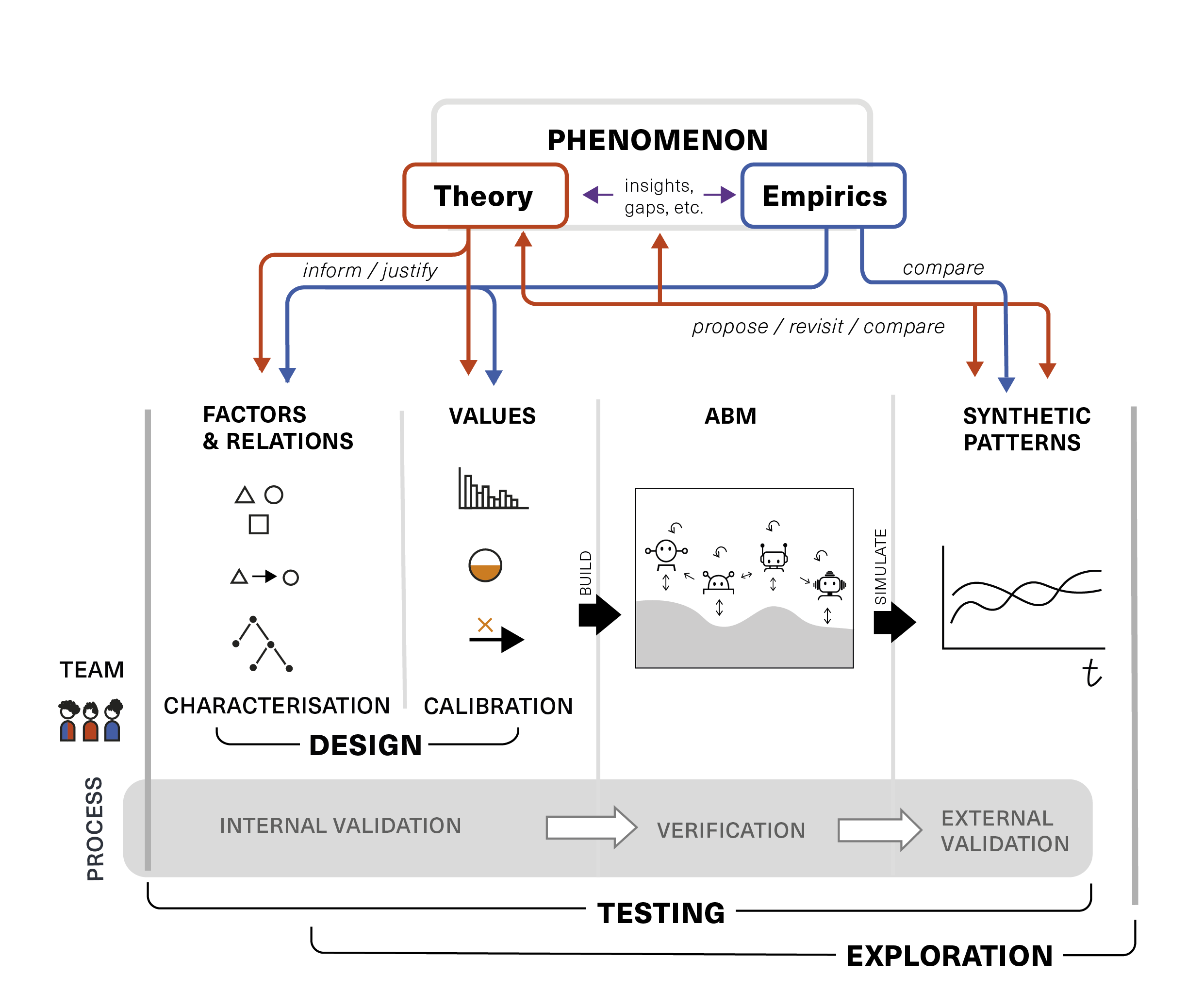
We introduce the THEMP (THEory and EMPirics) approach, designed to contribute to the creative aspects of theory development by allowing both theory and empirics to take the centre stage. THEMP visually and textually enables researchers to harmonise theoretical reasoning with empirical insights, supporting the researchers’ reflections during the modelling process, and guiding audiences in understanding the process once final outcomes are presented or published. THEMP gives special attention to the design stage (characterisation and calibration), the testing stage (process, internal, verification, and external validation) and the exploration stage of agent-based social simulation, all with the goal of supporting the development of highly explanatory theories.
The remainder of the paper is structured as follows. Section 2 introduces key notions, such as theory and the distinction between theoretical and empirical modelling, and clarifies how THEMP positions itself. Section 3 details the THEMP approach across all stages of the modelling process. Section 4 illustrates the approach using the Norm@Risk model, which combines behavioural experiments with agent-based modelling to test and advance theory. Section 5 concludes by discussing how THEMP, by embracing both theory and empirics, can better support theory development with social simulation.
Background
To discuss theory development with agent-based social simulation, we focus on models that explicitly engage with both theory and empirical evidence. Theory can have wildly different meanings (Antosz et al. 2023). Here, following Swedberg (2012), we understand it as the effort to explain empirical observations, ranging from early sense-making to middle-range theories to more general abstractions. Theorising (the process leading to theory), in this view, is an ongoing process of developing, testing, and refining explanations. This process is never complete, and it is precisely this iterative cycle that THEMP aims to support. By empirics, lastly, we mean data, evidence, and narratives that connect models to the real-world phenomena they seek to explain.
Models in agent-based social simulation can serve very different purposes i.e., prediction, explanation, description, theoretical exploration, illustration, analogy, and social interaction (Edmonds et al. 2019). The general debate about theory and empirics often contrasts theoretical and empirical models, as if they were distinct, dichotomous categories. However, if one regards them not as separate categories but as continuous dimensions, a richer variety of models can be distinguished, each serving specific purposes. Importantly, a model’s purpose shapes the consequent choices researchers make throughout the modelling process, including model building, testing, and justification.
Figure 1 (adapted from Edmonds et al. 2019) maps model purposes onto axes of theoretical and empirical use. Models that rely primarily on empirics, but are theory-free (upper left quadrant), are typically aimed at description, representing key features of a particular case, or prediction, anticipating data patterns based on observed regularities. On the opposite diagonal (bottom right quadrant), models grounded in theory, but are empirics-free, often serve purposes of theoretical exposition, such as characterising (or assessing) hypotheses about mechanisms without direct reference to observed data (Edmonds et al. 2019).
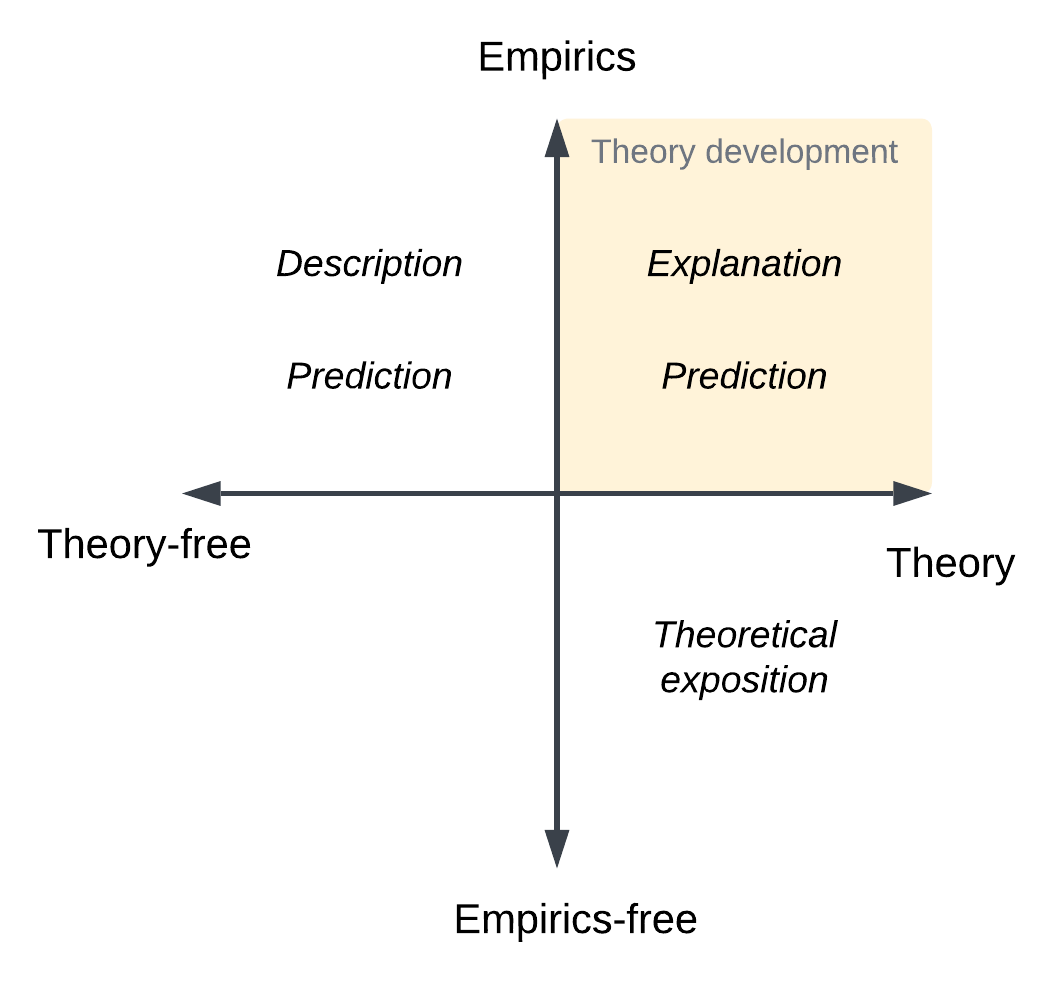
Our main interest lies in the upper right quadrant, which characterises models that combine both theory and empirics. These models typically aim for prediction or explanation and engage in theory development. Predictive models in this space use empirics to evaluate a model’s ability to anticipate data or contrast the value of different theories or hypotheses (falsification). Explanatory models seek to understand why a phenomenon of interest occurs by explicitly representing a causal chain (mechanism), testing its ability to reproduce the empirical pattern and exploring the explanatory power of the model. Hence, the credibility of predictive models is judged primarily by the accuracy of their outcomes, explanatory models derive instead their credibility from embedding plausible – often empirically embedded – micro-foundations and micro-level processes that are able to reproduce the target phenomenon.
This explicit link between theory and empirics supports the iterative process of sense-making that characterises middle-range theories (Epstein 2012; Manzo 2022; Merton 1968), revealing the mechanisms that link specific empirical observations to broader theoretical patterns. THEMP positions itself in this space, offering a framework that allows for building theories with high explanatory power by making the interaction between theory and empirics explicit at every stage of the modelling process.
THEMP Approach
To support theory development, THEMP provides a structured approach for integrating both theoretical and empirical insights throughout all stages of the modelling process. It assumes a cyclical and iterative process of theory creation, revision, and testing. It can be useful when existing theories cannot (fully) explain empirical observations, when there are multiple competing explanations, or an absence of explanation of a phenomenon of interest. For instance, it can help clarify, develop, contrast and explore mechanisms, by either introducing more precision to an explanation, systematically comparing different explanations, and exploring possible explanation(s) under different situations (what-if scenarios/counterfactuals) etc. Figure 2 provides a visual overview of the approach, specifying where theory and empirics may come in at different stages of modelling for theory development.
The main modelling purpose of the THEMP approach is explanation, i.e., to understand the mechanisms that generate the target phenomenon, rather than predicting the phenomenon. Models that have prediction as a modelling purpose may also use theory and empirics and engage in theory development, but seek to anticipate unknown data (target phenomenon) and not necessarily focus on the mechanisms and processes leading to the outcomes (see background for more details), i.e., not on being able to ask ‘why’ questions with the model.
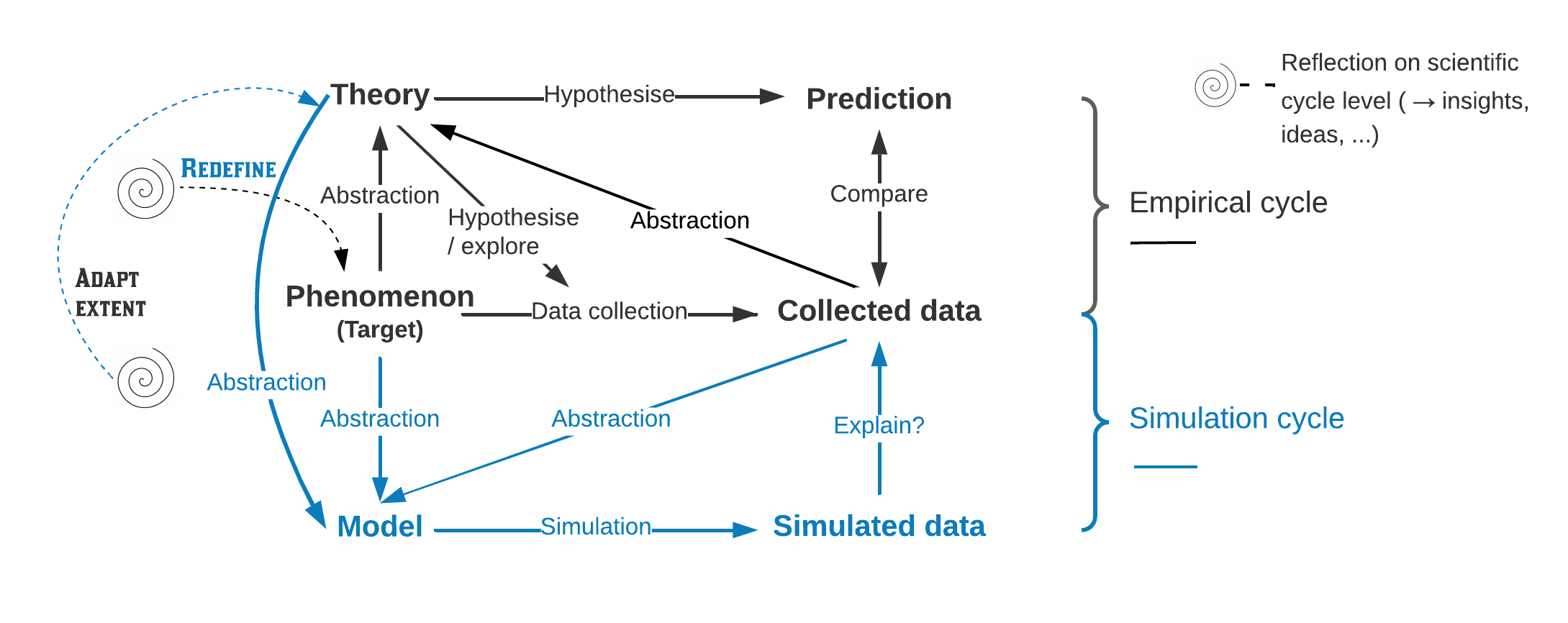
THEMP combines two complementary cycles: the empirical cycle (De Groot 1961) and the social simulation cycle (Gilbert & Troitzsch 2005), connecting theory, empirical observation, and simulation in an iterative, continuous loop (Figure 3). In the empirical cycle, theory identifies the core mechanisms underlying the target phenomenon, from which hypotheses can be derived and tested against empirical data OR theory emerges from the data holding the different views/explanations there may be. The results of these empirical inquiries provide insights that may refine or generate theories. Subsequently, these insights feed into a social simulation cycle, where the mechanisms and processes specified in the theory are formalised into an agent-based model. When the simulation results successfully reproduce patterns in the empirical data, this strengthens the theoretical understanding of the underlying mechanism, which can feed back into the theory and guide another empirical cycle. This iterative process ensures that theory and empirics continuously inform each other, supporting the development of more robust explanatory models.
Essentially, the THEMP approach helps knowledge advancement by testing, renewing, refining, extending, and proposing theory through the accumulation of evidence. It makes explicit how theory and empirical insights shape both model design (characterisation and calibration), model testing (verification and validation), and lead to model exploration that compares, complements or generates new explanations (sensitivity, counterfactuals).1 In the remainder of the section, we explain how the THEMP approach specifies each of these stages.
THEMP in model design
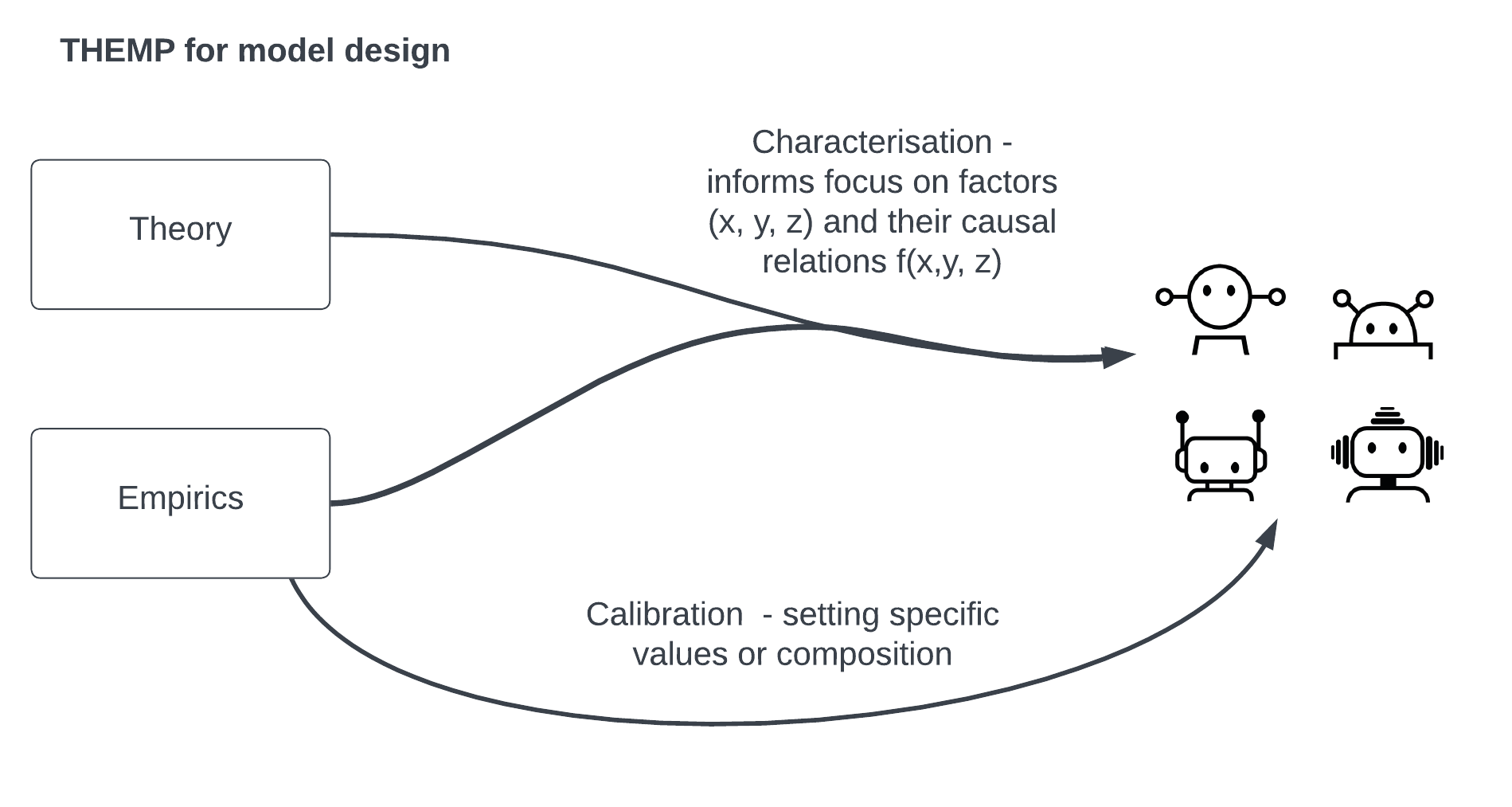
In the model design phase, THEMP integrates theory and empirics in model characterisation and model calibration (see Figure 4). Model characterisation shapes an explanation by selecting variables and articulating the causal relationships between them.
Model calibration (or parametrisation) is the process of assigning values to these variables or specifying the degree of their influence. This conceptual distinction between characterisation and calibration is important, as it differentiates the roles that theory and/or empirics play in model design.2
THEMP places particular emphasis on model characterisation. This stage is often least visible, under-described or left implicit, and instead most attention in model reporting goes to decisions on how data is used for the calibration of the model. Since the choices that actually shape an explanation are made in the model characterisation stage, it is crucial to make explicit how and where theory, assumptions, and empirics enter into this stage (Wijermans et al. 2023).
To summarise, applying THEMP in the model design stage means making explicit how both theory and empirics guide the selection of explanatory factors and specification of (causal) relationships. Theory may provide conceptual frameworks or well-accepted explanations from the literature, while empirics provide observations, narratives, or measurements to inform variable values and the strength of their influence. By emphasising the characterisation phase, THEMP stresses how theory and empirics jointly shape the core explanatory mechanism, enhancing transparency and rigour in model design.
THEMP in model testing
Assessing whether a model is fit-for-purpose – i.e., credible – is a core task in agent-based modelling. How verification and validation (V&V) are carried out depends on the model’s purpose (David et al. 2017; Edmonds et al. 2019), which (recall Figure 1) for THEMP is explanation.
THEMP emphasises the integration of theoretical and empirical approaches throughout V&V process. V&V involves several key steps: evaluating the model development process (what led to the model’s creation), identifying key stakeholders and participants (e.g., domain experts, modellers, and end users), evaluating included components (internal validation), verifying that the model functions as intended (verification), and testing whether the model effectively reproduces and explains the target phenomenon (external validation).
Following David et al. (2017), we treat V&V as a credibility practice that is intertwined within every stage of modelling and, most importantly, must be clear and transparent. Note that THEMP explicitly includes process credibility as a key dimension, evaluating how the research was conducted (including who contributed), to increase confidence in the model’s explanatory power.
To summarise, also in the model testing phase, THEMP makes explicit the distinct roles of theory and empirics. Empirics, as widely documented, are used to assess the model’s ability to reproduce the observed patterns. Theory, instead, provides the framework for connecting outcomes to the model’s initial purpose to develop an explanation, e.g., by comparing the model against alternative explanations (and observed empirical patterns). THEMP’s innovation lies in making explicit what is tested and in assessing the explanation itself, evaluating it not only against the empirical patterns, but also in how well it advances, refines, or strengthens existing explanations. This results in a more demanding test for the model’s credibility and explanatory value.
In the following, we discuss how THEMP operationalises its approach that integrates theory and empirics through four interrelated components of the testing phase, i.e., process credibility, internal validation, verification, and external validation.
Process credibility
Process credibility evaluates the process that led to the model’s development and outcomes. Transparency about how the model was designed, who was involved, and how theoretical and empirical knowledge informed it enhances confidence in its explanatory value. Particularly, if these processes explicitly incorporate theory and empirical evidence. Building upon the framework proposed by Edmonds et al. (2019) for addressing limitations in explanatory models during V&V, THEMP identifies three credibility tests: peer-stress-testing, multiple-pattern-testing, and breaking the model.
Peer-stress-testing involves external evaluation of the model’s assumptions and mechanisms on how theoretical and empirical insights were incorporated throughout the modelling process, for instance through conference presentations or peer review. Multiple-pattern-testing, instead, requires the model to reproduce more than one empirical pattern (e.g., across different outcome variables and levels of aggregation, such as individual behaviours and collective outcomes). This improves the ‘structural realism’ of the explanation (Grimm et al. 2005), reducing the risk that an explanation fits the data by chance, and as such strengthens explanation credibility. Breaking the model means exploring the models’ limits. It involves running sensitivity tests that verify, for instance, how many runs are needed for reliable results, how many agents are required, or what happens under extreme settings for our variable range, to observe effects on model outcomes and identify the boundaries within which the model reproduces valid results.
The THEMP process highlights these practices to show that credibility arises not only from results, but from the quality of the inputs, and the transparency and robustness of the entire modelling process. By implementing high standards for testing explanations, THEMP allows researchers to thoroughly assess the validity of the proposed explanations (causal mechanisms); incorporating peer feedback and applying multiple-pattern-testing strengthens the model’s explanatory value and supports theory development, a core goal of THEMP.
Internal validation
Internal validation refers to the credibility of the elements and processes included in the model. While it may appear under different labels e.g., a type of verification (David et al. 2017), or micro validation (Moss & Edmonds 2005), they all refer to the conceptual fidelity of the model: whether the chosen elements and mechanisms plausibly represent the target phenomenon, independent of the computational implementation.
In THEMP, internal validation goes one step further: it emphasises justification and documentation to include the why and how behind the elements and processes incorporated in the model. This includes, for instance, justifying why certain agents, variables, and interactions were included, how mechanisms were operationalised, and whether these elements were derived from theory, from empirical insights, or other sources. Transparency around these choices helps to assess not just on a logical level whether outputs follow from inputs, but also whether the model’s internal structure plausibly captures the conceptualised intended mechanisms and supports the explanatory goals of the model towards theory development.
Verification
While internal validation focuses on the conceptual content of the model, verification scrutinises the computational implementation: it involves evaluating whether the model has been correctly implemented, reflecting whether the code faithfully realises the intended design and mechanisms of the conceptual model (David et al. 2017). This includes checking for an error in the code, i.e., bugs, to ensure that the model outputs are generated according to the intended mechanisms rather than being artifacts from coding errors.
For the THEMP approach, verification requires detailing how both theoretical foundations and empirical observations are formalised into model code and what the expected model behaviour would look like based on these elements. By tracing the influence of theory and data on implementation, THEMP provides benchmarks for assessing whether the model indeed correctly operationalises the intended explanation and improves model understanding and reproducibility.
External validation
External validation assesses whether the model is a good representation of a ‘real world’ phenomenon given the model purpose (e.g., to explain behaviour versus to predict outcomes) (David et al. 2017). It reflects the practice of testing whether the behavioural patterns of the model correspond with the empirical patterns. With THEMP this is done through multiple-pattern-testing, also mentioned under Process Credibility. By adopting a pattern-oriented approach (and thus attempting to reproduce multiple patterns simultaneously), the risk of getting the right results for the wrong reason (i.e., by chance) is reduced. Individual patterns may be replicated quite easily, while sets of patterns are much more difficult to reproduce (Grimm et al. 2005).
Empirical evidence plays a crucial role in evaluating a model’s external validity, whether the outcomes reproduce patterns in empirical data, and by extension the real-world phenomena represented by the data.
THEMP in model exploration
In THEMP, exploration is a distinct stage on par with Design and Testing in that it deliberately challenges the proposed explanation or explores possible explanations. The aims are to: (a) test mechanism necessity and boundary conditions via counterfactuals/what‑if analyses; (b) compare the target explanation against plausible alternatives, and (c) feed the resulting insights back into theory before the next empirical cycle. This stage enables stepping back and reconnecting theory and empirics by revisiting, proposing, or comparing explanations.
Counterfactuals. THEMP requires systematic what‑if analyses that expose the explanation to unobserved or extreme theoretical/empirical conditions to probe mechanism necessity and limits. It aims to gain understanding of how an explanation acts under unknown situations. This entails varying initial conditions and parameter regimes (including theoretical extremes and distributional shifts), conducting stress tests that intentionally “break the model” (for example by altering the number of runs required for stability, changing population size, or imposing extreme scheduling or noise), and examining sensitivity to structural assumptions such as decision rules and interaction topology. This phase is used to detect false positives by revealing regions where the mechanism no longer reproduces target patterns—or does so for the wrong reason—and to delimit explicit boundary conditions. It provides a deeper understanding of how an explanation (can) play out, spark curiosities/questions about an empirical phenomenon or other ideas about possible factors and interactions that could be explanatorily relevant. For transparency, we specify success/failure criteria and target patterns ex ante and report results alongside any theory revisions they imply.
Compare against other explanations. To situate an explanation among alternatives and assess whether and how it contributes meaningfully to theory development, THEMP encourages comparisons with simplified or alternative mechanisms that could plausibly generate the same patterns. Comparisons are judged on multi‑pattern fit across levels and variables (pattern‑oriented modelling), robustness across parametrisations and initialisations, and parsimony given comparable explanatory adequacy.
By contrasting different models in their ability to reproduce (sets of) patterns, the conditions under which the best‑performing explanatory model(s) prevail can be identified. This strengthens the explanatory value of the best performing model(s), as it guides reflection on theory revision, and supports formulation of new hypotheses or curiosities for empirical inquiry (recall Figure 3).
To summarise, THEMP encourages exploration and explicitly scrutinises the explanation itself what it claims in under-explored or unreflected situations and how it positions itself relative to existing explanations thereby enabling theorising.
Communicating models with THEMP
Engagement with theory and empirical evidence during model development should be reflected in how the model is communicated. THEMP targets theorising and thus promotes a practice of communication and reflection on where and how theory and empirical evidence come together in the model during development, e.g., within the research team. Once the model is communicated externally, THEMP reflections add transparency to this often implicit process through documentation and journal articles. Including THEMP reflections integrates well with established practices for communicating agent-based models, e.g. ODD for general model documentation and TRACE for process documentation etc. For the ODD, this would involve making explicit the role of theory and empirical evidence in those sections that justify what is in and out of the model (e.g., Entities and Process Overview), and situate the model in context (e.g., Design Concepts concerning basic principles; see Table 1). Use of the visualisations provided in this paper is encouraged.
| ODD section | THEMP detailing |
|---|---|
| §1. Purpose and patterns | It includes that the purpose is explanation, targeting theory development, and complements it with the theories and empirics from which the model departs. |
| §2. Entities, state variables and scales | §2 and §3 are where theory and empirics (THEMP) justify which variables are included or excluded and how processes are ordered and scheduled. |
| §3. Process overview and scheduling | |
| §4. Design concepts and Basic principles | These are the sections to detail THEMP reflections and to situate the work in a wider context. They should position the current simulation cycle relative to previous cycles and to the prior work on which it builds. |
Applying THEMP: An Illustration
To illustrate how the THEMP approach can guide modelling for theory development, this section demonstrates its application in a concrete example. Rather than a conventional model (with result) demonstration, the aim here is to show how each stage of the modelling process, from design to testing, was informed using the THEMP principles. Through this illustration, we demonstrate how theoretical reasoning and empirical evidence can iteratively interact within the THEMP framework and how THEMP supports model credibility, interpretability, and contribution to theory development.
We illustrate these principles through the Norm@Risk model (Vriens et al. 2025; Wijermans et al. 2025), as they reflect the principles that guided the design, testing and exploration of an agent-based model of cooperation under collective risk. Note that this model process inspired the design of THEMP, as it made us reflect deeply on our theorising.
Norms@Risk combines behavioural experiments with agent-based modelling for theory development. In particular, this model represents a simulation cycle following an empirical cycle of two waves of a behavioural experiment that tested how people respond and what types of social norms emerge in repeated collective risk social dilemmas (Szekely et al. 2021; Vriens et al. 2024). While the overarching tightness-looseness theory (Gelfand et al. 2011) was able to explain some general patterns, it could not account for the observed diversity in individual behaviour. The model thus exploits the ability of ABMs to incorporate heterogeneity to explore whether a heterogeneity-sensitive explanation could reproduce the observed behavioural patterns that do not follow from theory.
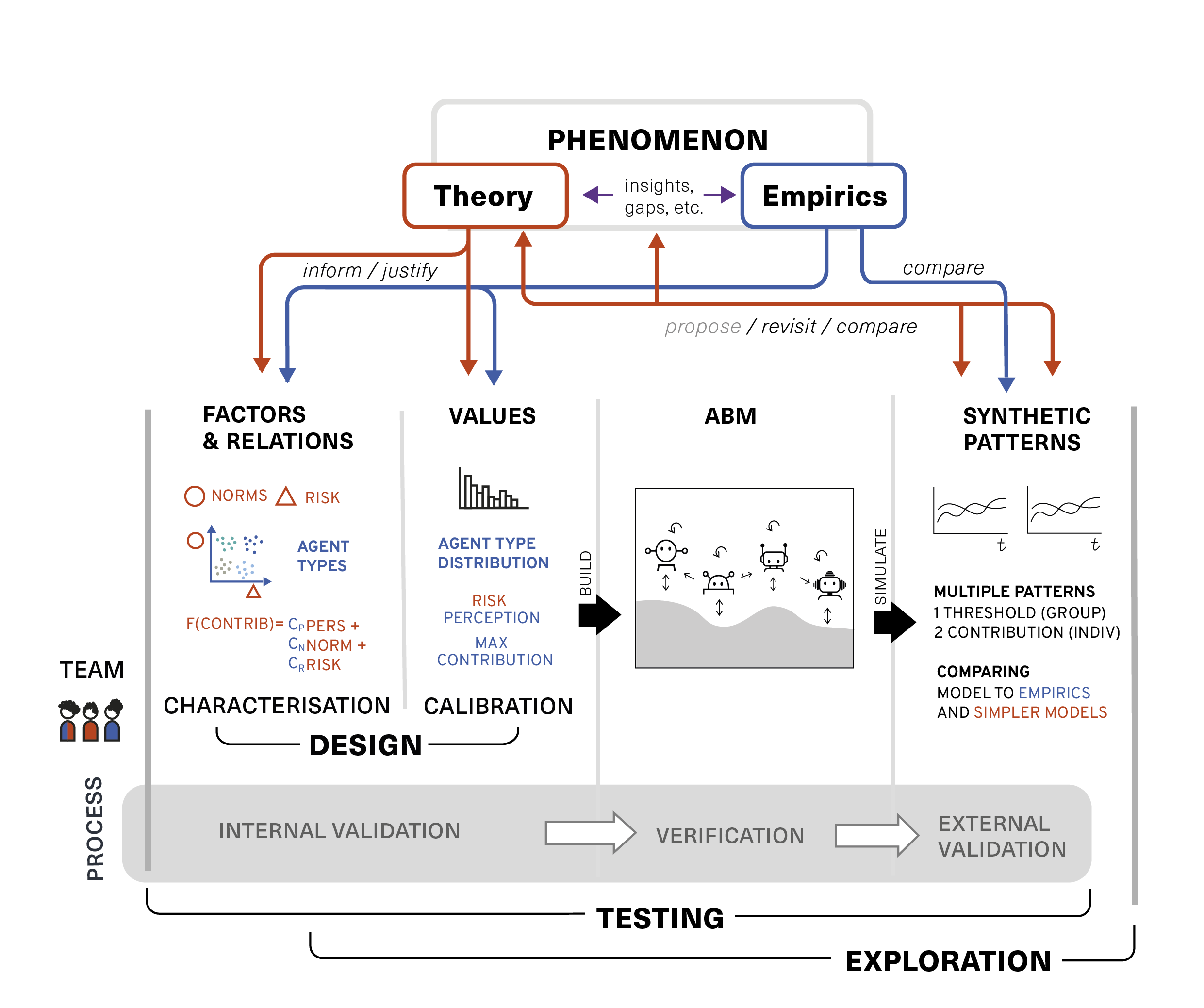
Figure 5 provides a visual summary of THEMP in Norms@Risk, illustrating how theory and empirics guide model design and testing. For the purpose of this article, we focus on the application of the THEMP approach; for further details on the full model and results, we refer readers to Wijermans et al. (2025) and Vriens et al. (2025).
The Norms@Risk study
The Norms@Risk study investigates how people respond to collective risks (e.g., impacts from the climate crisis) and how social norms promote cooperation. Specifically, it explores how risk and social norms interact in Collective Risk Social Dilemmas, where group members can prevent a collective loss if their combined contributions exceed a collective threshold (Milinski et al. 2008; Tavoni et al. 2011).
Two empirical cycles (waves 1 and 2) tested how the disaster risk severity affects social norms and cooperative behaviour (Szekely et al. 2021; Vriens et al. 2024). Results showed that higher risk strengthened social norms and increased cooperation, but also revealed substantial diversity in individual behaviour (i.e., contribution decisions) that could not be fully explained by tightness-looseness theory (Gelfand et al. 2011).
To understand this heterogeneity, a simulation cycle was done using an ABM that mirrors the decision structure of the behavioural experiments. Agents engage in repeated rounds of a collective risk social dilemma, facing varying risks of collective loss and interacting in reshuffled groups each round. The ABM was designed to capture individual differences observed in the experiments and to test whether these could reproduce and explain the aggregate outcomes observed empirically.
THEMP in model design
In this section, we describe how the Norms@Risk model was designed following THEMP principles. Detailed specifications of the rules of the game or variable values are only included if relevant to illustrate the application of THEMP. Instead, we focus on those aspects of the model that are essential for understanding how theoretical reasoning and empirical data were integrated, particularly the representation of agent heterogeneity and their characterisation of behaviour types.
Norms@Risk’s aim is to develop an explanation of how individual differences in sensitivity to social norms and environmental risk shape collective outcomes. Existing theories often (implicitly) assume groups to be homogeneous, particularly underestimating the diversity of agents regarding risk and norm sensitivity. Consequently, the mechanisms through which heterogeneity facilitates or undermines collective action remain poorly understood.
To illustrate how THEMP guided model design, we describe how Norms@Risk integrates theory and empirical data for both model characterisation and calibration. The model is grounded in the decision context of the Collective Risk Social Dilemma, and its focus on the explanatory power of norms and risk (and their interaction) builds on insights from previous empirical cycles (Szekely et al. 2021; Vriens et al. 2024). Theory here characterises the core elements of the explanation, while empirical data shape and refine agents’ sensitivity to risk and social norms and decision-making rules. In particular, a cluster analysis on the empirical data identified different behavioural types, accounting for differences in sensitivity to norms and risk. The role of theory and empirics in model design is summarised visually in the design section (left part) of Figure 5.
Although empirical data is used to calibrate some distributions (e.g., agents’ types distribution and risk perceptions), the cluster analysis constitutes the central methodological tool for THEMP-based model characterisation in this example. It combines theoretical guidance with empirical observations to define heterogeneous agent types and connect individual differences to collective outcomes.
Core THEMP aspects in the Norms@Risk model (and thus in its explanation) grounded in theory and empirics are:
- Key explanatory factors: The focus on norms & risk is theory-driven, inherited from their presence in previous empirical cycles. This illustrates the THEMP principle of grounding the core mechanisms of the model in theory, ensuring that the explanation captures what are considered essential drivers of cooperative behaviour (characterisation).
- Functional form of decision-making: Agents’ decisions are derived from a utility function combining norms and risk. Choosing this functional form allowed the theoretical factors to be operationalised in a way that connects and integrates theory and data in a traceable manner. The functional form follows established modelling approaches (Gavrilets 2021), providing continuity with prior scholarship (characterisation). This illustrates the THEMP principle of being transparent and clear on what shapes the explanation while forming the explanation.
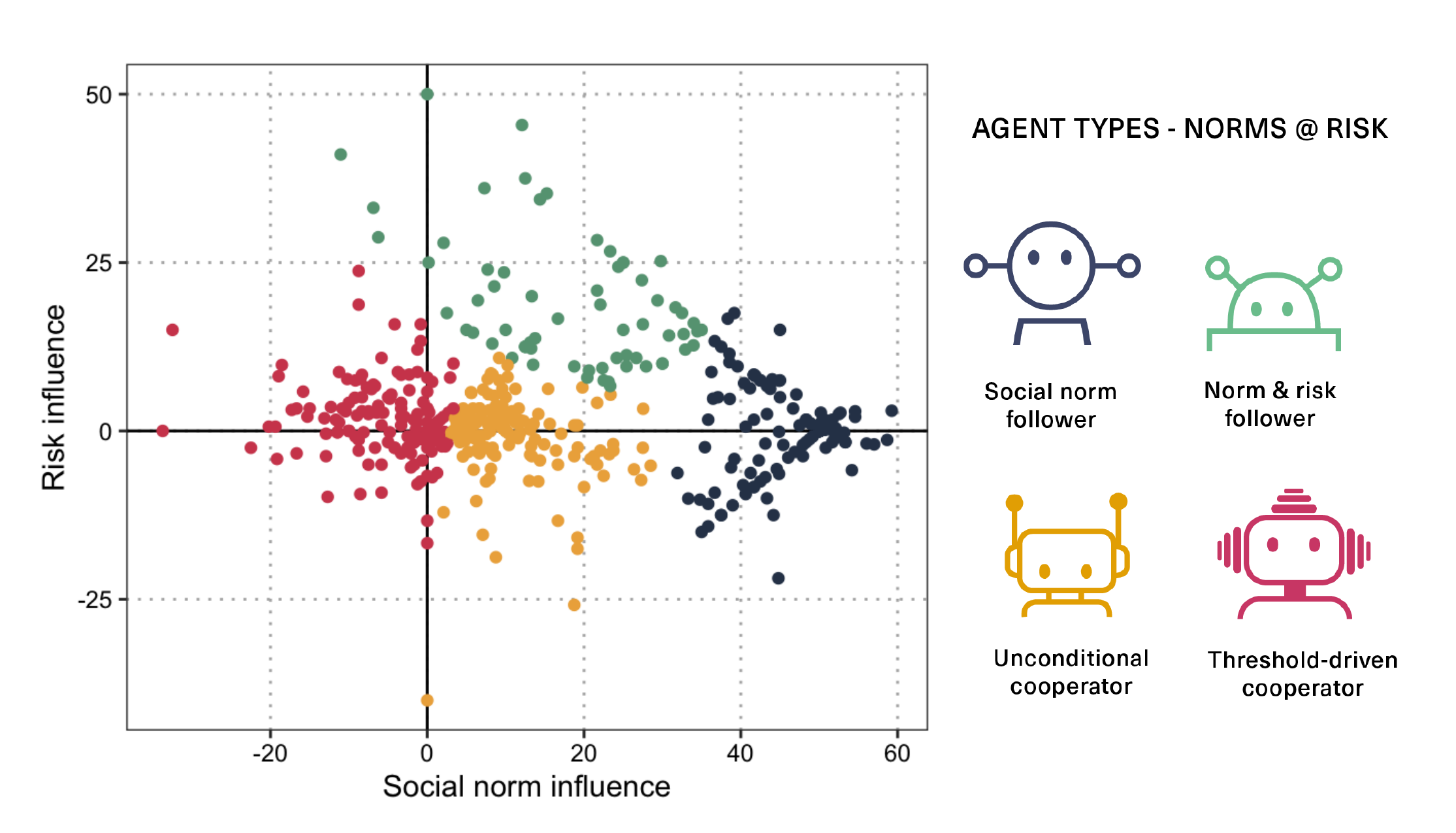
- Heterogeneous agent types: Cluster analysis of conditional contributions in the behavioural experiment (obtained through the strategy method) identified four distinct agent types. In this design choice, theory and empirical evidence jointly guide the relevance of norms and risk for each type through the assignment of type-specific weights. The distribution of types within the population is taken from the empirical data (characterisation and calibration).
- Risk perception: The inclusion of heterogeneous risk perception comes from theory, while empirical data were used to calibrate the distributions for different agent types (characterisation and calibration).
- Behavioural bounds: based on range of contributions/behaviours in the experiment we hard-coded the maximum contribution of agents in accordance with the experiments (calibration).
Together, these design choices illustrate the THEMP principle in practice by showing how theoretical mechanisms such as norm compliance, risk perception, and heterogeneity are not treated as abstract assumptions, but are theoretically grounded and empirically anchored, characterising and calibrating the resulting agent variables. This ensures transparency and clarity, allowing for the interplay and critical engagement with theoretical reasoning and behavioural evidence while in the process of co-designing models. Moreover, these choices emphasise how empirical data can guide model characterisation, beyond their more typical application to model calibration alone.
Model characterisation: Cluster analysis
A core element of the THEMP-guided characterisation of Norms@Risk is the empirical characterisation of theoretically informed heterogeneous agent types. Theory describes on system level that when risk of a disaster is high, norms are stronger and people cooperate more (Gelfand et al. 2011); behaviour is thus the result of a response to risk and norms, yet the empirical cycles indicated that the behavioural manifestation of risk and norm sensitivity varies across individuals. To capture this heterogeneity a cluster analysis was applied to the empirical data. Specifically, data was used where participants indicated how they would behave under two different risk levels (high or low) and two social norm conditions (cooperative or non-cooperative group members). Answers to these questions allowed us to classify participants in their sensitivity to changes in risk, norms, or both, using a K-means cluster analysis.
This cluster analysis showed four behavioural profiles: one cluster primarily sensitive to social norms, one sensitive to both norms and risk, and two clusters with limited sensitivity to either norms or risk (see Figure 5). Consistent with theoretical expectations about cooperative motivations, the empirical clusters were translated into four agent types:
- The Social Norm Follower matches their contribution to their perception of the social norm;
- The Norm & Risk Follower adjusts their contribution both to their perception of the environmental risk and their perception of the social norm;
- The Unconditional Cooperator always cooperates, but might slightly adjust their contribution upwards or downwards in line with the social norm;
- The Threshold-driven Cooperator type always cooperates, but will compensate if needed to meet the cooperative threshold or reduces their contribution if there is no need.
This analysis illustrates the THEMP principle of using empirical data not only to calibrate variables, but to guide model characterisation. It formalises behavioural regularities into (theoretically interpretable) agent types, thereby creating a structured space where theory and empirical insights meet and fuel the negotiation for what is important in an explanation, while strengthening the explanatory relevance of the model.
Reflections on THEMP in model design
While research articles present a model in its final form, they rarely report how theory and empirical evidence were integrated or the iterative, negotiating process through which elements were selected for inclusion. The synergy between theory and empirics comes about through discussion and successive adjustments to the model. This iterative process shapes the model’s structure and strengthens confidence in its design choices.
An example from the Norm@Risk design process to illustrate this back and forth between theory and empirics is the number of agent types in the model. Theoretically, one would expect some people to be driven mostly by norms, others mostly by risk, some by a combination of the two, and others by neither. Using K-means clustering, a distinct risk-sensitive cluster only emerged when the algorithm was forced to divide the data into five clusters. This fifth cluster, the risk-sensitive cluster, was very small, and the empirical results from the five-cluster model did not hold in comparison to its four-cluster counterpart. Empirical observations thus challenged the theoretical idea of a purely risk-sensitive agent and informed model characterisation through a four-type solution without a separate risk-sensitive agent. Characteristics of a risk-sensitive type were instead embedded in a subgroup of the Norm & Risk Followers to maintain theoretical coherence while simultaneously representing the empirically observed behavioural diversity.
Another example of the back and forth between theory and empirics is the choice for the functional form of decision-making in Norms@Risk. For theoretical simplicity, a single overarching utility function was chosen to underlie the decision-making of all types, where different weights for the norm and/or risk components of the utility function distinguish the different types. However, the empirical data on participants’ choices showed that not all types would be well-captured by this generalised form. The operationalisation was adjusted for these types by modifying the decision-making strategy. This back and forth between theory and empirical data illuminates the tension between a functional general form given by a theoretical structure versus particularities of behavioural diversity observed in the empirical data, respecting the overarching theoretical structure and the diversity observed in the empirical data.
When theory and empirics meet, this is where important negotiations happen. These examples show how theory and empirics interact as complementary sources of constraint and insight. Rather than treating data as a validation tool for theory, THEMP frames modelling as an arena where theory, empirical evidence, and the modeller(s) jointly shape explanation through a process of negotiation: empirical evidence can refine or refute theoretical assumptions, and theory provides coherence to empirical interpretation. This way, modelling becomes a means of exposing (not obscuring) the relationship between theoretical assumptions and observed behaviour.
THEMP in model testing in Norms@Risk
While the previous section discussed how theoretical and empirical reasoning interacted using model design, the testing phase illustrates how these same principles inform the evaluation of the model’s explanatory ability and credibility, by recognising process credibility, internal validation, verification, and external validation. Figure 5 summarises how these elements can be recognised in the Norms@Risk model.
Process credibility
Process credibility evaluates the modelling process and the confidence we can have in its explanatory mechanisms based on how things were done. For Norm@Risk, the process combined several complementary theoretical perspectives (on collective action, social norms, and environmental risk) through an integration of different theories and these theories with empirical data. The model was co-created by the author team, and repeated interdisciplinary discussions throughout the design and testing phases served as an implicit credibility mechanism, ensuring that all theoretical concepts were consistently operationalised, empirically anchored, and properly tested.
Building on these interdisciplinary discussions, process credibility was further ensured through peer-stress-testing (e.g., by presentations at different conferences, e.g., the Social Simulation Conferences in 2022, 2023, and 2024), evaluating multiple patterns of outcomes, and exploring the limits of the model (see Section 4.27 for more details). All of these exchanges served to verify that theoretical concepts and empirical grounding were accurately represented.
Internal validation
THEMP’s internal validity rests on the justified, well-documented design of its model elements and mechanisms, grounded in theory and empirical evidence. This grounding informs the model’s characterisation and, to a lesser extent, its calibration, ensuring transparency in the ‘why’ and ‘how’ behavioural mechanisms were designed.
In Norms@Risk, this involved choices grounded in theory and empirics. Firstly, the choice to centre the model on norms and risk as core explanatory mechanisms, drawing directly from theory. Secondly, agent types were designed with distinct sensitivities to norms and/or risk, using cluster analysis as a structured process to integrate empirical observations with theory. And lastly, the population composition of these agent types was initialised to align with empirical findings, and behavioural parameters were constrained within empirically observed limits.
Together, engaging with and explicitly documenting these choices ensures that the mechanisms plausibly capture the phenomena of interest.
Verification
The verification of Norms@Risk focused on two key aspects: testing for software bugs and validating that each agent type behaves according to its conceptualised and designated sensitivity to norms and/or risk. For example, the behaviour of Social Norm Following agents was tested under varying norm initialisations to confirm that over time they showed the expected norm-influenced behaviour, while remaining unaffected by changes in risk. Similar systematic tests were conducted for the other agent types to confirm whether expected sensitivities and insensitivities are visible in their behaviour. Following THEMP principles, these verification tests trace whether the theoretical assumptions and empirical insights that came together in a conceptual model are actually reflected in the computational model.
External validation
Norms@Risk provides a possible explanation for society’s ability to cooperate to avert or reduce the impact of collective crises. Core to the explanation the model embodies is the heterogeneity in people’s sensitivity to norms and/or risk, which shape individual differences in behaviour and consequently group-level differences in cooperation rates. External validity evaluates Norms@Risk’s ability to reproduce different behavioural patterns observed in the behavioural experiments (Szekely et al. 2021; Vriens et al. 2024).
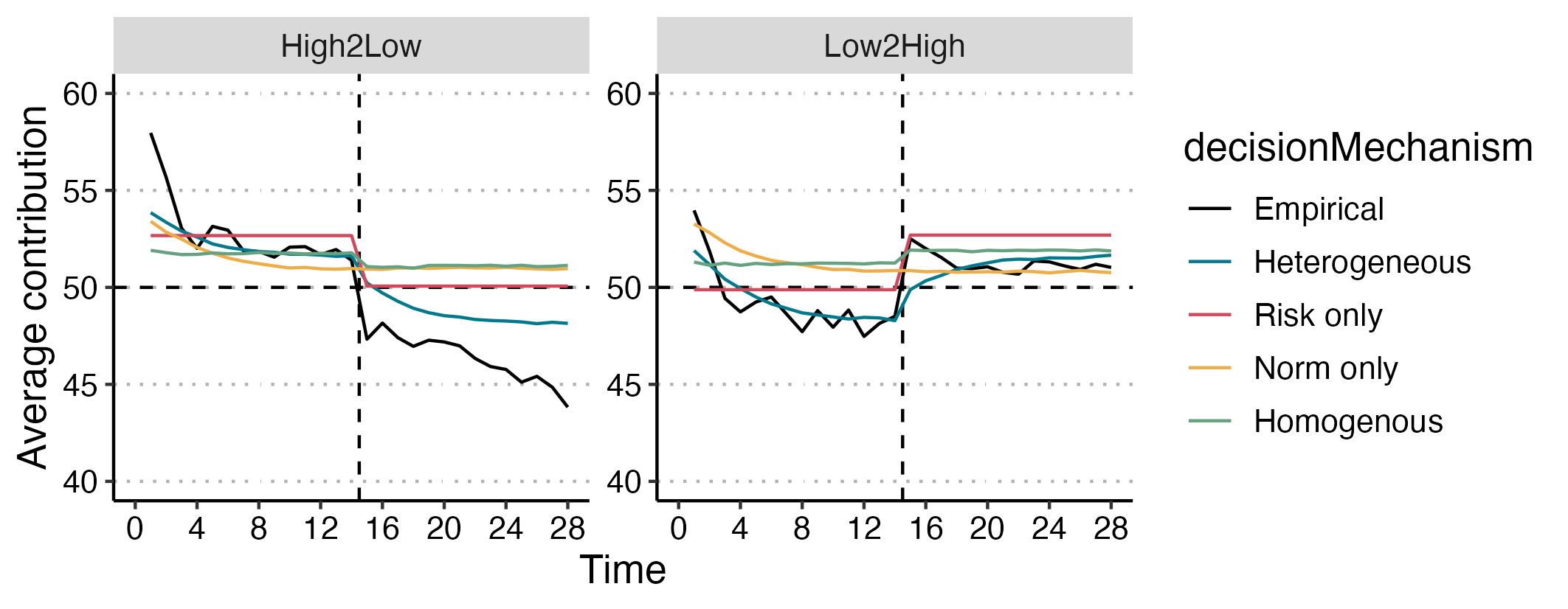
The Norms@Risk model was evaluated based on two patterns: average individual contributions (individual-level pattern) and the percentage of groups reaching the cooperation threshold (group-level pattern). Figure 7 illustrates that the Norms@Risk model captures both patterns: when risk is high, more groups reach the threshold (top row) and individual contributions are higher (bottom row). Over time, the fluctuations of the empirical data fall largely in the bandwidth of the variance across all simulation runs. On the individual level, the empirical data shows a more abrupt behavioural change in the round after a change in risk than the trend of all simulation runs, but this does not undermine the overall pattern reproduction. Overall, the different panels show how the explanatory mechanisms of the Norms@Risk model consistently generate plausible behavioural outcomes both on individual and group level, supporting the model’s external validity.
Testing multiple-pattern testing ensures that the Norms@Risk model reproduces relevant empirical patterns. Empirical data tests the model against observed behaviour. This approach strengthens confidence in the external validity of Norms@Risk, through meaningfully capturing processes underlying individual- and group-level behaviour in collective risk contexts.
Reflections on THEMP in model testing
Testing the Norms@Risk model illustrates how both theory and empirics are important for model testing, or, more specifically given the model’s purpose, to assess the model’s explanatory power. Theory guided not only how to test the model but also how to interpret its results. For instance, the focus on norms and risk determined which mechanisms were included in the model and thus formed the basis for assessing the model’s mechanistic plausibility (internal validation).
In the external validation stage, empirics played a conventional central role in model testing through external validation, but were just as central to the internal validation. Internal validation ensured that each mechanism and agent type was explicitly grounded in empirical observation, providing plausibility for the explanatory mechanisms the model embodies. External validation involved comparing simulation outcomes with behavioural data across multiple patterns.
Overall, the interplay between theory and empirics in model testing led to careful design of model evaluation procedures and provided anchors for the reflections on which outcomes could be considered successful in terms of their capacity to reproduce empirical patterns. Used in this way, theory and empirics together enhanced the model’s explanatory robustness and strengthened its contribution to theory development.
THEMP in model exploration
We use Norms@Risk to both explore the unknowns and compare other explanations. Here we illustrate the latter by testing whether all elements of the proposed explanation norms, risk, and their heterogeneity are necessary.
To scrutinise the role of the explanation itself—are all the factors needed to reproduce the observed patterns, or would a simpler model suffice?— we tested the heterogeneous Norms@Risk model against three simpler models: a norms-only model (all agent types become insensitive to risk), a risk-only model (all agent types become insensitive to norms), and a homogeneous model (creating a single, average agent type where sensitivities to both risk and norms are given by the proportion of those types in the total population). Figure 8 shows that the heterogeneous Norms@Risk model best reproduces the empirically observed patterns. Simplified models fail to capture changes in contributions over time, the adjustment of contributions after changes in risk, and the overall variance in contributions across individuals. Thus both heterogeneity and dual sensitivity to norms and risk are necessary to explain the observed behaviour.
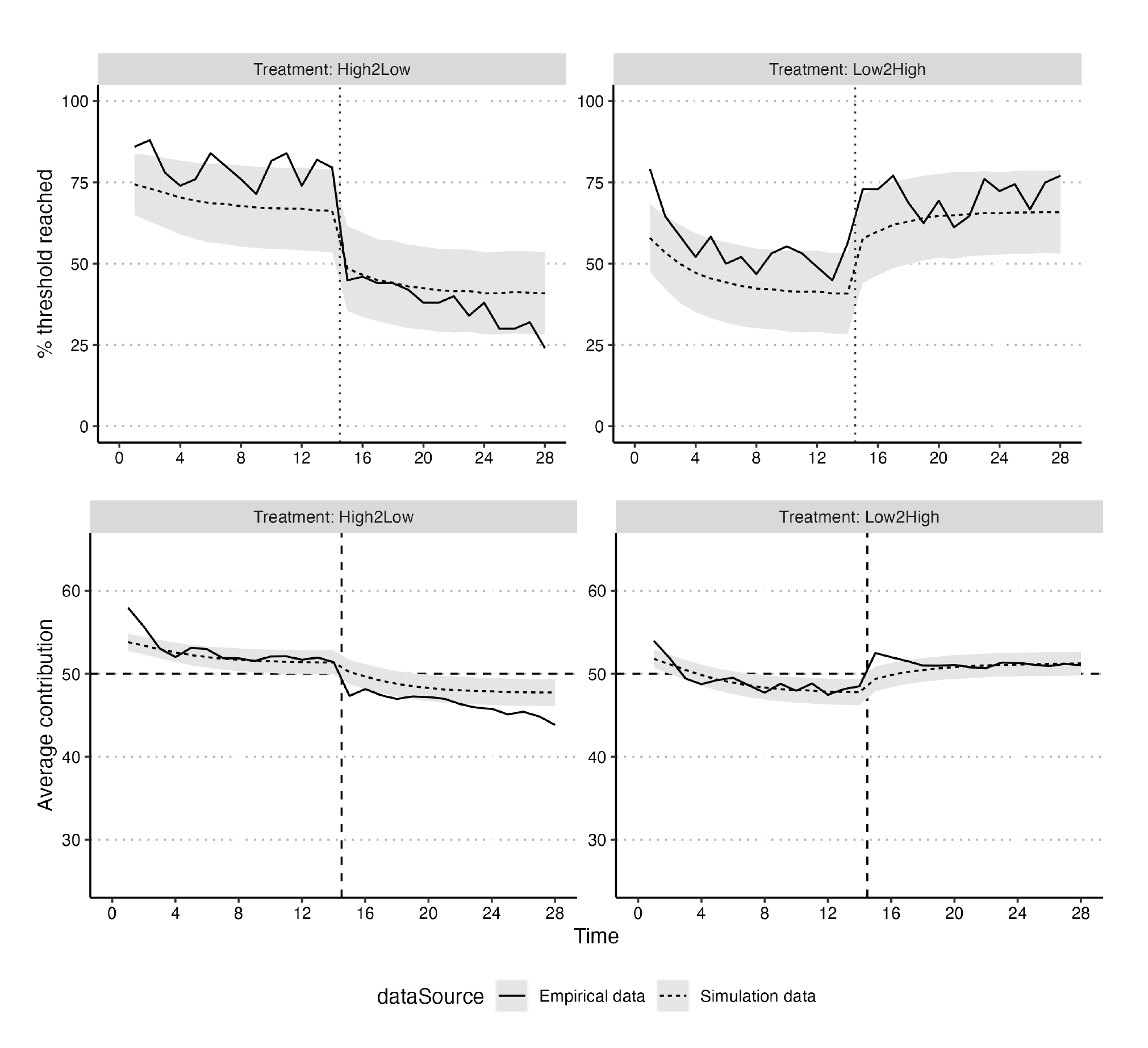
These explorations systematically tested whether the model’s core explanatory mechanisms were necessary. Theoretical reasoning guided both the selection of the core mechanisms and the comparison with alternative models.
Reflections on THEMP in model exploration
In the model exploration stage, theory guides the selection of alternative models for comparison. In doing so, the THEMP approach goes beyond merely fitting observed patterns: it considers what the proposed explanation implies in light of existing theory, evaluates the necessity of its central claim, in this case, heterogeneity, and helps strike an appropriate balance in model complexity.3
As in the external validation stage, empirical data provide the behavioural patterns against which we compare the simulation outcomes with behavioural patterns. The interplay between theory and empirics clarifies criteria for success, reproducing empirical patterns, and thereby enhances explanatory robustness and the model’s contribution to theory development.
Conclusion
Recently, scholars have called for greater engagement in theory development using ABM, emphasising its potential to accumulate and generalise understandings (Grimm et al. 2024; Lorscheid et al. 2019). Although the importance of ABM for theory development is widely acknowledged, the way we present our models –stressing that they are empirically based – often renders the role of theory implicit, thereby weakening the reciprocal interplay between theory and evidence needed for solid explanations. This includes a lack of attention to creative and subjective aspects of modelling that generate explanations that complement empirical practices and to tools for model justification that emerged as agent-based social simulation has matured.
To advance theory development in ABM, we introduced THEMP (THEory and EMpirics), an approach that brings the interplay between theory and empirical evidence to the forefront of model design, testing and exploration. THEMP highlights that modelling for theory development benefits from the harmonisation and interplay between theoretical insights and empirical findings throughout the research process. This integrated approach allows researchers to develop robust theoretical frameworks while preserving empirical validity.
The THEMP approach encourages a shift in attention from privileging theory or empirical modelling to supporting theory development through both. During design, it guides researchers to explicitly identify the role of theory and empirical evidence in each core modelling decision, and to reflect on how these elements come together in model’s design. During testing, THEMP embeds theory and empirical evidence prompting scrutiny of what goes into the model into systematic processes internal internal validation and peer-stress-testing, and by testing whether the proposed explanation reproduces the observed empirical patterns (external validation). During exploration, theory and empirics inform the exploration of relevant (non-empirically observed) scenarios and guide reflections on the explanations, whether it represents a meaningful advancement over existing explanations. Finally, for signalling and collective learning, explicitly stating the model’s purpose and how theory and empirics are integrated, whether or not labelled as THEMP, allows researchers to connect with and learn from related work.
Although THEMP is mainly informed by our experience combining agent-based modelling and behavioural experiments for theory development, the framework applies to any ABM that integrates theory and empirical evidence for the purpose of explanation and theory development. We invite readers to use THEMP not just as a method, but as a way to refocus their practices by explicitly harmonising theory and empirical evidence throughout the modelling process. THEMP offers structure, not rigid rules: adopt it, adapt it, or use it as inspiration to develop your own practices to expand the explanation-making space in agent-based social simulation.
Author contributions
Conceptualisation: N.W., E.V., G.A.; Writing (first draft): N.W.; Writing (review & editing): N.W., E.V., G.A.; Visualisation: N.W. Model example: N.W., E.V., G.A.; Project administration: G.A.
Acknowledgements
This research was funded by the "Norms@Risk" grant from the Italian Science Fund of the Ministry of University and Research 2024-2029, the "DYnamics of SOcial NOrms under collective Risk" grant funded under the PRIN (Research Programs of Great National Interest) Project–(2022-2024) and the “Social Norms for Cooperation Under Collective Risk” grant from the Swedish Research Council 2023-01306, "Fostering Open Science in Social Science Research" (FOSSR) grant funded by the Ministry of University and Research as part of the National Recovery and Resilience Plan (PNRR) (2022-2025) awarded to G.A.
We are grateful for Tove Salomonsson’ support in professionalising the illustration in Figure 2 & 5; to Bruce Edmonds, Lucas Sage & the anonymous reviewers for their invaluable feedback on earlier versions of the manuscript; to Hanna Sinare – Nanda’s writing group buddy – for the many Mondays of feedback and support engaging with parts of this paper; and the enthusiastic and critical engagement of peers during the presentations at the Social Simulation Conference (Glasgow 2023, Cracow 2024), the Empirically Calibrated ABMs workshops (Athens 2023 & Toulouse 2024), and Norms@Risk workshop (Capri 2023).
Notes
- Social simulation distinguishes design, building, testing (verification and validation), and communication (publication) as core stages (Gilbert & Troitzsch 2005). With THEMP, we explicitly include exploration as a modelling stage to engage in theorising through a simulation model, seeking to understand model behaviour beyond the situations that we know through what-if scenarios, exploring possible worlds.↩︎
- We adopted this distinction from Smajgl et al. (2011), who pioneered the development of guidance and explanation in empirical agent-based modelling.↩︎
- simplified in the sense of Polhill et al. (under review): "Simplification is when elements of a representation (or considered representation) are omitted or combined, so that the representation is easier to deal with (fewer variables, more solvable, easier to compute etc.)."↩︎
References
ACHTER, S., Borit, M., Chattoe-Brown, E., & Siebers, P.-O. (2022). RAT-RS: A reporting standard for improving the documentation of data use in agent-based modelling. International Journal of Social Research Methodology, 25(4), 517–540. [doi:10.1080/13645579.2022.2049511]
ANDRIGHETTO, G., Brandts, J., Conte, R., Sabater-Mir, J., Solaz, H., & Villatoro, D. (2013). Punish and voice: Punishment enhances cooperation when combined with norm-signalling. PLoS ONE, 8(6), e64941. [doi:10.1371/journal.pone.0064941]
ANTOSZ, P., Birks, D., Edmonds, B., Heppenstall, A., Meyer, R., Polhill, J. G., O’Sullivan, D., & Wijermans, N. (2023). What do you want theory for? - A pragmatic analysis of the roles of “theory” in agent-based modelling. Environmental Modelling & Software, 168, 105802. [doi:10.1016/j.envsoft.2023.105802]
BIANCHI, F., & Squazzoni, F. (2015). Agent‐based models in sociology. Wiley Interdisciplinary Reviews: Computational Statistics, 7(4), 284–306. [doi:10.1002/wics.1356]
BOERO, R., & Squazzoni, F. (2005). Does empirical embeddedness matter? Methodological issues on agent-based models for analytical social science. Journal of Artificial Societies and Social Simulation, 8(4), 6.
BRUCH, E., & Atwell, J. (2013). Agent-based models in empirical social research. Sociological Methods and Research, 44(2), 0049124113506405. [doi:10.1177/0049124113506405]
CHATTOE-BROWN, E. (2013). Why sociology should use agent based modelling. Sociological Research Online, 18(3), 31–41. [doi:10.5153/sro.3055]
CHATTOE‐BROWN, E. (2020). Talking prose all these years: Agent‐Based modeling as process‐Oriented analysis. Canadian Review of Sociology, 57(2), 286–304. [doi:10.1111/cars.12282]
CHÁVEZ‐JUÁREZ, F. (2017). On the role of agent‐based modeling in the theory of development economics. Review of Development Economics, 21(3), 713–730.
CONTE, R., & Paolucci, M. (2014). On agent-based modeling and computational social science. Frontiers in Psychology, 5, 1–9.
DAVID, N., Fachada, N., & Rosa, A. C. (2017). Verifying and validating simulations. In B. Edmonds & R. Meyer (Eds.), Simulating Social Complexity, a Handbook (pp. 173–204). Springer, Berlin Heidelberg. [doi:10.1007/978-3-319-66948-9_9]
DE Groot, A. (1961). Methodologie, Grondslagen Van Onderzoek En Denken in De Gedragswetenschappen [Methodology: Foundations of Inference and Research in the Behavioral Sciences]. Uitgeverij Mouton, The Hague.
EBERLEN, J., Scholz, G., & Gagliolo, M. (2017). Simulate this! An introduction to agent-based models and their power to improve your research practice. International Review of Social Psychology, 30(1), 149–112. [doi:10.5334/irsp.115]
EDMONDS, B., Page, C. L., Bithell, M., Chattoe-Brown, E., Grimm, V., Meyer, R., Montañola-Sales, C., Ormerod, P., Root, H., & Squazzoni, F. (2019). Different modelling purposes. Journal of Artificial Societies and Social Simulation, 22(3), 6. [doi:10.18564/jasss.3993]
EPSTEIN, J. M. (2012). Generative Social Science. Princeton University Press, Princeton, NJ.
GAVRILETS, S. (2021). Coevolution of actions, personal norms and beliefs about others in social dilemmas. Evolutionary Human Sciences, 3, e44. [doi:10.1017/ehs.2021.40]
GELFAND, M. J., Raver, J. L., Nishii, L., Leslie, L. M., Lun, J., Lim, B. C., Duan, L., Almaliach, A., Ang, S., Arnadottir, J., Aycan, Z., Boehnke, K., Boski, P., Cabecinhas, R., Chan, D., Chhokar, J., D’Amato, A., Ferrer, M., Fischlmayr, I. C., Fischer, R., Fülop, M., Georgas, J., Kashima, E. S., Kashima, Y., Kim, K., Lempereur, A., Marquez, P., Othman, R., Overlaet, B., Panagiotopoulou, P., Peltzer, K., Perez-Florizno, L. R., Ponomarenko, L., Realo, A., Schei, V., Schmitt, M., Smith, P. B., Soomro, N., Szabo, E., Taveesin, N., Toyama, M., van de Vliert, E., Vohra, N., Ward, C., & Yamaguchi, S. (2011). Differences between tight and loose cultures: A 33-nation study. Science, 332(6033), 1100–1104. [doi:10.1126/science.1197754]
GERRITSEN, C., & Elffers, H. (2020). Agent-based modelling for criminological theory testing and development. In C. Gerritsen & H. Elffers (Eds.), Agent-based Modeling for Criminological Theory Testing and Development. Routledge, London. [doi:10.4324/9780429277177-1]
GHORBANI, A., Dijkema, G., & Schrauwen, N. (2015). Structuring qualitative data for agent-based modelling. Journal of Artificial Societies and Social Simulation, 18(1), 2. [doi:10.18564/jasss.2573]
GILBERT, N., & Troitzsch, K. G. (2005). Simulation for the Social Scientist. Open University Press, London.
GRIMM, V., Berger, U., Meyer, M., & Lorscheid, I. (2024). Theory for and from agent-based modelling: Insights from a virtual special issue and a vision. Environmental Modelling & Software, 178, 106088. [doi:10.1016/j.envsoft.2024.106088]
GRIMM, V., Revilla, E., Berger, U., Jeltsch, F., & Mooij, W. M. (2005). Pattern-oriented modeling of agent-based complex systems: Lessons from ecology. Science, 310(5750), 987–999. [doi:10.1126/science.1116681]
GROFF, E. R., & Badham, J. (2020). Agent-Based Modelling for Criminological Theory Testing and Development. Routledge, London. [doi:10.4324/9780429277177-4]
HECKBERT, S., Baynes, T., & Reeson, A. (2010). Agent-based modeling in ecological economics. Annals of the New York Academy of Sciences, 1185(1), 39–53. [doi:10.1111/j.1749-6632.2009.05286.x]
HUGHES, H. P. N., Clegg, C. W., Robinson, M. A., & Crowder, R. M. (2012). Agent‐based modelling and simulation: The potential contribution to organizational psychology. Journal of Occupational and Organizational Psychology, 85(3), 487–502. [doi:10.1111/j.2044-8325.2012.02053.x]
JANSSEN, M., & Ostrom, E. (2006). Empirically based, agent-based models. Ecology and Society, 11(2), 1–13. [doi:10.5751/es-01861-110237]
LORSCHEID, I., Berger, U., Grimm, V., & Meyer, M. (2019). From cases to general principles: A call for theory development through agent-based modeling. Ecological Modelling, 393, 153–156. [doi:10.1016/j.ecolmodel.2018.10.006]
MANZO, G. (2022). Agent-based Models and Causal Inference. John Wiley & Sons, Hoboken, NJ.
MILINSKI, M., Sommerfeld, R. D., Krambeck, H.-J., Reed, F. A., & Marotzke, J. (2008). The collective-risk social dilemma and the prevention of simulated dangerous climate change. Proceedings of the National Academy of Sciences, 105(7), 2291–2294. [doi:10.1073/pnas.0709546105]
MOSS, S., & Edmonds, B. (2005). Sociology and simulation: Statistical and qualitative cross-validation. American Journal of Sociology, 110(4), 1095–1131. [doi:10.1086/427320]
POLHILL, G., Sutherland, L.-A., & Gotts, N. M. (2010). Using qualitative evidence to enhance an agent-based modelling system for studying land use change. Journal of Artificial Societies and Social Simulation, 13(2), 10. [doi:10.18564/jasss.1563]
POLHILL, J. G., Roxburgh, N., Salt, D., Edmonds, B., van Loon, E., Heppenstall, A., & Elsenbroich, C. (Under review). Theory-building with models using a“generalization-first” approach. Environmental Modelling and Software.
ROBINSON, D. T., Brown, D. G., Parker, D. C., Schreinemachers, P., Janssen, M. A., Huigen, M., Wittmer, H., Gotts, N. M., Promburom, P., Irwin, E., Berger, T., Gatzweiler, F., & Barnaud, C. (2007). Comparison of empirical methods for building agent-based models in land use science. Journal of Land Use Science, 2(1), 31–55. [doi:10.1080/17474230701201349]
SCHLÜTER, M., Caniglia, G., Orach, K., Bodin, Ö., Magliocca, N., Meyfroidt, P., & Reyers, B. (2022). Why care about theories? Innovative ways of theorizing in sustainability science. Current Opinion in Environmental Sustainability, 54, 101154.
SCHLÜTER, M., Orach, K., Lindkvist, E. A., Martin, R., Wijermans, N., Bodin, Ö., & Boonstra, W. J. (2019). Toward a methodology for explaining and theorizing about social-ecological phenomena. Current Opinion in Environmental Sustainability, 39, 44–53.
SECCHI, D., Grimm, V., Herath, D. B., & Homberg, F. (2024). Modeling and theorizing with agent-based sustainable development. Environmental Modelling & Software, 171, 105891. [doi:10.1016/j.envsoft.2023.105891]
SMAJGL, A., & Barreteau, O. (2014). Empirical Agent-based Modelling - Challenges and Solutions. Springer, Berlin Heidelberg.
SMAJGL, A., Brown, D. G., Valbuena, D., & Huigen, M. G. A. (2011). Empirical characterisation of agent behaviours in socio-ecological systems. Environmental Modelling & Software, 26(7), 837–844. [doi:10.1016/j.envsoft.2011.02.011]
SMALDINO, P. E., Calanchini, J., & Pickett, C. L. (2015). Theory development with agent-based models. Organizational Psychology Review, 5(4), 300–317. [doi:10.1177/2041386614546944]
SMITH, E. R., & Conrey, F. R. (2007). Agent-based modeling: A new approach for theory building in social psychology. Personality and Social Psychology Review, 11(1), 87–104. [doi:10.1177/1088868306294789]
SUN, S., Parker, D. C., & Brown, D. G. (2023). From an agent-based laboratory to the real world: Effects of “neighborhood” size on urban sprawl. Computers, Environment and Urban Systems, 99, 101889. [doi:10.1016/j.compenvurbsys.2022.101889]
SWEDBERG, R. (2012). Theorizing in sociology and social science: Turning to the context of discovery. Theory and Society, 41(1), 1–40. [doi:10.1007/s11186-011-9161-5]
SZEKELY, A., Andrighetto, G., Payette, N., & Tummolini, L. (2020). Aggression, conflict, and the formation of intimidating group reputation. Social Psychology Quarterly, 83(1), 70–87. [doi:10.1177/0190272519882389]
SZEKELY, A., Lipari, F., Antonioni, A., Paolucci, M., Sánchez, A., Tummolini, L., & Andrighetto, G. (2021). Evidence from a long-term experiment that collective risks change social norms and promote cooperation. Nature Communications, 12(1), 5452. [doi:10.1038/s41467-021-25734-w]
SÆTRA, H. S. (2017). Exploring the use of agent-based modelling in mixed methods research. Barataria. Revista Castellano-Manchega de Ciencias Sociales, 22, 15–31.
TAVONI, A., Dannenberg, A., Kallis, G., & Löschel, A. (2011). Inequality, communication, and the avoidance of disastrous climate change in a public goods game. Proceedings of the National Academy of Sciences, 108(29), 11825–11829. [doi:10.1073/pnas.1102493108]
TROITZSCH, K. G. (2013). Historical introduction. In B. Edmonds & R. Meyer (Eds.), Simulating Social Complexity (pp. 13–21). Springer Verlag, Berlin Heidelberg.
VRIENS, E., Szekely, A., Lipari, F., Antonioni, A., Sánchez, A., Tummolini, L., & Andrighetto, G. (2024). Assessing the effects of pandemic risk on cooperation and social norms using a before-after Covid-19 comparison in two long-term experiments. Scientific Reports, 14(1), 3356. [doi:10.1038/s41598-024-53427-z]
VRIENS, E., Wijermans, N., & Andrighetto, G. (InPress). Embracing differences: What group composition reveals about the dynamics of collective action. PNAS Nexus.
WIJERMANS, N., Schill, C., Lindahl, T., & Schlüter, M. (2022). Combining approaches: Looking behind the scenes of integrating multiple types of evidence from controlled behavioural experiments through agent-based modelling. International Journal of Social Research Methodology, 25(4), 1–13. [doi:10.1080/13645579.2022.2050120]
WIJERMANS, N., Scholz, G., Chappin, É., Heppenstall, A., Filatova, T., Polhill, J. G., Semeniuk, C., & Stöppler, F. (2023). Agent decision-making: The elephant in the room - enabling the justification of decision model fit in social-ecological models. Environmental Modelling & Software, 170, 105850. [doi:10.1016/j.envsoft.2023.105850]
WIJERMANS, N., Vriens, E., & Andrighetto, G. (2025). Norms@Risk (Version 1.0.0). Available at: https://www.comses.net/codebases/949d9b22-36af-4551-afec-ff9e32b19bf5/releases/1.0.0/.
YANG, L., & Gilbert, N. (2008). Getting away from numbers: Using qualitative observation for agent-based modelling. Advances in Complex Systems, 11(02), 175–185. [doi:10.1142/s0219525908001556]